What is dog to man? What is the worth of one terrier to a band of stoical countrymen who live in a harsh place in a depressed time? How hard and how long will such men strive to save a dog from perishing, out of pure respect? Our late Cumbrian friend Ron Black gave us a story to remember.
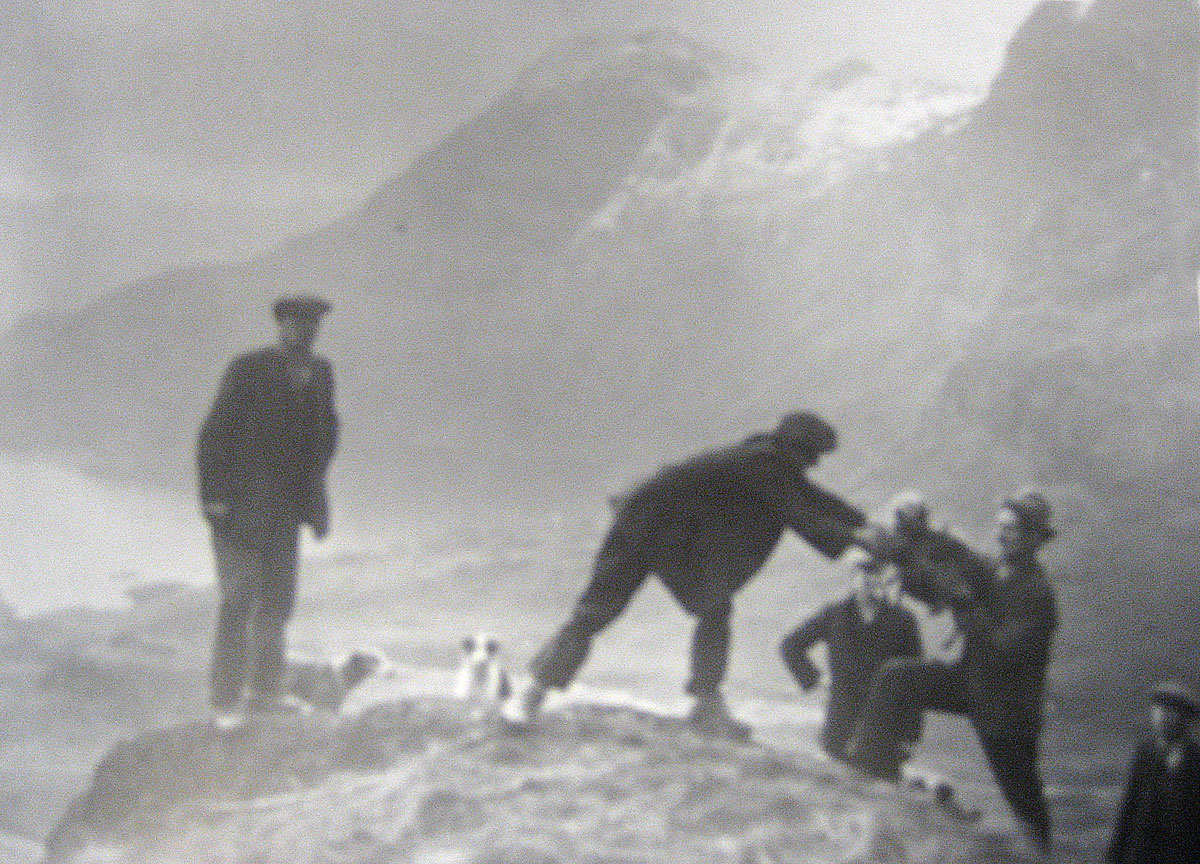 The rescue, 1934
It’s a long pull from the New Dungeon Ghyll Hotel to the site of the borran. You first climb up Stickle Ghyll following the track as it ascends, beside the beck, at first gently, but just before Tarn Crag there is a steeper section. At Tarn Crag the track swings right-handed, and you can cross the beck and follow it up to the tarn on the left bank picking your way through the rocks.
At the tarn you stop for a blow and a look around. To your front is Pavey Ark (2,288 feet), several hundred feet of rock broken in places by ledges and grooves, but on the right it’s vertical rock. To the left the bulk of Harrison Stickle dominates the skyline. Turn your head back to the right, and a good mile further on Sergeant Mann (2,214 feet) attracts the gaze. Your breathing has settled after the climb so you get to your feet, shoulder the pack, and follow the track beside the tarn toward Sergeant Mann.
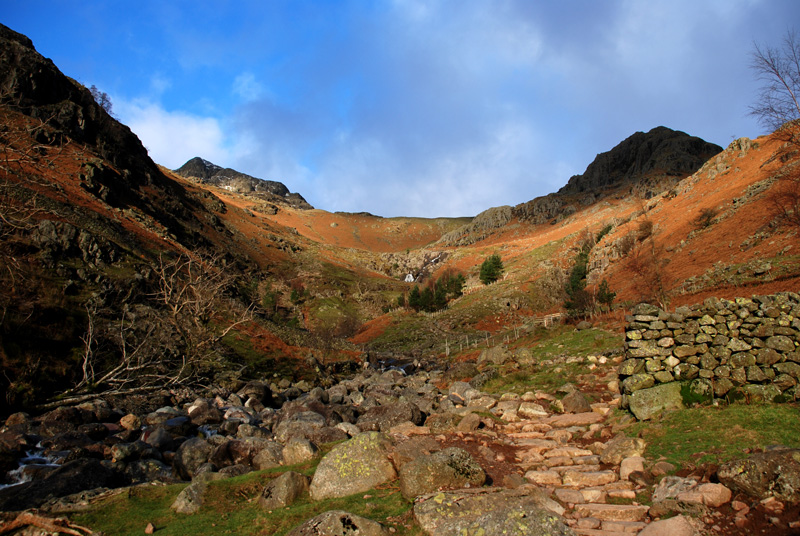 Stickle Ghyll
Twenty minutes later you arrive at the site of the borran, a jumble of rocks in a weather-blasted landscape. You sit down in the lee of a boulder, out of the wind, open the pack, take out a flask, pour a brew, and sit there remembering the story. It is not a bad day on your visit, but when the “rescue” happened in 1934, there was snow on the high fell and showers of rain and sleet at the dig site.
It’s late January 1934. The Coniston Foxhounds have been hunting the Great Langdale Valley, and huntsman Ernie Parker’s hounds are on the line of a fox. In an effort to escape pursuit the fox goes to ground in a borran. There is some discussion as to the name of the borran. To some it is nameless, whilst others know it as “Cat Luggs.” Whatever the name, this borran is a bad place. It is Saturday afternoon when the three terriers Spider, Set, and Floss are sent in.
The borran is formed of huge rocks which have piled up at the bottom of a scree bed, and the terriers, entered at short intervals, could be heard at grips with the fox at a distance that both amazed and frightened the hunters. Ernie Parker, the huntsman, remained at the place until darkness fell, when the terriers were left.
It was decided that rescue work would have to be carried out, and a party was organised by Braithwaite (Brait) Black of Ambleside, a hunter and breeder of terriers. He got together a number of unemployed quarrymen from the Ambleside and Langdale neighbourhoods, and, with the exception of Tuesday, they worked every day for a week. Among the workers were Messrs R. Atkinson, A. Pearce, L. Langhorn and E. Stobbart (all of Ambleside), T. Harrison (Loughrigg) R. and J. Birkett, H. Mounsey and H. Dover (Langdale) and T. Faulkener (Ambleside).
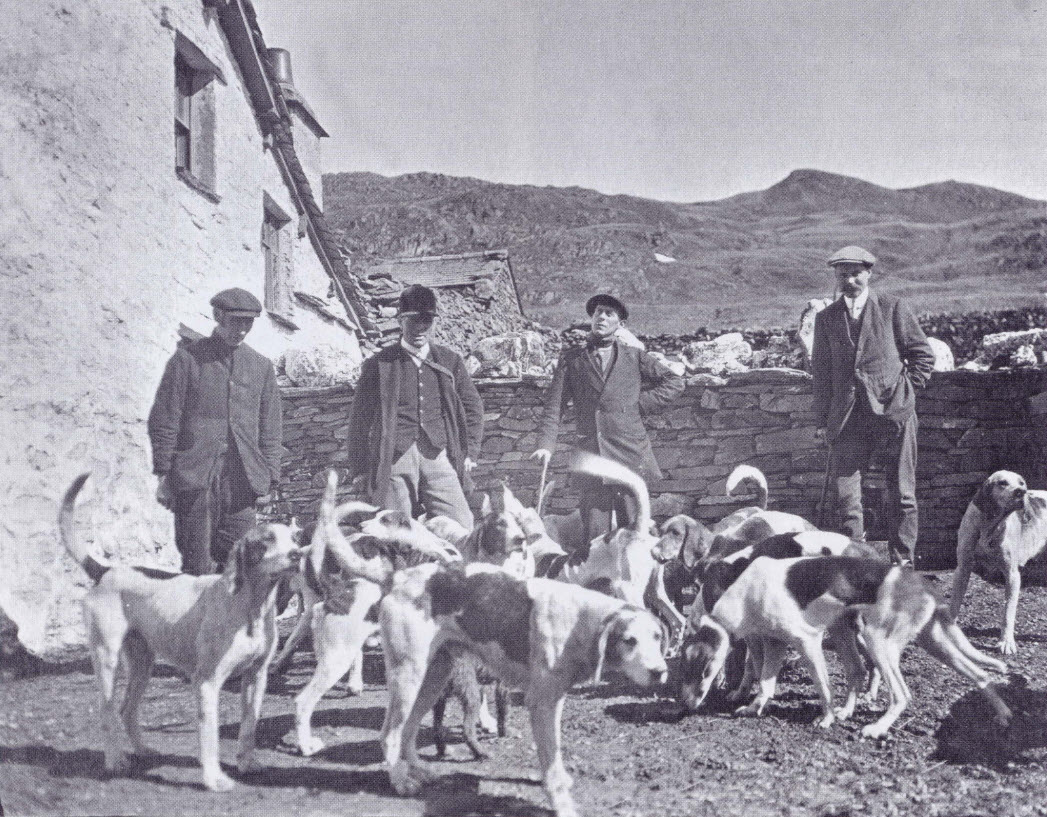 A meet at Kirkstone Top Inn with huntsman Goerge Chapman. Brait Black is third from the left.
Operations were begun at the left hand corner on the low side of the outcrop at the place where the terriers entered, but this was soon abandoned and a fresh entrance opened out on the topside. It was then discovered that at some time a shaft nearly fifteen feet deep had been worked out and partially filled in with stone. There were also drill holes, showing that blasting had been carried out. It appears that some seventy-odd years previously, terriers belonging to the local parson had also become stuck in the same borran, but their fate is unknown. At the time, those who lived in the valley had forgotten this incident.
After four day’s work it was found that a downward sloping crevice branched off the vertical shaft, being formed by a narrow space under a huge slab, hundreds of tons in weight. All this time the terriers could be heard whining and whimpering each time the dynamite pills shattered the silence of the fells, and on Friday afternoon Brait, candle in hand, crawled into the downward sloping fissure more than twenty feet down. With colleagues holding his feet he called to the terriers, and to his delight saw the muzzle of Spider emerging from the gloom. Probably through being in a weak and dazed condition, Spider did not show any great anxiety to be rescued, and Brait had the mortification to see the terrier disappear once more into the darkness. Undeterred by this disappointment, the men resumed work with their varied assortment of tools—picks, crowbars, spades, garden rakes, and hoes—enlarging the hole as far as possible. Before they left the place on Friday night the workers pushed pieces of meat down the ginnel, but it is not known if they reached the terriers. On Saturday morning the persevering dalesmen made the steep climb from Dungeon Ghyll—a walk occupying well over an hour—in the confident hope that the seventh day would be the last.
For five hours they worked on the underground crevice until no more loose material could be removed, the walls and roof of the narrow aperture being formed of tremendous slabs of rock on which it would have been unsafe to use dynamite. At 1:30 p.m. Brait again disappeared into the bowels of the earth, armed with a lighted candle and the head of a cod fish attached to a piece of cord. Brackens had been strewn on the ground, and Brait, lying full length, wriggled downward until he was more than twenty-five feet below the mouth of the shaft. Despite the confined space, he manged to throw the fish head down the slope, meanwhile shouting the names of the terriers.
Suddenly, as on the previous day, the brown muzzle of Spider appeared and approached the fish head. With bated breath Brait coaxed the dog, and after he had gently jerked on the cord and made the bait move a few inches Spider took hold! The watchers further back were unaware of the drama taking place inside, for all they could see of Brait were the soles of his boots. At a word from him they drew him out by the feet, and to the delight of all Spider also appeared, her teeth firmly gripping the cod’s head. Thus their week’s work had not been in vain.
Heartened by this success Brait tried again, but although the two other terriers had been heard only a few minutes before and were known to be alive, they could not be persuaded to show themselves.
Apart from momentary blindness through being brought into the light of day after a week’s imprisonment in the blackness of the borran, Spider appeared little the worse for her experience. She was not thin or wasted, and it is likely she had had a feed of the fox. After being taken down to Dungeon Ghyll farm she satisfied her thirst with a drink of milk, curled up by the fire and fell asleep, perhaps to dream of underground encounters with Reynard. Next day she was quite brisk, but was satisfied to remain by the fireside.
Brait and his colleagues decided, during Saturday afternoon, that they could not make any more progress in the shaft, and in view of the knowledge gained they started to work into the centre of the outcrop on the bottom side. As the fissure from which Spider appeared ran in this direction it was hoped that a passage could be broken into it from below. Therefore Sunday morning saw the adoption of a fresh line of attack, and in one respect the work was much easier. In the previous excavation the shaft was vertical and the deeper they went the further they had to carry the stone removed. On Sunday they worked on the sloping fellside, and as soon as a rock was dislodged it required little effort to start it rolling downhill. Operations again started at 8:30 a.m., and the band of workers was larger than ever.
It was during the morning that the dalesmen realised that, for the first time in eight days, there was no sound from the borran. Shouts and even blasting failed to bring a whine or sound of any description, and as the day wore on it was agreed that all hope had gone, and that the terriers were dead. The work did not suffer through these fears, however, and more rock was removed than on any previous day, through the better facilities. One huge slab weighing several tons required the combined efforts of seven or eight men to send it toppling down the mountainside towards Stickle Tarn.
During the afternoon a small aperture was made, following two blasting charges, and through this there emanated a stench that proved the proximity of fox and terriers to this point. No way could be broken in, however, owing to the size of the rocks, and as no sound was heard, even from this obviously nearer point, the workers turned sadly homeward as a full moon mounted the sky and shed a ghostly light into the chimneys and gullies of Pavey Ark. Several of the men returned to the place on Monday, but, through no fault of theirs, they had failed in their mission of mercy. The same eloquent silence enveloped the borran, and it was a silent party that shouldered spades, bars and drills and skirted Stickle Tarn on the path down to Dungeon Ghyll.
At the time, the national press carried this story, and there is even a Movietone film of the rescue. Brait became something of a hero but received no reward other than the respect of his friends. A song was composed about his exploits; here are two of the verses.
Those terriers did their duty –
Every one of them, my lads, a little beauty!
But in that trying hour,
They had no more the power
To climb aloft the perpendicular,
To regain the borran’s inlet – now afar,
Than you have strength to reach the midnight star.
Forgetfulness of danger, with no regard for self,
Had brought them to a wet abysmal shelf.
From which they could not rise,
Indeed it was to them a terrible surprise.
Then from a shaft, in four days made,
Black crawled, head–first, and unafraid.
Into a sloping crevice underground,
Which his keen quarrymen had found.
And with a shining candle in his hand,
To illuminate the darkness of that land,
He descended five and twenty feet,
With a pocket full of choice and varied meat.
There are two reasons why this is a special story for me. First is that a man would give up his time when he should have been seeking work (the 1930s were the years of the Great Depression), and Brait was unemployed. Incidentally he lived in Ambleside, which is a further nine miles from the New Dungeon Ghyll Hotel, and I do not know where he spent the nights. Should it have been at home, he would have a further eighteen-mile walk to add to his day. And they were not even his terriers. Second is that he was my great uncle.
Glossary of Terms
BECK…small mountain river
BORRAN…Anglo Saxon term basically meaning a stone pile
CAT LUGGS…name of a borran. Cat is self explanatory; luggs means ears. There is a piece of rock close by whose shape resembles a cats head.
CRAG…a cliff
DYNAMITE PILLS…explosive charges
GHYLL…a valley, usually with a stream flowing down
GINELL…narrow opening
SCREE BED…pieces of stone which have fallen from the crag behind
(Three mountain peaks are named in this story. I am unable to find the meaning of their names, but there are probably Viking/Anglo Saxon influences within.)
Visit the late Ron Black’s website for more Lakeland Hunting Memories.
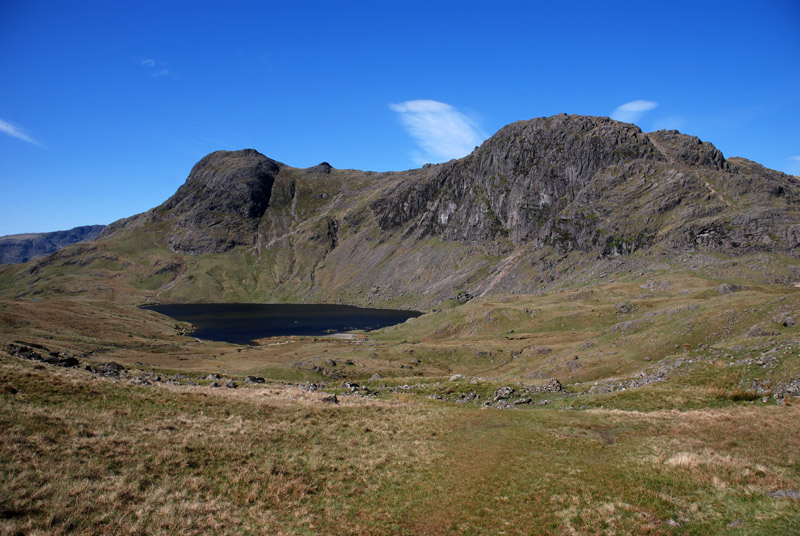 Harrison Stickle, Pavey Ark, and Stickle Tarn
Re-Posted August 2, 2019