
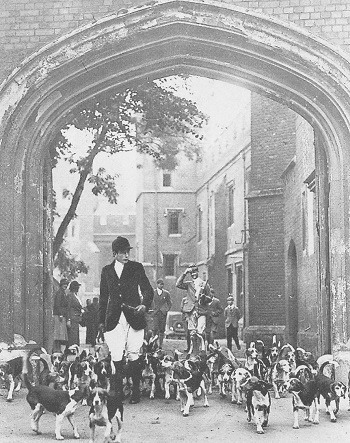
 Ronnie Wallace with the Eton College Beagles, where he set records as yet to be equalled.When we were beaglers with school or college packs we tried to be as professional as possible. At the Eaton Beagles we had a splendid fellow, Bill Perkins. He had been second whipper-in to a number of high class establishments, and as he told us all, he’d only come to the Eton Beagles in 1926 because he’d disagreed with Arthur French Blake over half a crown. He drummed into us the parade ground stuff, the handling of hounds from home, rigorous exercise, and obtaining hounds’ confidence.
He made us able to take hounds under strict control through the by-streets of Slough without a whipper-in. Later George Knight, Percy Durno, Bill Lander, Tony Collins, and now, Anthony Adams and Tony Wright were all trained to know there is a correct way of doing everything.
As a boy I began to see that the prestige of hunting as well as the success of hunting is based on a parade ground atmosphere. At that time it worried precocious young men that many beagle packs had whippers-in and others with whips held upside down, hunting horns stuck in their bosoms, sometimes shouting Get away, hark. It was worrying that high standards were not necessarily the normal state of affairs. Nor are they now.
Over the years I have been MFH I have a sneaking feeling that standards have not only slipped but are no longer aimed at in some foxhunting establishments. I know for certain that it is not good for sport and I suspect it is not great for public relations either. We have had suggestions that people should go hunting dressed as ratcatchers. I believe still that most village people, and certainly landowners and farmers appreciate the courtesy of clean and suitable turnout. Moreover, items of dress and equipment that seem to belong to another age are in fact well designed for recognition, tough weather, banging legs on gateposts, and all the vagaries of the chase.
The standards required of Masters, huntsmen, and whippers-in are essential to get the best possible sport out of the day and the territory available. I think modern life is not made easier because hats are a crowning glory. I appreciate (I regret to say) that safety hats have to be accepted; but they do detract from the visual impression, as well as hindering prompt performance in the field.
I still think that the ambition to attain the best is an essential part of a Master’s and a huntsman’s attitude, and that a pack of hounds should be able not only to control and disperse the local foxes to levels acceptable to landowners but also be capable of entertaining those who ride to it. It is sometimes said by older foxhunters that people are satisfied with very little now. Almost certainly it has always been so, and the answer is that hunt establishments must raise the expectations of their fields.
Talking is no substitute for showing sport, neither can you achieve it by reading books. Let us continue to aim high. When the huntsman and his hounds are developing a promising hunt, and are assailed by a column of cars all pointing the route back of the fox or foxes they have just headed, let him cast boldly forward and be rewarded with the sort of run of which our fathers would have been proud.
What we all need is a pack of hounds that are under control but happy, and inquiring. Hunt servants, amateur whippers-in, and terrier men who are polite, friendly, but attending to their business. Horses should look well, and they should be neatly trimmed and fit. There should be a manifest impression that each day’s hunting is conducted to a plan, and the feeling that no stone is being left unturned to show sport each and every hunting day.
If things are not done properly, no such result will be achieved. Then the hunt will lose the confidence of the locality. So all these aspects are indeed relevant to the situation and not, as some think, frills.
Much effort is always needed in hunting, much sorting out. Packs of hounds which get out of control are likely to do so in summer exercise, and they are apt to do so at the same place. Good foxhounds are high-mettled animals and they can easily start boiling up. The remedy for that is to slow down. Many people rush on with them, trying to steady them. What must be done is to slow them down until they stop, then start again at a lower impetus by getting them walking and looking about. Hounds need to be inquisitive and to think that life is interesting. It is not as easy as said, but it is so.
A sign of professionalism is somebody who, in approaching a day’s sport, may act and speak in a jolly way, but is deadly serious in what is going to be done. To show the best sport the huntsman needs to be like the conductor of an orchestra, with a wise Master in charge of intelligent whippers-in and helpers. Famous hunts need an input from the human element as well as the hounds.
The best conditions are probably a little less than a flying scent which makes foxes circle and go to ground. What is better to give a good run is half a scent, but a holding one. Of course, foxes are headed, that is the excuse. On the other hand they are much more used to people than they were 50 years ago, and they are less easily deterred.
A fox on the top of Exmoor is more easily headed by a lone horseman than he would be in the Heythrop country. But even on the top of Exmoor foxes are less sensitive than they were 30 or 40 years ago.
If we let hunting degenerate into a rag-tag-and-bobtail affair it will not survive. Landowners would not put up with it. But some others might say, If people are happy, why not let things slide? That is not my view. Masters and huntsmen who do it in the proper way are sometimes thought to be overbearing. This should be taken as a compliment.
Posted August 1, 2019
As published in Hunting magazine, London, March, 1994.
The late Captain Ronnie Wallace was the most highly respected Master, huntsman, and foxhound breeder of the latter half of the twentieth century. Since the original publication of this article, Britain’s Hunting Act of 2005 was passed, and foxhunting, as the author knew it, is no longer legal. And to be honest, the level of sport and its traditions have slid in many hunts due to a number of reasons, some even perhaps legitimate—like the welcome fact that many more people of lesser means may now hunt, and time demands of twenty-first century families may be more pressing than they were twenty-five years ago. However … while, as some might argue, the world and family priorities have changed, there is always wisdom to be found in harking back to better hunting days, and giving Captain Wallace’s words a thoughtful re-reading. Readers’ Comments are always welcome.