
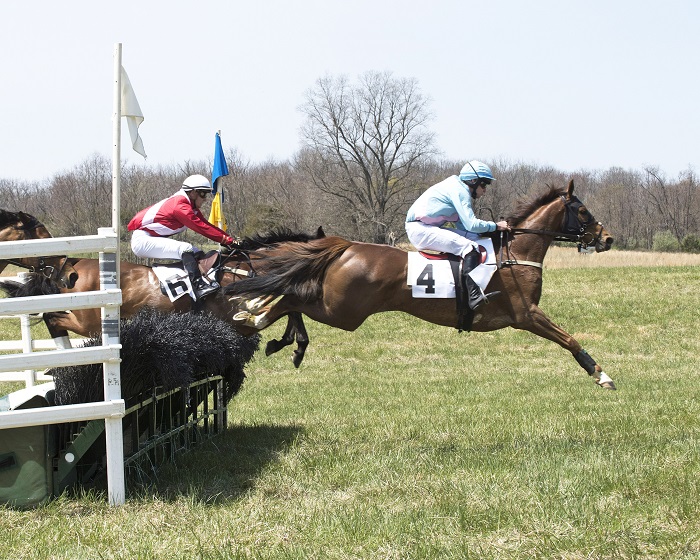
 Steeplechase horses swish through the man-made national fences routinely at most hurdle races around the country today. Brush fences were once expensive and time-consuming to set up, and racetracks were dropping steeplechase races from their cards. / Joanne Maisano photoIt was autumn of 1973, and the world was in turmoil. U.S. forces were pulling out of Vietnam, the Watergate scandal was rocking the nation, and a looming energy crisis was getting global traction.
The steeplechase circuit, too, was in a state of flux. The year before, the bottom had fallen out of the industry. New York basically kicked out the jumpers and went from eighty-three jump races at Belmont, Aqueduct, and Saratoga in 1970 to fifteen in 1973. And those were at Saratoga only.
Monmouth and Delaware Parks curbed their cards, too, and steeplechasing seemed to be in a death spiral. The mood was dark. Yet a few recognized that the jumps themselves may be at root of the problem.
Off-track betting, legalized in 1970 in New York, was reducing revenue at the tracks. Looking for costs to cut, track managers took notice of the labor and expense of building all-new brush fences each season at each track. Cut cedar was hard to come by, and costly, and construction of the jumps consumed hundreds of man hours.
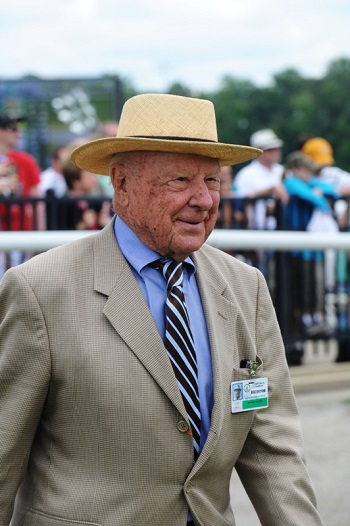 Randy Rouse had an idea to save steeplechase raciong in 1973. / Betsy Parker photoInto this tumult stepped an unlikely superhero, an unassuming Washington, D.C. area builder. Today, some forty-six years later, Randy Rouse is widely credited as the savior of steeplechasing. The three-time National Steeplechase and Hunt Association president who died at the age of one hundred in 2017 is considered a visionary.
Rouse was an ardent amateur jockey, an avid foxhunter, and Master of Virginia’s Fairfax Hunt. Each year during steeplechasing’s winter break in North America, Rouse took a foxhunting vacation to Ireland, “to stay fit and sharp” for the spring point-to-point circuit, he explained in a 2013 interview. In the winter of 1973, on a wind-whipped, rain-lashed country racecourse in Ireland, Rouse spied a contraption that would be critical to the continued success of American steeplechasing. Though he may not have recognized its future impact at the moment, it proved to offer a solution to a sticky problem.
The creation narrative of the so-called “national fence” reads like an adventure novel, with Rouse himself as provocateur and firebrand of a near-impossible revolution. There were twists and turns to the tale, and a tense eleventh hour showdown, but the story has a happy ending, with the principals riding off into a twenty-first century sunset.
The Creation of the National Fence
When Rouse began riding races in the 1960s, fences were living hedges or clipped brush, he explained in a 2016 interview. He didn’t so much pine for the old days, as much as recognize a looming issue.
“There’s nothing like change,” he said. “You know it won’t stay the same. When I saw where [the sport was] headed, I knew something had to change.”
In the winter of 1973, Rouse met Lord Harrington, a Joint-Master of Ireland’s County Limerick Foxhounds. Amiable conversation quickly revealed a shared passion for steeplechasing. Harrington hosted Limerick’s spring point-to-point, just as Fairfax Joint-Master Rouse was in charge of his club’s fall meet. Rouse heard that Harrington had developed a synthetic steeplechase fence because of the difficulty obtaining enough natural birch in Ireland to construct jumps. As in America, it was an expensive, relentless, labor-intensive nightmare for race organizers.
Rouse and NSHA executive secretary Jack Cooper went to the Limerick races to see how the course rode. They liked what they saw, and Rouse, who was a builder operating a busy construction firm outside Washington, had the resources to modify and tweak it to better suit American racing. They arranged to have several sections of fence flown to the U.S. and set to work to make it an original.
“Mr. Rouse had them sitting in his front field, I remember,” said Kevin Palmer, an amateur jump rider who rode in the very first race over the new jumps. (Palmer later became Fairfax huntsman and still trains for Rouse’s estate.) “He had a lot of ideas. He tried wheels [on the rolls and metal frames] because he was worried about how to move them.” That didn’t work. “He was always trying to improve on the design.”
By mid-summer Rouse was at last pleased with the prototype, and he “took the bit in his teeth,” according to the 1973 NSHA yearbook. He had a set of jumps made for his Fairfax fall meet.
Rouse was certain the jumps would standardize racing across the circuit, thus solving a lot of problems for NSHA and race meet hosts. Association officials inspected the course and gave a thumbs-up for three hurdle races.
There was just one more group to convince, and Rouse knew they’d be the hardest sell of all. The jockeys.
The Big Day
The 1973 Fairfax Races were run at “the old Bowman property,” today part of densely developed Reston, a meticulously planned “new urbanism” community started in the late 1960s. The tract was part of an original land grant to England’s Thomas, Lord Fairfax before the Revolutionary War.
The Fairfax Hunt was founded by the Bowman distillery family on their 6,000-acre Sunset Hills farm in 1928, and recognized by the Master of Foxhounds Association in 1933. The club’s racecourse was a sweeping oval encircling farm fields, Kevin Palmer recalled—high land overlooking a feeder creek to Difficult Run.
The track is long gone, of course, leveled under homes and Reston’s commercial development; only the road names reveal its past: Steeplechase Drive, Paddock Lane, Stirrup Road, Whip Road, Tack Lane, Canter Lane. And two that nod to the sport’s deeper roots: Birch Place and Cedar Road.
“It was a nice track,” said Palmer, a 10-pound bug at the time, a kid playing with the big boys at that September 22, 1973 Fairfax Races meet. “It was left-handed, pretty level and wide. There was a little hill, down then up, on the backside.”
Rouse was excited and nervous he said in a 2016 interview. “I knew the horsemen would balk at first, but I knew we needed it, and I knew it would work.”
“Balk” was putting it lightly, said Rouse’s widow, Michelle, recalling conversations with Randy as he chuckled at the collective jockey reaction.
“There was complete uproar” at the racecourse that day, Michelle said, saying Randy was ever-diplomatic addressing riders’ concerns. “You know how he was, so smart, so smooth. He told everybody to calm down, ride the first race, and see how it went.”
Jerry Fishback remembers. The steeplechase Hall of Famer, five-time leading rider, and third-leading jump rider in American history recalls the one win that day at Fairfax that, in essence, pushed him over the 300 mark to 301 lifetime wins.
The ground was firm that day, Fishback said, and the day warm.
“I was already riding for [Jonathan] Sheppard, so I didn’t always go down to the Virginia meets,” Fishback said. “But I’d taken some mounts, including one for J. Arthur Reynolds in the second. It was a maiden over hurdles—over those new jumps.”
Fishback partnered Reynolds’ homebred Gun Gold, a four-year-old who’d broken his point-to-point maiden that spring under Ted Gregory. It was Fishback’s first time on the horse.
When reminded of the initial protests from the jockey colony, Fishback said he doesn’t recall. “What I do know is that we eventually just went out and rode like it was completely normal.”
Fishback and Skip Brittle on Too Far Gone were stirrup to stirrup headed to the first. Too Far Gone reached it a neck in front, getting the asterisk in history as the first horse to reach the first national fence in the first race. After that, it was all Gun Gold.
“They rode well,” Fishback said. “The old stuffed cedar jumps could be softer and smaller, but sometimes they were bigger and stiffer. That was the beauty of this new jump; it standardized steeplechasing.”
Fishback and Gun Gold were two-and-a-half in front at the wire, the win one of Fishback’s twenty-four-win championship season that year. In all, nineteen horses jumped thirty-six fences in three races that day, with no fallers, no pull-ups. The other two hurdle races were won by Kip Elser and Joe Aitcheson.
“Everybody was so scared of them that morning,” Palmer said. “But, I mean, hell, it was just a jump. It was fine.”
So encouraging was the result, New Jersey’s Far Hills races a month later also used the jumps, and in 1974, Peter Winants wrote in his Steeplechasing: A Complete History, “most hunt meets had switched over. Delaware Park was the first track to use that fence the next summer.
“Traditionalists initially…had difficulty accepting the national fence,” Winants wrote. “But steeplechasing would not have survived without the national fence. It’s far and away the most important development of the era. The sport is deeply indebted to the foresight and perseverance of Rouse and Cooper.”
“I think Mr. Rouse was ahead of his time,” Fishback echoed. “He deserves all the accolades. It was an excellent idea, a real vision. I think Mr. Rouse’s foresight was amazing thinking we’re talking about this almost fifty years later, the exact fence we’re still using today.”
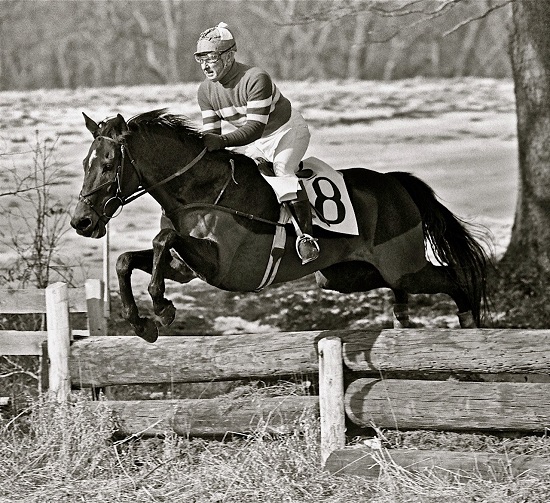 Randy Rouse riding his own Cinzano to win the Casanova Cup at the Casanova Point to Point on the Spring Hill race course in 1981. / Douglas Lees photo
Profile of a Visionary
Rouse died at age one hundred on April 7, 2017. A few months prior, he’d been recognized with NSA’s highest honor, the F. Ambrose Clark Award, accepting in person at a meeting in Middleburg.
He was only the twenty-sixth recipient of the Clark Award, created in 1965 to recognize those who have “done the most to promote, improve and encourage the growth and welfare of American steeplechasing.”
Rouse also holds the distinction of being the oldest trainer in North American Thoroughbred racing to saddle a sanctioned winner. He was ninety-nine in 2016 when his Hishi Soar won the Van Clief at Foxfield—fittingly, over national fences.
Rouse was born in 1916 in Smithfield, and he grew up riding ponies and workhorses on his grandfather’s farm. He graduated Washington and Lee University in 1939, and he served in the U.S. Navy during World War II. He founded Randolph D. Rouse Enterprises, a construction and investment firm, in 1947.
After the war, Rouse moved to Arlington. He became Fairfax race chairman in 1957 and was made Joint-Master in 1961.
Rouse rode his first point-to-point—a winner—in 1967, and ended on a twelve-race winning streak with his last ride in 1983. As trainer, Rouse saddled nearly nine hundred starters from 1966 to 2016. He won nine Seven Corners owner-rider timber championships, and was four-time Virginia Point-to-Point Association leading rider over fences.
He was NSHA president 1971-1974.
Rouse campaigned three Virginia Steeplechase Association and three VPPA timber champions.
He won the Francis Thornton Green Award from the VPPA in 1987, and the VSA Special Recognition Award in 2003.
Rouse was named to the Virginia Steeplechase Hall of Fame in 2007.
He was married briefly to the late Audrey Meadows, Alice Kramden on the 1950s TV series “The Honeymooners.” He married fellow amateur steeplechase jockey and foxhunter Michelle Rouse, also a one-time TV actress, in 1983.
“(Randy) was just amazing. He attacked every day with enormous passion,” Michelle said. “It’s a case of loving what you do. When you have such passion…it’s like you’ve never worked a day in your life.”
Rouse was pithy and sharp to the end, quipping in 2016 when asked about being oldest on the circuit. “I’ll never retire,” Rouse said. “I may wear out, but I won’t rust out.”
The National Fence: What Is It?
A man-made, portable fence used in all U.S. hurdle races, the national fence was loosely designed on British “sheep hurdles” used in England and Ireland.
Each jump measures 53-inches high with black plastic “brush” stuffed into an angled metal frame fronted by a 36-inch green tarp-covered foam roll. White ground lines and knee lines were added to the design in the last decade.
Four or five eight-foot sections are used for most fences.
The jumps are portable and can be moved from course to course and shared around the circuit. There are three sets of national fences in use today, with a more recent innovation, the SafTFence, being used at Charlotte and a few other southern NSA meets.
Jumps are delivered to racetracks by truck and trailer and can be set up in a few hours with a few volunteers and a tractor. They can be swiftly disassembled and pulled aside in minutes to allow for turf racing.
Posted April 19, 2019
This article was first published in the Temple Gwathmey Steeplechase Foundation newsletter and website.