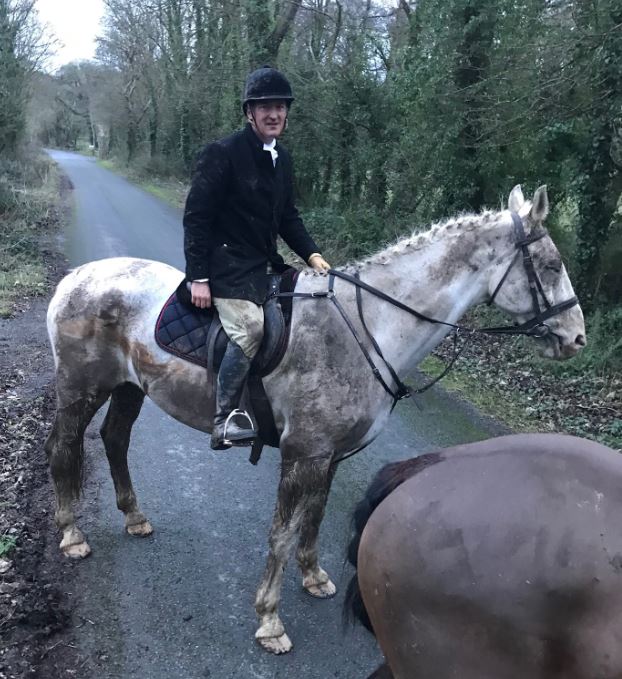
 The author on Gus: muddied but unbowed / John Flavin photoDid you ever hear the expression “cheating death?” This question was posed to me by Bob Goodman, my newfound friend and fellow foxhunter, as we both emerged from one of those double drain jumps common to the south of Ireland. The question carried added meaning coming from Bob, a former Air Force fighter pilot with 336 combat missions in Vietnam.
I arrived in Ireland on January 18, 2019 and made my way from the airport straight to Flavin’s stable near Tramore in County Waterford to practice jumping banks and ditches before the next morning’s hunt. On a good horse who knew his business, I found these obstacles to be easy enough, and I was assured that actual hunt conditions would be no more challenging than these practice jumps. Although confident, I had a sense that actual conditions might in fact be different…
My hunting companion, Nathaniel St. John, is a more experienced foxhunter than I, but both of us were new to Irish hunting and curious about what we’d see. The hunting country in this part of Ireland requires negotiating the single or double drainage ditches that line the farm fields instead of fences, often with ramps of banked earth, and sometimes including hedges on the banks. The toughest of these are the double drains, where your horse leaps across a ditch, which may be five to eight feet across and equally deep, to a dividing earthen bank just wide enough for a landing, a scramble up and over, and a leap across the second, and similarly large, drain to the other side.
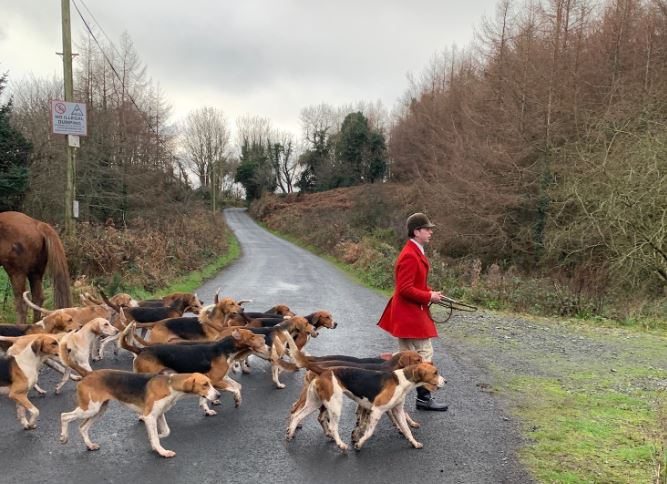 Waterford huntsman and his pack of Old English foxhounds / Lucy Fugate photoThe Waterford
The next morning near The Sweep, a pub in the village of Kilmeaden, I met the hunt horse that had been selected for me by Flavin’s. Gus is a seventeen-hand, lean and tough campaigner, reliable and courageous, with a white coat, dish plate feet, and equine shivers affecting his hindquarters when excited. He would carry me on what proved to be the most challenging days on horseback I have ever experienced in twenty-nine years of riding. After the hunt field was mounted in the side lanes leading off from The Sweep, we were joined by the staff and hounds of the Waterford Hunt, and all moved out of the village and downhill to a crossing from road to farm field.
I had understood that today’s planned hunting country would be a good introduction to Irish hunting—not too tough but enough to get Nathaniel and I used to the conditions. However, I soon came to think we’d been tossed into the deep end of the pool without much swim practice. Crossing from the road into the first farm field involved tackling our first double drain. Waiting in line to jump, I saw a rider ahead of me go down with his horse in the first drain and remain there, face down. Hunt followers moved in to help the Irishman up; half of his face was covered in blood from a kick he took from his horse when both struggled to emerge from the fall. We later learned that he’d been out until 3:00 am and was still feeling the effects. He called out his intention to return to the pub but was taken to a hospital instead. Welcome to Ireland!
Fortunately, the rest of us moved through without incident. Gus took the double with two big and rapid bounds, after which we cantered to join the rest of the field. In Ireland most of the hunt horses really seem to know their business. I did see a few refusals, but they were rare, especially given the nature of the obstacles they were asked to navigate. A refusal generally seemed to result from a sudden re-calculation by the horse, to be followed straight away by a successful leap.
The instructions I’d been given were to take the jumps on a long loose rein in the left hand, holding the martingale or “Oh, shit strap” with the right. Trouble generally came when riders exhibited distrust of their mounts by shortening the reins, looking down at the jump, or in some way trying to “help” the horse. They must be left to their own calculations, as human direction often proves to be in error.
Next, the hunt field moved through a pasture and down into a very tight and boggy area, which quickly acquainted us with true Irish mud, soft and nearly knee deep. Around a corner in the fence line through thick brush we came to our next double drain. Nathaniel and I were near the back, and by the time his horse Titan went through, the jump was slippery from the earlier horses. Titan belly flopped coming across the second drain, throwing Nathaniel forward into the mud. I came through next, not realizing when we started that Nathaniel was down, so when Gus and I made it over we found Nathaniel below us and Titan bounding away free. Nathaniel had sensibly rolled into a ball, and Gus swerved left to avoid him. Despite Gus’ efforts, he tripped over Nathaniel, went down and threw me into the muddy earth as well. I was happy to see Nathaniel come up laughing, and I was unhurt too, but I realized that I’d been following too closely into the jump and wouldn’t make that mistake again. Titan was retrieved, and we quickly rejoined the group.
As mentioned before, this day’s hunt was expected to be a low key introduction for us—a good warmup or training hunt before the more serious second day with the Waterfords. It definitely proved to be good training, but this Saturday hunt proved to be the most challenging hunt of my life, until Tuesday!
Over the next several hours, the hunt visited a number of coverts without success, and I realized that while the country is teeming with foxes, a typical day might involve hours of seeking and waiting, followed by a mid- to late afternoon burst of activity as hounds strike and run a series of foxes. Our Saturday hunt fit the pattern.
While I expected to encounter daring jumps on a chase, I found these to be commonplace even when moving casually from covert to covert. In one instance, the Master jumped a five-bar cattle gate, bending it at the top but not disturbing his horse. There was a way around or through without jumping, at least this time, and no one else felt compelled to emulate the gallant (or reckless) Master.
In Ireland we Americans all did things we would not consider doing at home. We galloped our horses down paved roads, jumped wire fences and metal gates, and generally assaulted any wall or bank without knowing what lay on the other side. It was exhilarating, but occasionally it gave us pause, and with good reason, as when all were jumping a stone wall and one of our horses tripped over a concealed wire that ran along the top, sending horse and rider flying to the ground. It could have been a nasty accident, but it wasn’t, proving only to be a brief and notable distraction.
Everyone soon followed over, after first giving it a few thoughts. in Ireland, unlike our hunting country at home, nothing is prepared specially for the foxhunters—no coops designed and placed in the fencelines to jump, no riders on the stone walls, no special mowed paths. It’s all just farm country, and you take what comes.
At about 4:00 pm we got into a wild run that included a single file sprint through narrow overgrown trail tunnels through trees and hedges as well as several wide open ragged cavalry charges over stone walls, several jumping abreast. We came through a pasture and funneled into a fence corner, then through a narrow gate, jumping into a woodlot, with an immediate tight turn left and into a hundred-yard dark gallop up a lane between the trees. We lost one rider at the gate when horse and rider went different directions.
Coming out the top end of the woodlot, one by one we made a sharp turn in the trees to jump a fence into a pasture, losing another rider at this obstacle. Into the open and wheeling right, we crossed two stone walls at a gallop and circled back across a third. Running up a long gravel hill road with rocks flying about our heads, we circled through a wooded path, and then back up the same hill again. Cantering down a paved road, our Field Master stopped, turned abruptly left, and charged a five-foot bank, vaulting into the field beyond. We couldn’t really see in but tried to give each rider a decent interval as each person’s turn came. These are the times you’re just happy to keep with the person ahead of you.
On we went until finally after another wide circle we found huntsman and hounds at a stop as the sky darkened, and we rode quietly in through single lane paved roads back to Kilmeaden and The Sweep. I’d been out five hours and had ridden thirteen miles, with a top speed of twenty-two mph, as compared to a big day at Belle Meade Hunt Club in Georgia, where we might cover eighteen miles in three to four hours, with more sustained speed and fewer jumps versus the shorter bursts and long stops needed for people to clear the big obstacles in an Irish hunt. Of the roughly twenty-five riders in the hunt field, I counted a dozen falls that day. The Field Master generally stopped to take care of the injured if he saw them, and sent the field off in the care of another Master; there might be three or four scarlet coats in the field, each denoting a Master. Only the hunt officers in Ireland wear scarlet, unlike our U.S. hunts where the scarlet coats are more common among experienced field members.
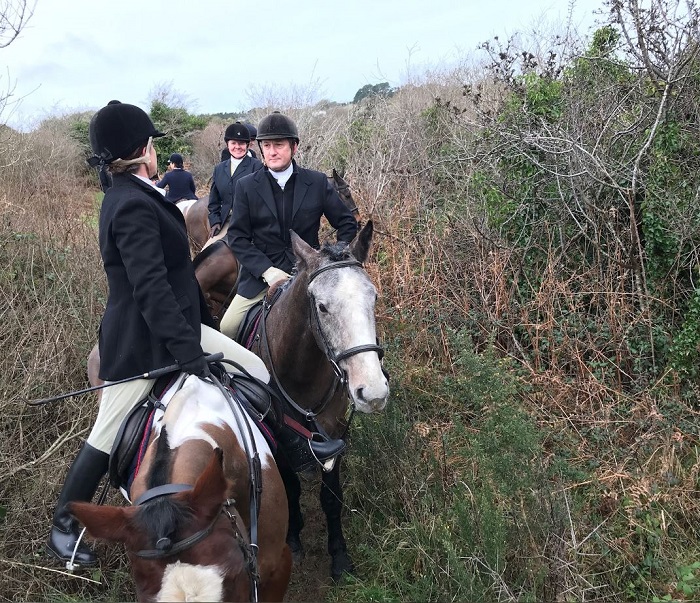 Nathaniel St. John surrounded by welcoming Waterford field members and belligerent plant growth / Robert Fugate photoIrish vegetation, like many of its people, can be tough and wiry. The grass is, of course, lush, thick, and brilliant, blue-green in the shade and sparkling emerald in sunlight. For the horse, living here must be like an early equine afterlife in the Elysian Fields. Aside from grass, however, everything else that grows seems to be sharp, stiff, prickly, unbending, and fierce, if it’s possible for a plant to be fierce. Gorse, blackthorn, heather, nettles, and thistle in the hedges and fields, thick around the creeks, with oak, cedar, and pine in the wooded patches. My boots were thoroughly scratched up by these belligerent herbs, and I was glad of my heavy wool coat which served me as a suit of armor when I did battle with these omnipresent adversaries.
Kill Harriers
The next day’s hunting, a Sunday, began as a lawn meet at the home of the Kill Harriers’ Master near the village of Kill. Originally organized for hare hunting and traditionally hunting on Sundays, Masters and huntsman are attired in forest- or bottle-green coats instead of scarlet. Today they hunt the fox with Old English foxhounds rather than hare with harriers. The fixture for the day was known as the Kilbeg Meet. The Kill Harriers had a family feel, with more children in the field than the Waterfords.
After the exertions of the Waterford Hunt the day before, the less challenging country of the Kill Harriers came as a bit of a relief. The day was clear and bright, and the fields were rolling farmland, with less formidable obstacles than at the Waterford’s fixture. We had several banks and drains to jump of moderate difficulty and one or two more challenging ones, a couple of good runs, and lots of distant viewing of the pack working the fields and coverts. The hounds entered some dense wooded areas, and the Masters kept the field well clear of some areas off limits to us but where hounds and staff were allowed to work. After several circles through this country when hounds struck, we ended the day back at the Kill village pub. On this hunt we were out four hours, covered twelve miles, and my horse reached a top speed of twenty-seven mph.
I had been assigned Gus as my mount for each day, but he had thrown a shoe on Saturday, so for the Sunday hunt at Kill I was given a smaller paint horse named Ziggy. Sturdy and unflappable, Ziggy took everything in stride. This was his day at the office, with no excitement at the runs or jumps but with a perfect willingness to address whatever was shown to him, before easily quieting back down to a walk. All told, a very sensible horse, with an air of dependability such as that imparted by a long trusted family servant…a sort of equine butler.
The following day several of us had arranged for a beach ride at the seaside town of Tramore. I was back on Gus, and my wife, Lucy, had Ziggy, who proved his versatility by going just as fast as Lucy wanted and no more, always listening to her. In fact, Ziggy showed Lucy the benefits of a fully trained and calm veteran horse over the nerves of one still learning his or her job. It was a cold day, in the high thirties, with a stiff wind and a moist spray. We cantered down a three mile beach and walked our horses into the Atlantic.
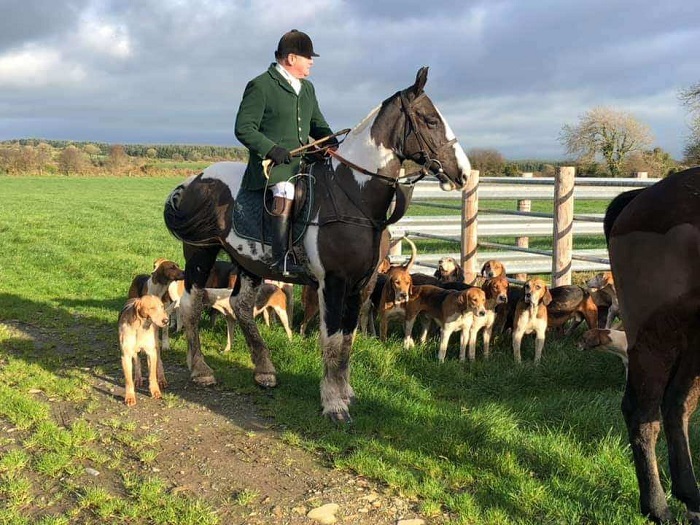 Kilmoganny Master and pack of Old English foxhounds. The Kilmoganny started as a harrier pack in 1918. / Debbie Brady photoKilmoganny Foxhounds
Tuesday, January 22, was cold, cloudy, and windy but with no rain, with the sun breaking through to smile at intervals through the day. Back with the Waterford for our final day’s hunting, we learned that the Waterford huntsman feared an outbreak of kennel cough so had kept his pack in, but the neighboring Kilmoganny Hunt came to the rescue, bringing their huntsman and hounds. The Master flew in from London for the day, and some of their members came, so it became a joint meet. Ireland has about 150 hunt clubs, and the Kilmogannys proved to have a very fine pack of Old English foxhounds, who showed us sport equal to or better than that of the Waterfords on their Saturday meet.
Believing that I had done it all on my previous day with the Waterford Hunt and brimming with misplaced confidence, I had one goal for the day—to watch hounds run a fox in an open field, something I hadn’t really seen the other two days and a rare sight for me in the heavily wooded hunting country back home. This day would bring the best hunting I had experienced and three long views of foxes running at top speed in front of us, with the pack in full cry behind!
The hunt met just down the lane from Pat Flavin’s stable north of Tramore. Pat and his son, John, had provided some of us with the fine horses we enjoyed on this trip, with John often riding behind us on the hunts.
American: “John, that was quite a jump.”
John, in his distinctive brogue: “Ah, you looked grand!”
American after five hours out: “John, I think my horse is getting tired.”
John: “Ah, he’ll be fine!”
The meet started at 11:30, and as the field rode down to pause in a lane overlooking one of the first coverts, I heard my neighbor say, “There’s your fox.” I turned to see him flying across our front some two hundred yards away. The foxes in Ireland all looked to be well fed and conditioned, with luxuriant coats. The hounds gave chase, and we moved out. Our short circling run was a good start to the day, but the view was the best part.
The huntsman put hounds into numerous coverts that day, producing two more fine views for me, including one where the fox led our pack into a field of tall kale.
“Watch the birds fly out; they’ll show you where the fox is,” and little meadow birds flew up at zigzag intervals across the field to show us how the fox wove his way through the crop to our right.
To our left, hounds entered the kale and followed the pattern, pausing to bob up above the kale then dive back down again, regaining the scent. As they followed the line, the fox, a minute or two ahead of them, emerged below us through the hedge lining the kale field and raced through the cow pasture five hundred yards to the next covert of thick brush along a creek bottom, with hounds in pursuit. Our fox led us circling up and down this hill pasture and through the creek a couple of times before eventually leaving us behind.
This run took us through an immense bank and ditch, across a field, into a blackthorn jungle, up a bank and down into a narrow but deep creek, then up a steep bank and into the big sloping pasture leading to the kale. There’s really no feeling that compares to jumping into a field after emerging from a thicket, then galloping up a long grade on a brisk sunny day to reach a wide view of green countryside, rolling open for miles before you, on a big horse who seems to share the same joy that you have.
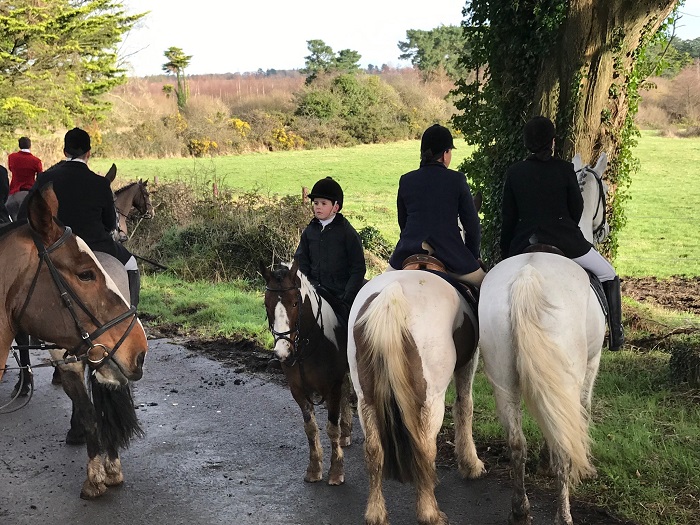 A youngster and his paint pony skimmed over all the obstacles without hesitation / Robert Fugate photoA little boy, maybe eight or nine years old, was off from school, out for a day of hunting with his mother. I saw the boy on his brave little paint pony take every jump that the tall men on their big Irish hunters made, boy and pony never hesitating, just going ahead. At one point as I cantered down a paved country road I looked down and the little jockey went racing by me. The lad and his mother dropped off and went home late in the afternoon, as did our Field Master and his teenage daughter.
One of the intrepid Irish women attempted to jump a cattle gate that was leaning toward her. As her horse clipped the top bar, they flipped, throwing her hard and injuring her ribs or back. A number of the others had taken it, but someone wisely opened the gate after this incident. She and a friend walked their horses home. A bit later we all came back through this place; the gate was closed again, and we jumped the leaning gate from the other direction.
Pausing afterward, my Irish friend, Michael, confided words of wisdom: “Never jump a gate leanin’ toward you, and never kiss a girl leanin’ away!”
Riding at the back of a field of some twenty riders is not advisable in this area, as the footing on some of these treacherous bank-and-drain jumps gets more slippery with each horse going through. As the day wore on, I often found myself near the back, or even at the very back of the field. And after more than four hours out, with lots of jumps and hard running, with several days’ hard work strung together, my Gus was starting to tire.
I was caught up in the moment and not really thinking of what might happen, but then it’s sometimes best not to do much thinking in the hunting field anyway. Gus and I were like one body, both tiring, but his brain was the one doing most of the thinking for us. Coming to a big double, he cleared the first drain, bounced on the dividing bank, cleared the second drain, then fell hard on his left shoulder, tossing me off onto my left shoulder. As we both struggled onto our feet, the last man went over cleanly; this was Nathaniel. The rest of the field were galloping out of sight, and Gus was anxious to join them, with or without me. The slick mud on my boot kept sliding out of the stirrup each time I reached my foot up the side of the 17-hand Gus, who was also moving about in all directions.
I heard Nathaniel say, “Can you help hold his horse?” which surprised me because I thought we were alone. But Mick had arrived just when needed! Mick follows the Waterford Hunt on foot with an axe and some fencing tools, clearing brush and repairing wire as needed. He held Gus steady, I mounted, and we were soon galloping around two fields to rejoin the group, at the rear.
They had stopped to negotiate the next double bank-and-drain, and Nathaniel had come through cleanly again but ahead of me. A repeat occurred here. Last to go through again, Gus and I slammed hard into the bank after the second drain, but this time on our right shoulders. Jumping up to grab the reins before he could bolt, I made it back into the saddle on my own, Mick not being around this time. As we galloped off, I had the sense of two sprained shoulders barking at me.
When we reached the group again, we had come back to the creek and bank that we had visited several times earlier in the day. Waiting in the soft bottom land, I felt Gus fidget and looked down to see that we were sinking nearly to his belly in the stew-like mud. Jumping off, I trudged along slowly, leading Gus to the creek bank where I could re-mount.
Most of the hunt field had left our little group behind, and I was now in front of it. Our long wooded path paralleled the creek, or farm drain. Tracking back to the main body, I noticed that our numbers were further diminished. All through the day the field had dwindled—some hurt, some tired, some taking kids in on a school night, some just quietly dropping off and hacking home.
One more double lay in store for us. By this time the day was darkening, I was hurting, and a few short prayers went up to the Lord of hunts to speed on our fox on and inspire the huntsman to call off the hounds. In this I was disappointed. Coming to the last big double jump of the day, we came through clean. This was of course mostly Gus’s doing, but I contributed to the success by continuing to suspend all rational thought or analysis.
Michael rode up and pretended to brush off my muddy coat, noting “It’s a badge of honor!” That was good news, since back home a muddy coat is generally a badge of ridicule.
Coming out of one farm and entering another, there were two choices facing us—the farm entrance with its big locked gate too tall for anyone to jump but with a narrow cattle chute alongside or a drop over a big water-filled ditch. A small group went right and made it across the ditch, until one horse became bogged for several tense minutes. The rest of us tried the cattle chute, dismounting and leading or sending the horses through. Once through, we remounted and ran again, following the hounds far ahead.
The next obstacle was a two wire fence across an unpaved farm road. John Flavin managed to reach down and pull out the top wire, leaving the bottom one about two and a half feet high. Two horses refused then went over when the stick and a few harsh words were applied. Gus took it without hesitation; he seemed to have his second, or at least his final wind, perhaps sensing the home stretch of the hunt.
Our group was six riders now, galloping out of the big farm and into a dark country lane by a fast flowing creek. We caught up with the huntsman, whippers-in, and Masters and learned that the hunt was over. Hounds were called in as darkness descended. Relaxing on Gus (I really didn’t want to dismount for the fifth time if there was a chance of needing to remount). I breathed a big sigh of relief and turned to Nathaniel. We made it to the end—alive!
We took the horses into the creek to wash their legs. Gus and I both had mud from bottom to top. The hunt this day lasted five-and-a-half hours, and we covered 18.6 miles. I didn’t realize it, but we were quite close to the sea, just north of the town of Tramore and just south of Waterford City. Looking back on this and the other fine days in the saddle in Ireland, I carry the most vivid and intense memories, all crowded together, and return for a mental vacation whenever one is needed.
Posted April 16, 2019
After twenty years of playing polo, Robert Fugate discovered foxhunting. “One of our newest and most enthusiastic members,” says Epp Wilson, MFH, Belle Meade Hunt (GA), “he took up foxhunting two years ago and he is on fire!”