
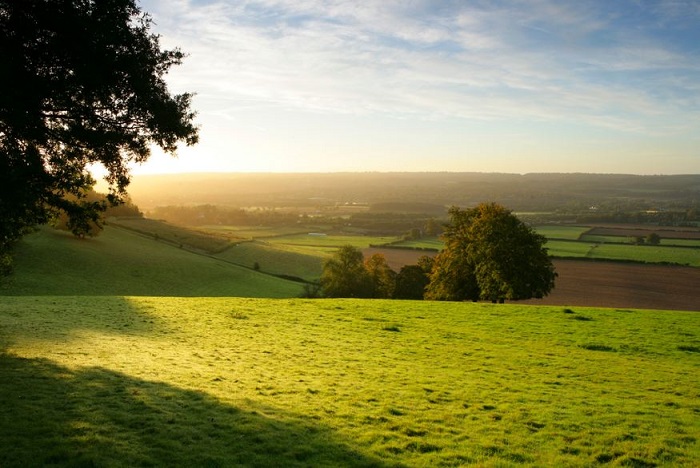
 North Downs Way, Kent, England
The light fades fast on a December day in the rolling chalk hills, the centuries-old beech woods, and the ancient countryside of the North Downs in the county of Kent in England. It is Roman country…old Roman country. The Roman presence can still be seen and felt there. Watling Street, now a motorway, was built by the Romans to conduct their chariots from the chalk cliffs of the coast at Dover to old Londinium. London today, of course. Straight as an arrow and solid as the rock foundations on which it was built. In places, you can still see the wheel ruts worn down by the centuries of travel.
Here too, in the well-trodden countryside, ancient history’s presence is felt as the Pilgrim’s Way meanders through the landscape from Winchester to the Thomas Becket shrine in Canterbury Cathedral. Much of the route of the Pilgrims Way follows an ancient track dating back to 500 BC.
Geoffrey Chaucer, in the years between 1386 and 1389, wrote in Middle English of this in Canterbury Tales, bequeathing us the characters in “The Nun’s Priest’s Tale, “The Wife Of Bath’s Tale,” and twenty-two other such stories. While being a social commentary on the times, the stories were told to while away the boredom as the pilgrims traveled along the North Downs to the cathedral in Canterbury. Parts of this meandering path can still be walked today, while much of it has been absorbed into the modern network of roads.
There is a stone monolith on the banks of the River Medway marking the point where the Roman Legions defeated the ancient Britons in battle in early June, in the year 43 AD. Forty-five thousand troops of the Eleventh Legion, under the command of General Vespasian, overcame 150,000 warriors of the local Iron Age Cantiaci tribe at this bend in the river.
The ill-prepared Brits had camped for the night on the west bank, thinking that the Roman centurions would not attempt to swim across the fast-flowing river with their heavy armour, shields and swords. The battle-experienced Romans solved that problem by swimming alongside their horses with their equipment slung over the backs of their more buoyant mounts. Taking the Cantiaci fighters by surprise under cover of darkness, the Roman army quickly won the skirmish and moved on to conquer the rest of Britain.
This is West Kent Hunt country, too. The land where, as a teenager, I first encountered the thrills of riding to hounds during the Christmas holidays. December days are short in Britain. The weather can be foggy, too, making the daylight hours even briefer. But this is the time of year when the crops are off the fields, the nip of frost is in the air, and the scenting for the foxhounds is good. All this contributed to some memorable days riding my pony in the hunting field.
In the few years immediately following the war’s end in 1945, the hunt was struggling to re-establish itself. Money was short, vehicles for transportation were almost non-existent, and petrol was still rationed. The few hounds which had survived the war were put to work breeding new packs across the country.
This meant that traveling to the meet involved hacking your pony across country, often for several miles. After a few hours of following hounds it became time to hack home again. With luck, the hunting might have been in the direction of home which would have shortened the return trip. As often as not, it was in the other direction, making the journey even longer.
Inevitably, darkness fell long before your tired pony and equally exhausted rider were within sight of home. Finding your way in the dark across country called for an unerring sense of direction and a steeled nerve to ignore those freaky sounds of creatures in the dark. If you were fortunate you had a companion to ride with you. If not, your pony was your sole companion and friend against the forces of the night. Sometimes, too, it was safer to rely on your horse’s instinct to determine which path to take.
These many years later, it is these long treks home which come to mind rather than the day’s hunting. Alone in the dark in that historic countryside, the spirits of the past are with you. As you ride through the ancient beech woods, as you pass moss covered signposts with fingers pointing to places with names derived from Roman days, you feel at home with history and those who have gone before you. If a place name ended with a “ham” or “chester,” you could be sure it was of Roman origin as in Meopham, the name of our village, or nearby Rochester.
Traveling with the ghosts of the past was not always with a comfortable feeling. In all honesty, I was likely scared, too. Scared of being lost, scared of the sounds of the night, and scared that you too can become one with the past—whisked away, recalled by your ancestors, never to be seen again.
But there is a bittersweet notion in recalling those long ways home. It is good to have your fears and hopes exposed from time to time. The call of a cock pheasant as it exploded from under your horse’s feet with its startling “cak, cak, cak,” reminded you that you are just part of the natural world. The metal latch on the five-barred field gate, located high on the top bar, positioned so that it could be opened from horseback, recalled that traveling by horse was the usual method for moving from village to village in the days of our forebears. The smell of wood smoke in the night air caused you to squeeze a little harder on your horse’s sides to hasten the arrival at your destination where a warm hearth and restorative supper awaited you. You and your pony were just a part of the natural world.
Life is a continuum. We are all part of the past, we live in the present and we help shape the future. It takes a long weary trek home in the dark to set the mind to thinking about such matters. Being a little scared, being tired and weary, being as one with your pony in the dark, forges memories that stay with you…for a lifetime.
Posted April 6, 2019
English-born Derek French grew up in Kent through the years of World War II, served as Master of the Eglinton and Caledon Hunt (ON) from 2000 to 2007, and is the author of Spirit: The Lighter Side of Life in Wartime Britain.
I found his story to be not only a graceful memory of boyhood by a hunting man but especially timely in this day of youthful challenges avoided and “safe places” to which to escape uncomfortable moments. -Ed.