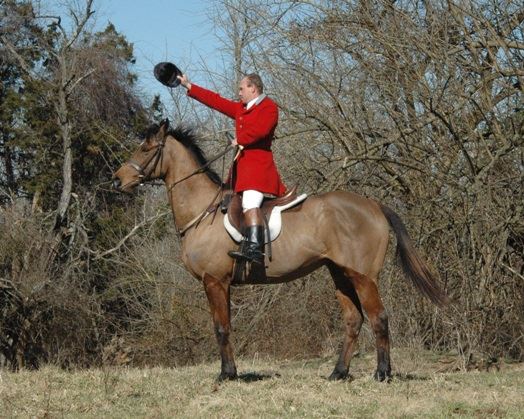
 The “Tally Ho” / Nancy Kleck photo
The next time you view old Reynard or that sneaky coyote slipping away from covert, you may be tempted to call out “Tally Ho.” There are occasions in the hunting field when it is appropriate to yell this call out loudly-and-clearly, but with our modern methods it is more likely that the huntsman will be informed by a whipper-in with a quick call over the hunt radio that the quarry has broken cover.
The quiet approach will be less disturbing to the hounds but it will not stir the adrenaline like the old-fashioned blood-curdling call of Tally Ho, yelled out loud at the top of your voice! Such an old-school call in the hunting field causes the mounted field to take in that extra hole in their girth, to cease “coffee housing” with their companions, and for the horses’ ears to prick forward in anticipation of exciting action to come.
When you say or call out Tally Ho you are continuing a tradition of nearly a thousand years. Imagine yourself as a mounted knight in full armor at the Battle of Hastings on October 14, 1066. You and your horse have been shipped over the English Channel from France in a rudimentary sailing barge flying the flag of the Duke of Normandy, later known as William the Conqueror. As you ride into battle against the army of the English King Harold II you will have left the white cliffs of Dover behind as you gallop into the fray across the rolling South Downs of Sussex.
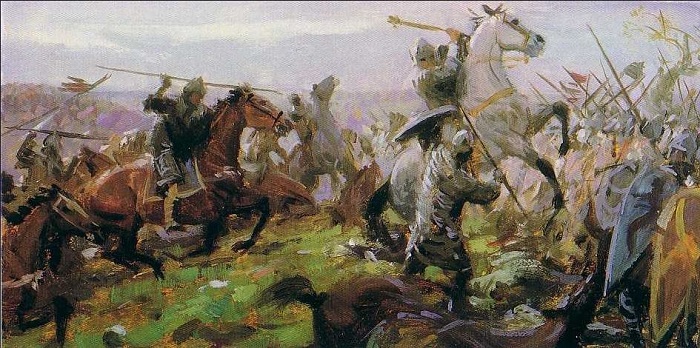 Battle of Hastings (1066)
Before the clash and clamor of battle you will hear the call from your commander to “Taille Haut!” To English ears the French pronunciation would sound like “Tahyee Oh!” The literal translation may be in question, but the meaning is clear! Translated from the Norman dialect of the French language, you might understand the order to say, “Cutting Edge High” (sword up) or “Size Up” (swell up, stand tall, and intimidate the enemy)—the meaning could be either—and you will descend upon the ranks of archers in the original version of “shock and awe” as you thunder toward the English lines. Does that sound just a little bit like your day in the hunting field as you anticipate the galloping excitement to come?
Perhaps your intentions and experience will be somewhat less bloodthirsty, but you will be sharing the same thrill as your Norman predecessors. Doesn’t Surtees tell us that hunting is “the image of war without its guilt?”
The evolution of the term from Taille Haut to Tally Ho is what generally happened to so many French phrases and names as they became anglicized through the ages. From these early days the next recorded use of Tally Ho is in 1772 when it was said to be used in the hunt field in a similar manner. The tradition has been continued ever since.
The first recorded use in America was in 1802 in a hunting publication. The term was no doubt brought to the New World by British colonists. There are other interesting uses of Tally Ho. As you might expect, there are several pubs in Britain with this name. A famous four-in-hand coach plied its trade between London and Birmingham for many years. There was even a British submarine so named during World War II. But perhaps the most interesting use of the expression has been by Royal Air Force pilots during the Battle of Britain in WWII.
As they left contrails in the sky during dogfights with German planes, the pilots used the term to denote the sighting of and the engagement with the enemy. As these young men, barely out of their teens, flew their Spitfires into aerial combat against their Messerschmitt adversaries, they borrowed the term from the hunting field in which many of them had so recently participated. It is coincidental that most of the air battles were fought over the same white cliffs of Dover and the South Downs of Sussex where their Norman forebears engaged their enemy with the cry of Taille Haut. No doubt the same adrenaline rush was experienced by the warriors of both battles even though there had been a time lapse of nearly nine hundred years between the two events. So next time that the fox or coyote breaks covert, use the term Tally Ho with the knowledge of its interesting, honorable, and ancient origins.
Afterword
The loose translations of Taille Haut that we have offered above come directly from the French language. If any entymologically-inclined readers have a different theory of what Taille Haut meant in the Norman dialect or as a Norman-French idiom. we would love to hear from you. Please add your Comment.
Posted February 19, 2019
[That taille haut should be anglicized over the centuries should come as no surprise. Think of Belvoir (pronounced Beever) and Cholmondely (pronounced Chumley). I like to think of this time-worn practice simply as England’s revenge against the Normans!
-Ed.]