
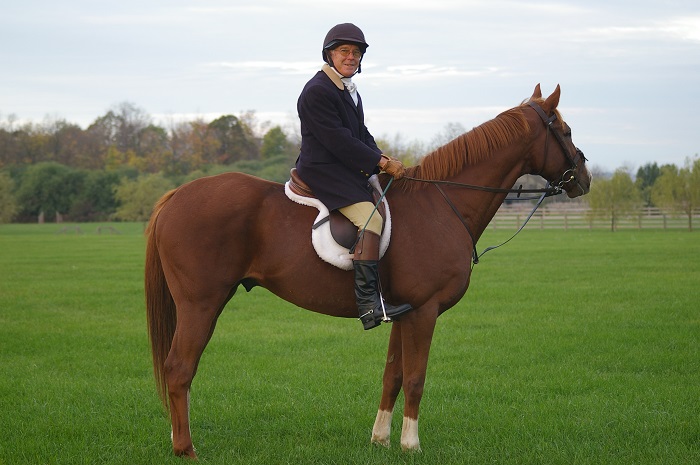
 Eric Myer wears the colors of the Genesee Valley Hunt (NY) early in the season. / Karen Kandra Wenzel photo
Eric Myer, DVM, is currently in his sixty-sixth season of foxhunting. And not just with one hunt. No, no. If that were the case, the hunting season would be far too short to suit him.
At eighty-two, Eric begins his season in mid-July up north near Rochester, New York with the Genesee Valley Hunt. His wife Martha has roots in Geneseo, and the couple has a summer farm there. Then, in mid-October, when the Piedmont Fox Hounds are well into their cubhunting season down south in Virginia, Eric and Martha return to their Boyce farm in the Shenandoah Valley.
Eric does his own grooming, schooling, and exercise riding. He has bred many of his best field hunters, and just retired one of his favorites—a nineteen-year-old that he has hunted since the age of six at Genesee Valley, Piedmont, Belle Mead Hunt (GA), and others while visiting.
“I give my horses a break from the end of the season until July, then start them up, riding one and ponying one about three days a week,” he explained. “And I school them. Even made horses need a tuneup.”
Over the years, Eric has served the Blue Ridge Hunt as chairman of the Spring Races, as a member of the Hunt Committee, and twice chairman of that committee. He has been a Field Master at Genesee Valley, Piedmont, and Blue Ridge and has been awarded colors at all three hunts. He’s also whipped-in at Piedmont and Blue Ridge.
“Being Field Master was always fun,” he says with a twinkle. “You’re right up in front.”
He even had his own small private pack of castoff hounds that he hunted from his Boyce farm for a few years through some tight country that was not used by the Blue Ridge Hunt. Your editor had the pleasure of following these old Crossbreds behind Eric as one in a field of two plus the huntsman. Sometimes, even a field of one!
For Eric, it all started with horses. He was possessed by the urge to ride from boyhood. Growing up in the old Meadowbrook hunting country on Long Island, at age sixteen, while a sophomore in high school, he got himself a job cleaning tack and mucking out at a local boarding stable. There, he had the chance to learn to ride and jump. Soon, he was exercising horses.
“I rode whatever and whenever I could,” he said.
He started hunting that same year, 1952. Later, in college, he worked with horses during summer breaks. One summer he found a job breaking horses in Ithaca. Another summer, he worked on a dairy farm near Geneseo, where he met Martha Welch, his future wife. Martha grew up hunting with the Genesee Valley Hunt, her brother, Bill, and her father who was an honorary whipper-in. While in college, Eric also exercised racehorses during summer breaks at the Phipps estate in Old Westbury, Long Island for the late Hall of Fame steeplechase jockey and trainer, Mikey Smithwick.
Having decided on a future with horses, Eric was recommended for acceptance to the Cornell School of Veterinary Medicine by a New York lawyer that he met…also through horses. After graduating, Eric from Vet school and Martha from nursing school, they married in 1961. The couple came to Virginia to spend the second half of their honeymoon scouting out locations for an equine practice. Through the Wadsworth family—founders and Masters of the Genesee Valley Hunt—Eric and Martha stayed for a time in Middleburg with Fletcher Harper, then ex-MFH of the Orange County Hunt, and his wife Harriet.
Later that year, Eric established his veterinary practice in Boyce, Virginia. In 1973, he built Roseville Veterinary Clinic at his farm, where he was able to perform large animal surgery. He practiced for nearly forty years, retired, and sold the clinic—a thriving small animal practice—to an associate. Only in his seventies at the time, Eric suddenly had a lot more time to hunt!
In 1968, while still building his practice, Eric and a friend had gotten together on a stallion, bred some mares for racing, and at a mixed sale in Warrenton bought a mare named Scheme. She turned out to be the foundation mare for his field hunters.
“She was ill-looking, but made well, and was a great producer of race horses,” Eric said. “”I’m now hunting her great-grandson.”
Of the biggest changes Eric has seen over the past sixty-six seasons, he noted two in particular. “There seems to have been a shift over the years, with more riders now hunting in the second field than in the first field,” he observed. “It has made foxhunting more inclusive, and has allowed more youngsters to hunt, which is a good thing
“I’ve also seen how changes in Masters and huntsmen too often produce shifts in the fortunes of hunts—not always a good thing.”
What has given Eric the most satisfaction over the years has been bringing both his children and his grand-children to the sport of foxhunting, and the joy they have mutually derived with three generations in the field, hunting together.
Posted January 8, 2019
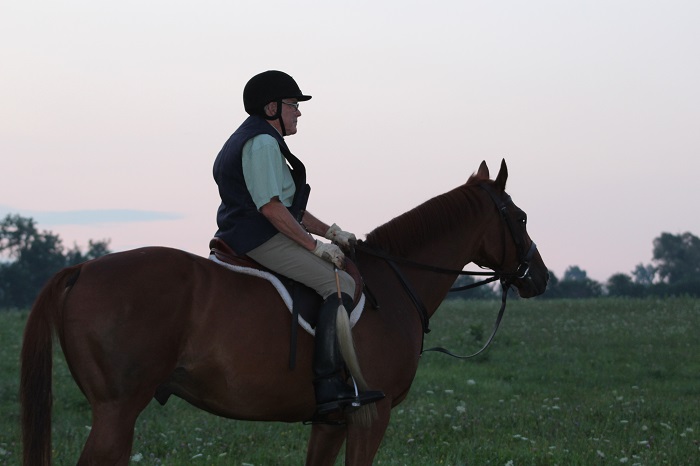 Karen Kandra Wenzel photo