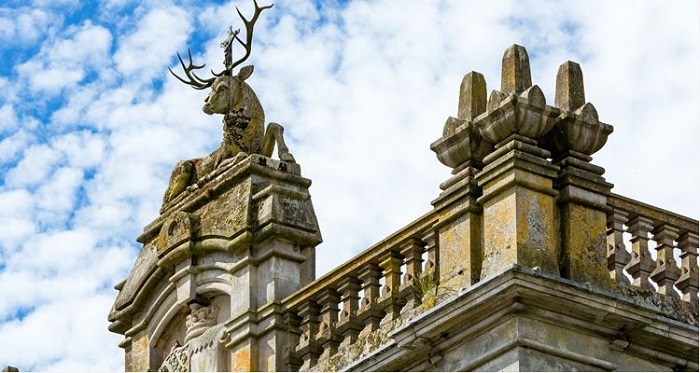
 St. Hubert’s stag and the crucifix atop the medieval tower at CurraghmoreOpening meets are always special, but when it is at Curraghmore for the Waterford Foxhounds, and a lawn meet to boot, it goes beyond special. Indeed, the hunt was originally known as the Curraghmore Hounds. The estate is steeped in all things of the horse. Even as we drove in the long avenue (it must be more than a mile), race horses were being unboxed and tacked up on the gallops and schooling grounds which are widely used by trainers in that part of the country.
Curraghmore is the historic home of the Ninth Marquis of Waterford. His ancestors through his maternal line, the de la Poers (Power), came to Ireland from Wales with Strongbow and the Normans around 1170—about a century after the Norman invasion of England and about 320 years before Columbus ‘discovered’ the New World.
Our primary mission, however, was to see, enjoy, and report on young Niall Dunne, now huntsman of this pack of Old English foxhounds. We weren’t to be disappointed.
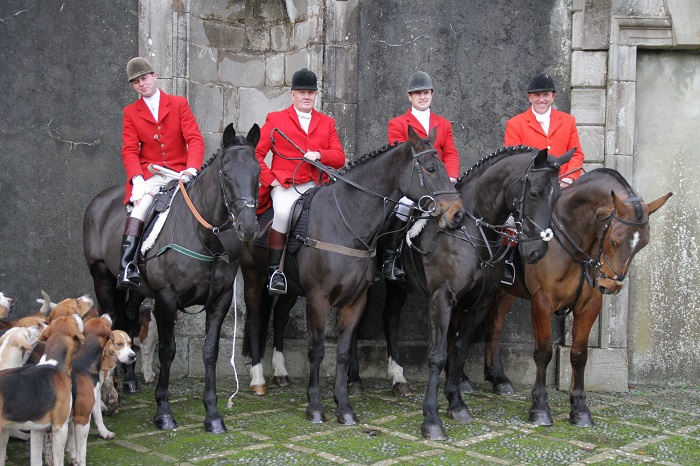 L-R: Waterford huntsman Niall Dunne with his Old English foxhounds and MFHs Lord Waterford, Raymond Morrisey, and John Kiely / Catherine Power photo
Curraghmore
Gnarled pink chestnut trees line the approach to the original castle tower, a Norman keep, expanded through the centuries to the present imposing edifice. St. Hubert’s stag with the crucifix between its antlers—the Power family emblem—gazes across the large courtyard from atop the tower. The courtyard is said to rival that of Blenheim Palace in Oxfordshire.
Some 3,500 acres of formal gardens, woodland, and grazing fields make Curraghmore the largest private demesne in Ireland and one of the finest places to visit in the country. A Sitka Spruce planted on the estate in the 1830s is one of the tallest trees in Ireland and, at a height of 180 feet, stands guard over King John’s Bridge. The stone-arched structure, built in 1205 and spanning the Clodagh River, was built in preparation for the visit of King John, which never happened. It stands today as the oldest functioning bridge in Ireland.
The Family
Early in the eighteenth century, after more than five hundred years at Curraghmore, the de la Poer (Power) male line from Normandy became extinct. Lady Catherine Power, age fifteen, married Sir Marcus Beresford, produced fifteen children, nine of whom survived to adulthood, thus creating one of the most powerful political dynasties in Ireland. An immense group portrait of the family, painted by John Astley in or around 1760, occupies most of the left-hand wall of the outer hall at Curraghmore. The Beresford-Power family has held the estate ever since.
It is said that during the Troubles, a group of republicans arrived armed with cans of petrol intent on burning the house to the ground. However, seeing the stag and the crucifix atop the ancient tower, they retired from their task to the Cotton Mill Bar in Portlaw* instead, thus saving the house built by Lady Catherine Power for posterity.
The Meet 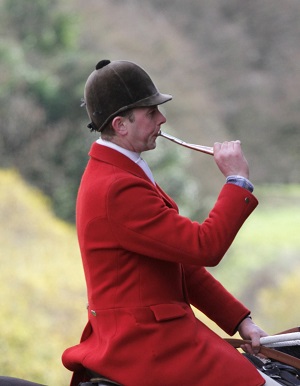 Waterford huntsman Niall Dunne / Catherine Power photoThe opening meet this day wasn’t even supposed to be in Curraghmore, but due to the un-seasonal weather and related issues, the meet which otherwise might have been postponed was moved to the estate. It was a jolly and sporting scene in the courtyard with horses being un-boxed, jockeys rather gingerly getting on board, an occasional improving drink imbibed before the rigors of the day.
Not everyone was mounted. Veteran Waterford follower Noel Phelan held a watching brief as did the two Lady Waterfords. We were first welcomed by the Marquis’ mother, Lady Caroline from Adare, who is one of the famed Dunraven family. Her two nieces, Lady Anna Johnson and Emma Thompson, are both Joint-Masters in their home county. Also there to greet guests was Mandy, the present Lady Waterford who is a sister of David Thompson, former huntsman of the Laois.
Lord Waterford was our host and he mounted up for the photo with the manor in the background. Known to one and all in the hunting world as Tyrone—though his proper name is Henry—he is the Ninth Marquis of Waterford. If that isn’t sufficiently confusing, consider the additional inconveniences of becoming the Marquis.
“It was a pain changing the bank cards,” Lord Waterford told The Irish Times in 2015 after succeeding to the title.
“You changed your cards?”
“Well I had to. I was the Earl of Tyrone before, so it said ‘Henry Tyrone’ on my credit card.”
“Not ‘the Earl of Tyrone?’”
“You don’t fit into the boxes when you have a title.”
“What does it say now? “
“‘Henry Waterford’. I’ll tell you, when I went into the bank manager he was fairly confused. He said normally you have to go through all these [processes]. They’re worried about people money-laundering, you see, but he said ‘I think this is a different situation.’”
To recap, in case of further confusion, Henry Nicholas de la Poer Beresford, previously the Earl of Tyrone but identified as Henry Tyrone on his credit card, although known throughout the hunting world as Tyrone, is actually Lord Waterford, Ninth Marquis of Curraghmore, and now identified on his credit card as Henry Waterford. Got it?
Sadly his son, Richard De Poer, now Earl of Tyrone, couldn’t be at the meet as he had to return to England on polo duty. Richard is the leading non-Argentinian polo player in England and recently married. Rounding out this brief family portrait, the third Marquess** who founded the hunt in 1840 lost his life in a hunting accident at a relatively young age.
Of the current Masters, only Ian Shanahan was missing but was ably represented by his sister Rosemary with camera, both of whom rarely miss a day. Whipper-in for this season is Jim Kenny who formerly turned hounds to P.J. Aylward at the Mullinavat Harriers. Bred in the purple, he is the nephew of Larry Byrne, a founder of the Mullinvac pack. Larry is still going strong and was out in the car this day.
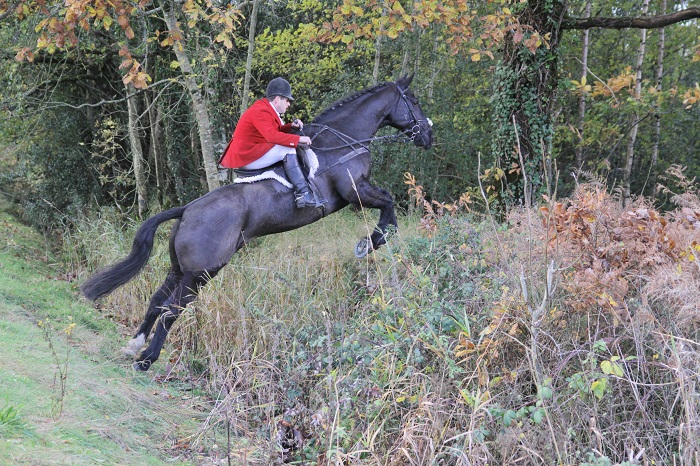 Raymond Morrissey, MFH jumping a ditch and bank / Catherine Power photo
Uniquely among county packs, the Waterford Mastership includes the Morrissey brothers, Raymond and his brother Alan. Alan was not riding as he was driving his dad around, but his wife Julie was. A true blue foxhunter, Julie grew up at the Mid Antrim, where her father, T.S. Caves is senior Master. Alan, dutiful husband that he is, was tacking up Julie’s horse and completed a perfect round by polishing her boots with a mechanical polisher as she sat on the back of their Range Rover!
Photographs taken, with the manor providing an aristocratic backdrop, hounds moved to the first draw in the wood known as the Wilderness, then on through Alma Heights, before finding in the very aptly named Pheasantry. It held at least a brace and an uncountable number of pheasant, quite a few of which were albino. The estate was host to a shoot just a few days earlier, and Curraghmore is an example of how shooting and hunting can co-exist.
The Waterford foxhound orchestra was in full voice, and, as our pilot scurried towards the cricket pitch, the pack was close on his heels. In the lead was fourth-season dog hound Charger (by Waterford Ladder). Charger had been bred by Niall in his first season at Waterford. Our pilot had been viewed away by eagle-eyed Michael McEwan, former huntsman at the Cattistock in Dorset.
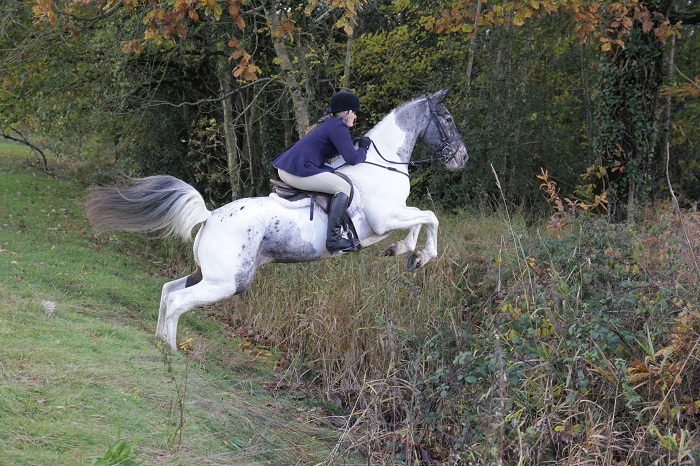 Kitty Shanahan on her spectacular blue/gray hunter / Catherine Power photo
As hounds ran back towards Clongam Church, which holds a marble bust of Catherine Power, Lord Waterford on the bay Roufus gave a great display taking a couple of wire fences in his stride. Our pilot then ran towards the Ballyquin entrance where hunt secretary Ciara Fahey, closely followed by Kitty Shanahan on a spectacular blue/grey coloured horse, flashed over an estate wall as if it weren’t there. Kitty is an equine osteopath and has just got engaged to our huntsman Niall Dunne (lucky man).
During a brief interlude we had a chance to chat to veteran followers Dr. Gordon Watson and his wife Hazel, a former Master of the Waterford. It would be indelicate to enquire too closely as to this marvellous couple’s age, but the good doctor qualified in 1967 at Trinity College Dublin, before going on to have a distinguished medical career as a surgeon. He started his hunting career with the now defunct Coolattin Hunt in Wexford. The Watsons still enjoy their hunting as much as ever and have two proper hunters.
As scent petered out, hounds went on to draw Smithstown and the Race Course belt. The latter held, and hounds hunted well towards the road before swinging right handed over the Clodagh River down by the old kennels which last held hounds in 1925. The buildings, now much modified and modernised, are home to the senior Lady Caroline Waterford. Hounds then swung left handed back over the Clodagh beside King John’s Bridge.
With shadows lengthening, the rugby match of the century (the All Blacks) to follow, and most of the estate drawn, our huntsman wisely decided to blow for home. So ended a marvelous day in a most spectacular setting. The Cotton Mill Bar in Portlaw beckoned!
* Portlaw, the local village, was once home to Ireland’s largest cotton mill which was forced to close during the American civil war as the supply of cotton dried up.
** In Britain, “Marquess” is traditionally used, while the French spelling “Marquis” is more often used on the European mainland. In this case, the suffix, “ess” does not connote the female gender.
Posted Decenber 17, 2018
A similar article was previously published in The Irish Field.