In this excerpt from “Foxhunting: How to Watch and Listen,” the author reveals what goes through the huntsman’s mind as hounds find their fox and push it into the open. In Robards’ celebrated book, the entire chase is chronicled from beginning to end, first from the standpoint of the huntsman, then from the viewpoints of the whipper-in, the Field Master, the hounds, and the fox.
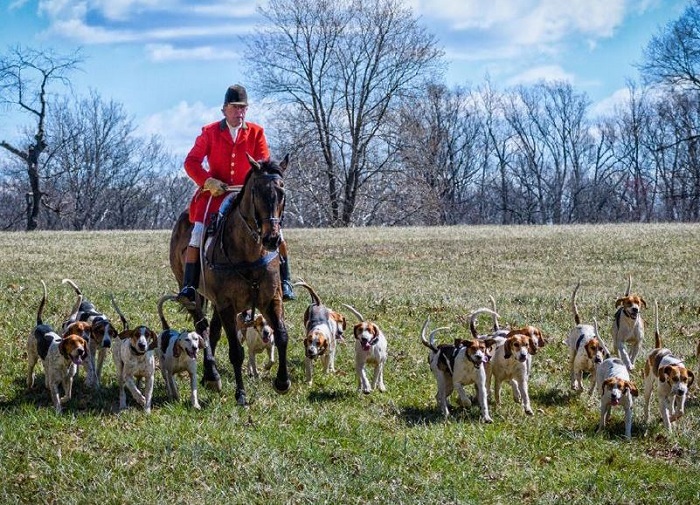 Hugh Robards and the hounds of the Middleburg Hunt / Middleburg Photo
Try to position yourself so you can hear what the huntsman is doing. You may hear a hound whimper. The huntsman has not only heard, but he has seen Wagtail trying to take a line to the edge of the covert where some thick briars cover the boundary ditch. The pack also heard the whimper and, knowing it is Wagtail, a hound on whose opinion they can rely, have come in close to her and the huntsman. Now you might see the huntsman quietly edge his hounds toward the ditch. As you strain to hear what is going on, everything in the covert falls silent.
All at once there is a huge roar of hound music as the pack rouses the fox in the boundary ditch. All of the mounted field tense in their saddles, waiting for the hoped-for halloa from a whipper-in, letting the huntsman and the world know that the fox has fled the covert. It does not happen. Once again there is silence. The pack was too close to its quarry, and the fox has turned short back into the covert.
You realize that hounds have already drawn the covert twice. It is badly foiled* by their own tracks as well as the fox’s, and the fox takes full advantage of this to gain some respite from the hounds.
You will notice that the huntsman is still silent. He wants nothing to distract hounds. All he wants is for his hounds to keep their heads down and keep trying for the scent of the fox over the foiled ground.
Hounds are working hard. Sterns start to wave. Villager opens. The pack clusters around him and, as one, opens on the line of the fox. What a glorious noise they make as they now get close to their quarry. The huntsman, as you note, is still quiet. The hounds are making all the noise that is necessary as they ring the covert.
Once again the mounted field becomes tense. Then, much to the Field Master’s relief, there comes a shrill view halloa from the far side of the covert. But he still holds the field steady. You will hear the huntsman cheering the pack to the halloa: “Forrard, forrard, forrard.” Still no need to use his horn as the hounds are packed up and driving on.
Normally, the huntsman would not cheer the pack to the holloa in case they were hunting another fox, but as he has drawn the covert twice, he is certain there is only one. Perhaps, as the pack is running so well, it was unnecessary for him to cheer them, but it does let the whipper-in know that his halloa has been heard. The pack has now reached the whipper-in, who is standing just a little away from the line of the fox, with his horse’s head and his own hunting cap pointing in the direction that the fox has gone.
Now, at last, as the pack settles to the line, you will hear the long and exciting notes of the gone away. Tighten your girth, sit down in the saddle, and plan to ride as close to the Field Master as you can. Look forward to taking those glorious fences as they come, but remain observant! We have already decided there is more to foxhunting than crossing the country, so let us now try to observe what the huntsman is doing.
The huntsman was somewhat relieved to hear the whipper-in letting him know that he had counted hounds away as they came out of the covert and that they are all there. As he passes his whipper-in, he hears, “All on, sir.” As you watch the huntsman crossing the country behind his hounds, you may think he is the luckiest man in the world: to be mounted on a good horse and paid to do a job he thoroughly enjoys. Perhaps he is a lucky man, but the huntsman is also aware that to many people he is only as good as his last hunt. As Mr. Jorrocks would say, A fish fag’s ware isn’t more perishable than a huntsman’s fame.”
As you gallop on, you must know that the huntsman is focused on the job at hand. He does not ride for reputation; he rides to keep with his hounds. He may have a second horse, but he rides his first one as if he is not getting a second. Therefore, he has necessarily developed an eye for a country, picking a place to jump in a fence with an experienced eye to saving his horse. He is also looking ahead, trying to divine the fox’s destination. Is it some woodland stronghold, or is it a head of open earths? Is the fox inclined to be bearing to the left or to the right?
These observations will help influence him in his casts if he has to help the pack at a check. Notice also that the huntsman is not riding directly behind his hounds. He rides a little to the side of them so as not to unwittingly push the pack over the line if the fox makes a turn.
His thoughts are also on things that may cause the pack to check: a herd of cattle on the side of a hill that the fox is pointing for; that heavy shower of rain that is threatening to fall and obliterate the scent; and, perhaps worst of all, the farm laborers burning hedge trimmings. The fox is running down wind, the smoke is drifting down wind, and the huntsman is making a mental calculation of how far he will have to take the pack on if they check in the smoke. You must not forget that even when he has got the pack beyond the smoke, it takes time for their noses to clear. The same problem is caused by the exhaust fumes from automobiles.
* For translations of any unfamiliar terms, which we have italicized, click on the Resources dropdown menu, then click on Glossary of Terms.
Posted October 29, 2018
Foxhunting: How to Watch and Listen is available from our Book Shop, as well as from sporting bookstores and popular online sources. The field member who understands what goes through minds of all the principle players during a hunt is certain to derive more pleasure from his day in the field than those who simply follow the Field Master without the insights provided in this celebrated book.