Book Review by Norman Fine
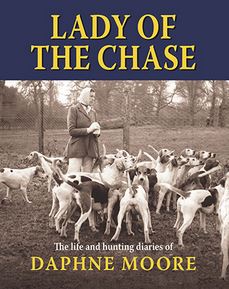 The Lady of the Chase, Alastair Jackson, Merlyn Unwin Books (UK), 2018, Hardcover, 208 pp, illustrated, available direct from publisher, book stores, and popular online sources.
Daphne Moore is Alastair Jackson’s Lady of the Chase. Before reading this new book, I knew of Daphne Moore only as an author. Her book, Foxhounds, published in 1981, is an excellent account of the revolt against the ponderous and massively-built English foxhound of the early twentieth century and the development of the lighter, active, and athletic animal we know today as the Modern English foxhound.
I learned a lot about foxhounds in Moore’s book, but I didn’t get to know Daphne Moore in the least. Now, Alastair Jackson’s biography of this fascinating lady has brought her to life for me—her joys (hunting), her problems (finances), her talents (writing and painting), and her sorrows (the loss of the one, brief love in her life to World War II). For any foxhunter with a passion for the hunting field, foxhounds, foxhunting people, and revered names still on our lips today, Jackson’s book will be a delight.
In 1930, when Moore was twenty years old, she began keeping hunting diaries. Jackson learned of the diaries when, in 2004, they were all delivered to the British MFHA office where he was Director. Moore had just died at age ninety-four, and Jackson was tasked with fulfilling the terms of her will by turning them over to legatee Simon Hart, ex-MFH. Hart is now a Member of Parliament and Chairman of the Countryside Alliance. In his Foreword to Jackson’s book, Hart writes, “Daphne’s immaculate, detailed and comprehensive account of over 50 glorious years…puts into words why we do it, and why we fight for it, and why it has survived.”
The characters whom Moore hunted with and wrote about were often those (and parents of those) foxhunters covered for years by your editor in these pages and well-known to foxhunters in the U.S.: Captain Ronnie Wallace, leading MFH and huntsman of the latter half of the last century; Martin Scott, MFH, leading expert on hound pedigrees in Britain and a member of Foxhunting Life’s Panel of Experts; Masters and huntsmen the Duke of Beaufort, Brian Fanshawe, and Thady Ryan; huntsman Tony Wright; artist Michael Lyne; photographer Jim Meads; to name just a few of the luminaries.
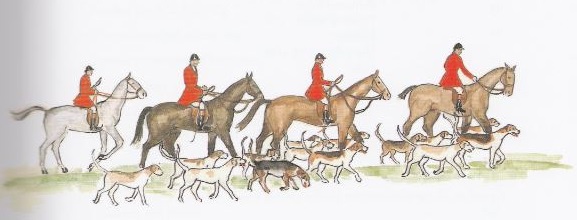
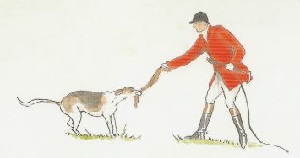 Moore was tall, slim, athletic, and well-spoken. With her dress and manners, she could have been taken for a member of the aristocracy, but that was far from her situation. She lived on a shoestring budget, deriving income from her hunting reports in Horse and Hound and other periodicals. She maintained her meticulous hunting diaries, and embellished them with charming watercolor paintings.
For her, hunting was a year-round passion. She foxhunted all through the fall and winter, sometimes up to six days a week, then followed the otter hounds in the spring and summer. (Otter hunting, once as foreign to me as space travel, now having read Jackson’s book, is much better understood, and even appealing!)
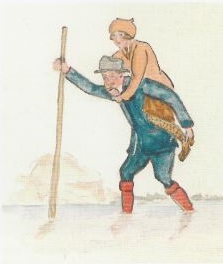 Her hunting was done mostly on foot or bicycle. When occasionally mounted, it was only because a local horse dealer needed schooling and experience for his green horses. Those portions of the season when foxhunting and otterhunting overlapped were extremely full for Daphne Moore. She would follow the foxhounds on foot after bicycling or hacking ten miles in the dark to the meet, then, whenever possible, go on to hunt with the otterhounds for the rest of the day. After which, finally at home, she would paint any images that stuck with her, and write a detailed account of the hunting.
Alistair Jackson has included portions of Moore’s diaries and, happily, much of her artwork in this volume. Her first recorded entry with foxhounds was dated August 25, 1930 with the Croome:
“I started off from Tewkesbury on my bicycle at about 5:45 this morning—the alarm clock having gone off just before 5:00 and my breakfast finished just after half past! It was a perfectly wonderful morning…no mist to speak of, and the sunrise over Bredon Hill was simply marvelous….
“A young man and maiden who had arrived at the first covert (he was presumably an army man, judging from scraps of his conversation and his somewhat vacuous expression!) had also departed and two of the Lygon girls, who had come out for a short time, attired most weirdly in long flannel trousers—all very well for the sea, but for cubhunting, no!”
The Welsh crosses at the Croome impressed her with their work, especially a dog hound named Verdict. She heard that Bill Scott, MFH at the North Cotswold had just sent his best bi*ch to Verdict, so she traveled a bit further afield for a day with Scott’s pack. She had a hard day on her bicycle across the country. Her report concluded, “The wind was against me all the way back to Tewkesbury and I had great difficulty in getting along.” However, in her all-consuming love for foxhounds, longing to learn and understand which lines were producing the best hunting hounds, and her appreciation for what Welsh bloodlines were contributing, she continued to go further afield and meet new Masters.
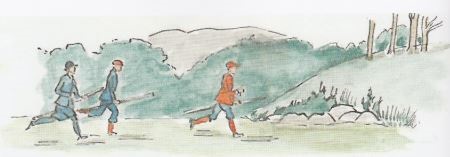
Moore met Ronnie Wallace in 1936 when he was a young Master and huntsman of the Eton College Beagles:
“This morning I bicycled over to Bishop’s Cleeve by 11:30 and left my bike at the Lodge. Vivian [Ronnie Wallace’s brother] had to go to Cheltenham and wasn’t whipping-in, so, to my delight, Ron asked me to take a whip. It’s always so much more interesting to hunt with any sort of hounds if one has a job of work to do.”
Indeed she was often a most competent helper in any field. This day, she saw a beautiful dog fox away on the other side of the covert, warned Wallace, and with the help of Perkins, the kennel huntsman, stopped the beagles off the line. Later, on the final hunt of the day:
“There was scarcely a check all through this hunt, and I, who was getting pretty well beat, almost prayed for one now. But they caught her at the edge of a ploughed field behind Cleeve Grange, after a very rapid half-hour. I saw hounds fed and then went into tea at Cleeve Grange—a most enormous one with two eggs; and bicycled home in the dark.”
Meeting up with Perkins many years later at a puppy show, Moore remarked that Perkins looked the same as he did when he whipped-in to Captain Wallace before the war. “Ah, Miss,” Perkins replied, “I’m not the same; I never shall be the same again. He nearly killed me!”
She met the love of her life at a meet of the Hawkstone otterhounds shortly before the war. Harry Glynn, a Border Counties member, was “a very tall boy” who, she discovered was also a fellow reporter. “He writes for the Border Counties when he’s at home, which isn’t very often, as he is in the Navy.” The pair had a wonderful but all too short time hunting together before the war broke out. Harry Glynn went to sea in the submarine service and was lost.
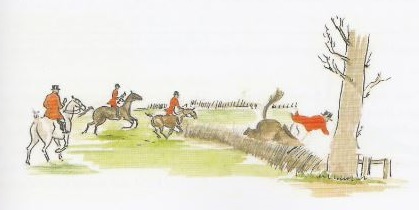
Moore must have impressed all whom she met with her knowledge of hounds and her hunting passion, for she was always invited back. After finally going to see the Duke of Beaufort’s hounds in action, she became, in time, a valued friend of the Duke and Duchess and a guest at Badminton. The Duke increasingly relied on her knowledge of pedigrees and her writing and drafting skills, and she soon became indispensable to the family. Later in life, she lived for forty years in a stone cottage at Badminton, where she was able to continue her reporting and write her book, Foxhounds, until finally moving to a nursing home in 1998.
Alistair Jackson’s The Lady of the Chase—chock full of our sport’s greatest characters; lively and humorous accounts of foxhunting, otter hunting, and beagling; and a cast back to hunting’s halcyon years as well as its war years—is a warmly personal and fully satisfying read for any foxhunter.
Posted September 25, 2018