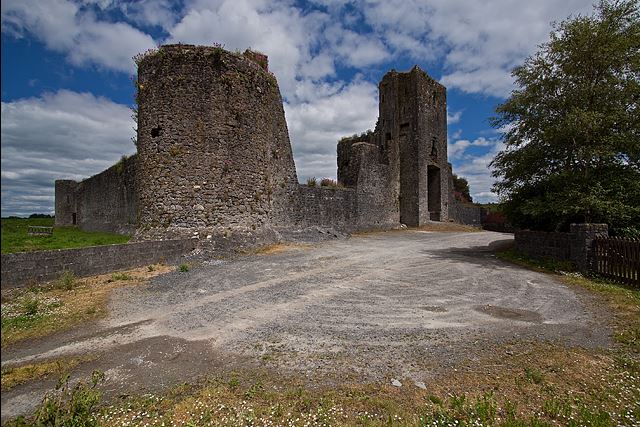
 Thirteenth century Liscarroll Castle in the Duhallow hunting country, near the site of the Battle of Liscarroll in 1642.
There are certain days that stand out in the sporting calendar, Gold Cup day in Cheltenham, Aga Khan day at the Royal Dublin Show, the Maryland Hunt Cup in the USA, Munster final in Thurles (especially if Cork and Tipperary are playing), but ranking at least equal to any of these must be a meet of the Duhallow in Liscarroll. The Duhallow kennels are nearby, and huntsman Ger Withers is a native of the parish so it could be described as their spiritual home. As if all this weren’t enough, longstanding hunt chairman Pat Fleming farms nearby, and the Flemings have been farming in Liscarroll since the Battle of Liscarroll around 1642.
The Duhallow claim to be the oldest pack of Foxhounds in Ireland having been continuously hunted since 1745, though their claim as the oldest is disputed by their neighbouring hunt, the Muskerry.
The Duhallow were founded by the Beecher family whose name will always be associated with Beecher’s Brook, the most famous obstacle in the most famous race in the world. While the Beecher family no longer lives in Duhallow, their direct descendant Irene O’Meara is still very much involved with the hunt and was out this day. In fact she acted as guide for our photographer and was an invaluable source of information on all things Duhallow.
It was with some degree of trepidation that I set forth, as the Liscarroll banks are noted for their challenge and the Liscarroll country’s ability to swallow horses and riders leaving little more than their caps above ground is the stuff of legends. So it was something of a reassurance when my daughter agreed to accompany me on this great adventure. The village of Liscarroll was en fete with horse boxes everywhere and jockeys in various stages of mounting with over eighty riders out.
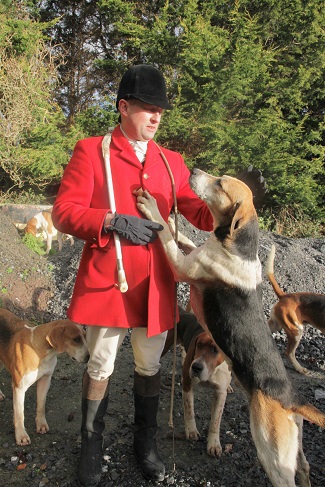 Duhallow huntsman Ger Withers. / Catherine Power photoGer Withers is an out-and-out hound man, and his pack showed this as his fourteen-and-a-half couple of Old English foxhounds looked a picture with gleaming coats and an obvious enthusiasm for the task ahead. Ger has carried the horn for almost ten seasons having taken over from Michael Buckley. Michael’s brother Ger, a bank manager in Mitchelstown, was out and going well. Assisting the huntsman were two amateur whippers-in, James Fleming, son of hunt chairman and a Teagasc advisor in the area, and Fergus Stokes from Tullylease, who on non-hunting days works as a farrier but never misses a day’s hunting. Joint-Masters Kate Jarvey and Rory O’Brien were on hand and, as ever, welcoming to all. Rory, a serious men across country, was accompanied by his daughter Niamh, a leaving cert student working hard for sufficient points to hunt three days a week. Missing was Joint-Master Matt Nagle but Maurice O’Connor was out, though not mounted.
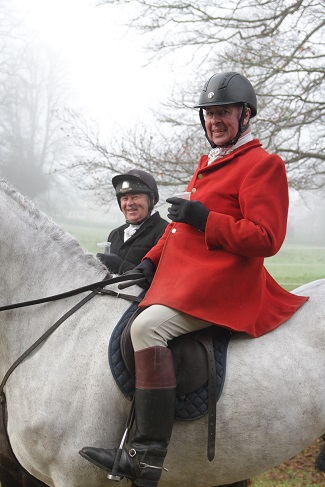 Maurice Coleman has served as Field Master in this demanding country for over thirty seasons. / Catherine Power photoKeeping order, if such a thing is possible with eighty well mounted riders all mad for action, was Field Master Maurice Coleman, as always beautifully mounted on a second season horse by Cult-Hero. Originally appointed by Capt Harry Freeman-Jackson the legendary Master and huntsman of Duhallow, Maurice has held office for over forty seasons and goes as well today as ever. Capt Freeman-Jackson represented Ireland no less than four times in the Olympic three-day event and won the four star Burghley in 1963 on St. Finbarr.
A short hack took us to the first draw at John O’Regan’s farm at Killinane. With girths barely tightened, hounds spoke and with a brace of foxes afoot, huntsman settled his hounds on one and we described a nice circle before running the fox back into a nearby plantation. Hacking back through O’Regan’s yard whipper-in Fergus Stokes was pressed into service as a farrier, and he re-placed a missing shoe.
Hunting is very much a family orientated sport with several extended families in the field. From nearby Kilbrin were the O’Connell sisters, Caroline, Rachel and Madeline, while from nearby Churchtown were the O’Leary’s father Eugene, who is an extensive dairy farmer with his family, Eugene, James, and Grainne, age ten.
The next draw after hacking back through the village was in the shadow of Liscarroll Castle which dates back to the thirteenth century and is still mostly intact. Drawing some rushes, hounds had a fine dog fox afoot who set his mask for the point-to-point field, reputedly the site of the Battle of Liscarroll in 1642 with over 1,550 men killed.*
Another important battle was staged at this site when the mighty Denman, ridden by Colman Sweeney and trained by Adrian Maguire, won his first point-to-point on this track in 2004 before going on to Cheltenham glory in the Gold Cup. The course is owned by the O’Brien family who also run a sporting pub of the same name in the village where we finished our day.
Warned by our Field Master to stay off the track, we pressed on at speed over some nice country towards Altemiara and on towards the quarries. Tumbles appeared to be the order of the day with enough loose horses to remount a battalion of cavalry, so I decided a good lead was in order. I was fortunate to tuck in behind hunt secretary Commandant Pat Coleman of the defence forces riding a smashing bay. Pat is brother of the Field Master and army duties permitting (and they usually do) hunts three days a week. As always, he didn’t put a foot wrong and my horse followed suit. Unfortunately, Jill Farrell from Castletownroche riding a nice grey was not as lucky, as she was dragged off by a bush giving her a mud bath that would have cost her a fortune in a spa! To add insult to injury, one of her leathers got pulled out, and it took a major operation to get her motoring again.
Jumping on to the road with hounds running parallel we passed Sunford Language School. Swinging left-handed into a farm roadway, young Eugene O’Sullivan (son of William O’Sullivan who rode Lovely Citizen to Cheltenham victory) took a heavy fall and was covered in mud. Eugene quicky caught his pony and was back in the plate in a flash, a jockey in the making.
Our pilot retraced his steps and we were again in the point-to-point field but hadn’t time to discuss either form or going as hounds were absolutely flying. We swung right-handed over some fine country, again with more loose horses than at the fair of Cahiramee. Running more or less parallel to the Dromina Road, hounds crossed, and finding the gate firmly locked, a canal like obstacle blocked our path. Hunt staff were over like a flash, as was Jimmy Mulchay from Scarteen having his first day ever with Duhallow. With the sides falling away and the obstacle getting wider by the minute, falls increased accordingly. Agricultural advisor July Roche had a spectacular fall off her blood cob who breasted the far bank sending her on a horizontal dive almost to the road. A similar fate was enjoyed by Ban Garda Catriona O’Sullivan riding a bay cob. Living near Milstreet she is attached to Academy St Garda station and also hunts with the Kingdom hunt in nearby Kerry.
Hunting on though at this stage reporting from the back stalls, we crossed the road and with horses under pressure eventually caught up. Hounds had run into a huge plantation owned by Tadgh Egan who was also hunting. With light in short supply and horse power even shorter, the huntsman blew for home.
* In the Battle of Liscarroll (1642), the Irish Confederate Army of Catholics, outnumbered three-to-one, was defeated by an English force led by a Protestant Irishman. The Confederates carried pikes for the most part, while the victorious English force which had occupied Liscarroll Castle in an attempt to cut off the English-held city of Cork was armed with muskets. The battle occurred around the start of the Eleven Years War, the most destructive war in Irish history.
Posted June 15, 2018
This article previously appeared in The Irish Field and is republished with permission.
 Catherine Power photo