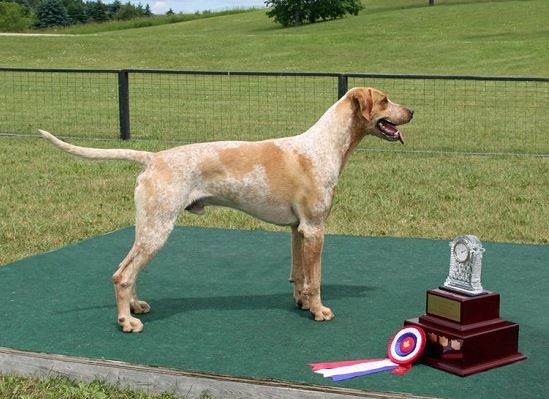
 The conformation of Toronto and North York’s Blue Ridge Wentworth 2015, Grand Champion Foxhound at the 2017 Canadian Foxhound Show, is clearly seen in this well-posed photograph. / Denya Massey photo
This may come as a surprise to new hound show photographers, but…
…your primary purpose at the hound show is to produce hound portraits that clearly display the conformation of those hounds recognized by the judges as superior examples of the breed.
Secondary purposes may be to include the smiling faces of the Masters, handlers, distinguished trophy presenters, and judges, along with candids of attendees enjoying the day and the action in the ring. Those are nice things to do. But they’re secondary. The hound show is about the hounds.
There are those experienced photographers who are expert at photographing four-legged animals, both hounds and horses. The basics are pretty similar. Editors of sporting magazines—those who cover dogs, hounds, horses—love those photographers. They make us proud by providing images for publication comparable to our unforgettable prose. So, here are some basic guidelines for shooting hound champion portraits at hound shows, even those that include all the smiling faces.
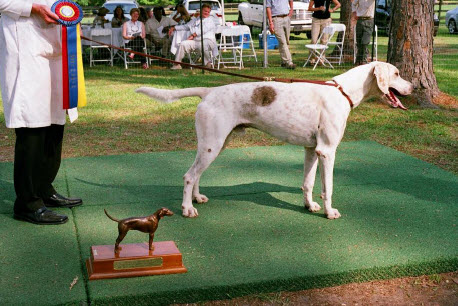 The incomparable Jim Meads captured this portrait of Fox River Valley Nightcap 2009 when she was judged Grand Champion at the Southern Hound Show in 2011.
For hound show organizers who engage photographers for their shows, may I suggest providing these guidelines to any new photographer before the show. How else is any new photographer to know his or her job?
To the photographer, then. Since you are carrying a camera, I will assume you know all about light, shadow, composition, ugly backgrounds, shutter speed, apertures, and such. Here is only what you need to know about shooting a hound portrait for the benefit of houndsmen.
And, yes, it is the duty of the handler to present the hound properly to the photographer. But since live animals tend to move around, the photographer needs to know when to shoot, and when not to shoot the image.
1. Face the hound squarely broadside (or close to broadside). Ideally, you and your camera want to be perpendicular to the axis of the hound. If the photo is taken from too much of a forward angle or too much from a rear angle, perspective may distort the hound’s conformation.
2. Crouch down closer to hound level so perspective doesn’t foreshorten the legs.
3. The foreleg closest to the camera should be vertical to show the hound’s front end angles (shoulder to point of chest to elbow) best. If the pose isn’t ideal, at least one of the front legs should be vertical. The other foreleg may be either vertical or slightly behind.
4. The hind leg closest to the camera should be vertical from the hock down (to show off the shape of the gaskin and a well let-down hock).
5. Head and neck should be in profile, extended naturally.
6. Otherwise, don’t shoot! Instead, make a courteous suggestion to the handler. As in, “Could you please stand your dog up?” Or kind words of your own choosing, if you want to stay friends.
This is the ideal pose for the hound. The shot available to you will not always be ideal, but a study of the photos accompanying this article should give you a standard to strive for. There is even some leeway in less than ideal poses that still result in useful shots.
Photos that accompany hound show results on the MFHA website or in feature articles should show the hound to its best advantage, and hound show organizers should be sensitive to this. The photo should help show off that foxhound to Masters, hunt staff, and breeders so its desirable characteristics can be evaluated for their own breeding program, and to all foxhunters wishing to train their eye to a standard of correct conformation. That’s the reason for the hound show.
So much for a discussion of the classic foxhound portrait. Photo/journalist Lauren Giannini agrees with these basic guidelines. She also has a few rather more sophisticated tips. Giannini writes:
“If you want people to move closer together, make sure they move their feet. Countless photos get ruined by not insisting that they shuffle closer together and pack up, instead of leaning towards each other so that the awards photo brings to mind the Leaning Tower of Pisa.
“The lovely, ancient trees at Morven Park create shade for hounds and humans, but wreak havoc when it comes to contrast and shadows. There is no easy solution, but sometimes in broad daylight, bouncing flash—an index card taped to the head of your flash—can help even things out without causing redeye or making the photographer go crazy editing.
“Re digital editing systems, some are better than others, but they also cost way more. Some professionals might use the basic built-in editing tools found on macbooks for a simple crop or easy exposure correction. For anything more complicated such as shadows, cloning (to get rid of a blue loo or something undesirable in the background), more sophisticated software is your best bet. Photoshop Elements (for PC or Mac) offers good value for your bucks.
“Sporting action—hound show candids, foxhunting, and other forms of horse-related motion—always entails shooting by the seat of the pants. At a hound show, most of the classes take place in rings, so you don’t have to worry about interfering with horses and riders, but it’s a tough stage to get great photos.
“The legendary Jim Meads does all his shooting with a fast 50mm lens. It doesn’t matter if he’s out on the downs chasing after the hounds, chasing after Charles James, or a drag, or at a hound show, he gets his shot. Oh, to be that skilled with a camera and fixed focal length lens that works like the naked eye….but that’s Jim Meads.
“The rest of us have to find our best focal lengths and hone our eyes to capture the important moments.
“Don’t get crazy. Keep your editing simple. Remember, it’s the hound that counts. But you want to try to make sure that the humans look nice, too. The hunt staff will be delirious with the hound’s achievement, so they’re easy. If Masters are in the frame, you want to try to make sure they look nice. Some of the best win photos are like a tableau—hound and handler posed beautifully with a backdrop of people, talking and smiling to each other and to onlookers.
“If you happen to photograph hounds showing off lead in any situation, the money shot is when the hound is leaping through the air like a dolphin as it chases the biscuit. Easy to capture if you have a motor drive and crank up your shutter speed: just hold down the shutter button and keep your camera steady at all times, but especially while panning.
“Editing is a very subjective endeavor. The goal is an attractive photo that shows off the winner and/or champion in the best possible way so that the image educates or affirms the eye of the beholder, who will agree with the judge, ‘Ahhh, yes, such a beautifully put together hound!’”
Posted May 31, 2018
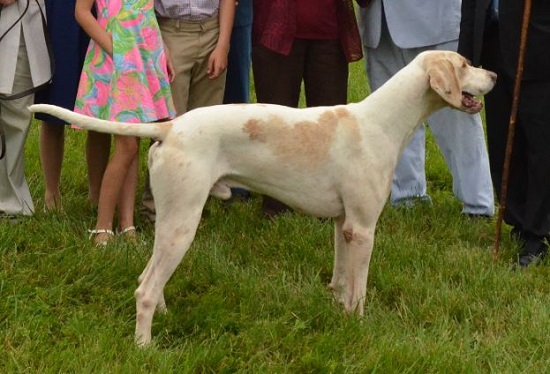 Nancy Kleck captured this excellent portrait of Midland Striker when he was judged Grand Champion at Virginia in 2016. This is a detail from a larger photo which includes all the smiling faces, but huntsman Ken George still made certain his hound was standing properly for the photo.
*reprinted from a previous article (2019) in FHL*