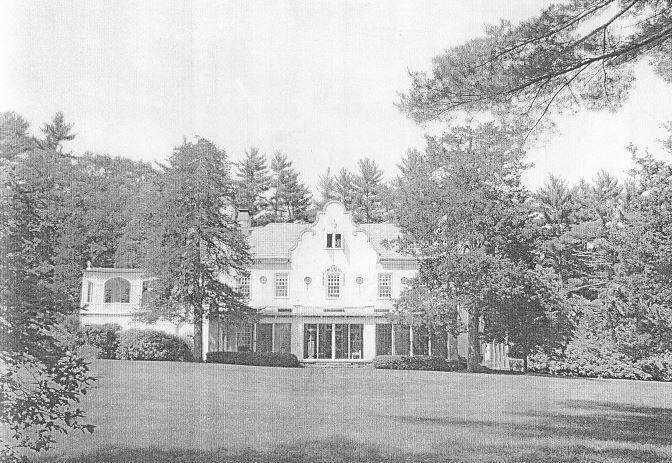
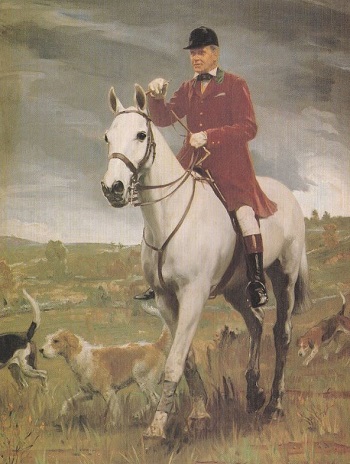
The Norfolk Hunt (MA) can boast of well-known men of American history throughout its earliest rosters—Louis Brandeis, Justice of the U.S, Supreme Court and Leverett Saltonstall, a three-term Governor of Massachusetts and three-term U.S. Senator—but none of its members so dominated the reputation and future of the hunt as did Henry G. Vaughan. He appeared as a member’s guest in 1900 and three years later was elected MFH, a position he held to acclaim for the next thirty years. He was a complete New England gentleman and one of the founding fathers of organized mounted foxhunting in America.
His was hardly the case of a man arriving at a backwater village and uplifting the native savages. Vaughan arrived in Boston from a small town in Maine by way of Harvard University into the midst of the Boston Ames, Cabots, Forbes, Peabodys, Perkinses, and Saltonstalls to be not only embraced, but feted, revered, and almost deified.
A gentleman in manner and deed, Vaughan lived by the democratic principle that all honest people deserved his respect and attention. He was able to chat as comfortably with the farmers and their wives as he did with leaders of Boston’s commerce. In 1907, together with Harry Worcester Smith and a handful of luminaries of that period, Henry Vaughan founded the Masters of Foxhounds Association in order to record the hunting territories of member hunts. Vaughan was named the first Secretary-Treasurer of the Association, the office of which was established at Vaughan’s law office at 53 State Street, Boston.
In a rare example of his own writing—his widow, upon his sudden death, ordered that all his papers be burned—Vaughan wrote in a Prefatory Note to a book in 1937:
“Hunting is one of the, if not the, greatest of sports, and has been pursued in one form or another since the beginning of time. It is an activity of the human race which affects and benefits not alone individuals but communities, even nations—England, for example, is well described as a sport-loving nation. Organized hunting to hounds today is the evolution of a pastime, not of a game, and can be enjoyed by young and old, men and women. It has to do with the out-of-doors, fields, woods, fresh air, and with hounds, horses, and companionship of those who are making the same endeavor, and engage in it as a sport and not as a competition.
“These attributes have a direct tendency to develop character along more considerate and unselfish lines, as Will H. Ogilvie writes:
‘The men who care but little for the laurels of renown;
The men who turn their horses back to help the man that’s down.’”
Vaughan was thirty-four years old when he assumed the Mastership of Norfolk in 1903; He was sixty-four years old when he stepped down. He was an indefatigable worker not only for Norfolk but eventually for all American hunting and steeplechasing. At the annual hunt dinner in 1904, Allan Forbes read from his amusing summary of the season. In his final paragraph, he gave credit to Master Vaughan while chastising the members for their helplessness:
“We can’t drink too many toasts to our hardworking and painstaking Master, for probably in no other sport has so much preparation to be made, with so little help from the rest. The members expect to find the kind of food they like on the table the moment they arrive. They expect the Master already to have told the head groom what horse each man should ride in each half; each member must be told in detail the height and order of each jump, where the gaps are, the way to the meet, the way home and proper foods and drinks must be waiting them when they reach home; in fact, he must be the ‘Man from Cook’s’ and a nurse combined.”
In 1918, Vaughan was named Vice Chairman of the National Steeplechase and Hunt Association, serving also on the Hunt Committee of that organization. He traveled extensively on behalf of the MFHA and the NHSA judging hound trials, arbitrating hunt territorial disputes, and officiating at race meets.
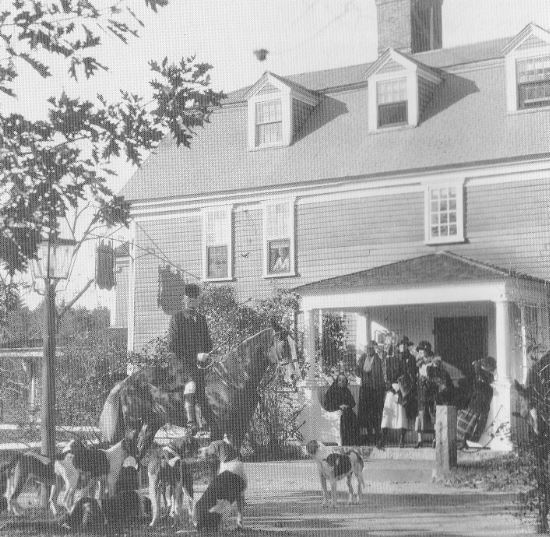
Vaughan developed a great sense of country. He was brilliant at finding clever ways of varying the familiar runs to keep the members interested and guessing and was untiring in his efforts to develop new country. On one occasion the Norfolk Hunt Club overnighted at the historic Wayside Inn in Sudbury, Massachusetts for a joint meet with A. Henry Higginson’s Middlesex Hounds. The Saturday drag hunt took them from the Wayside Inn through Marlboro, Hudson, and Bolton to the Thayer’s in Lancaster and the Saturday evening hospitality there. On Sunday, Henry Vaughan and two other Norfolk stalwarts hacked hounds back to the Norfolk kennels from Lancaster—some fifty miles.
In a 1976 letter to Mrs. John Sheldon, then MFH of Norfolk, Mrs. Evelyn Thayer Burr, age eighty-six, recounted those early days hunting with Henry Vaughan:
“After a run Mr. Vaughan sat majestically on his horse and received. We all paraded up to thank him for a lovely hunt—no matter if we’d had the hell of a ride!
“One day, Lothrop Ames, on a newly imported Irish hunter, collided over a fence with Nelson Perkins. Both being short-tempered by nature, fur flew. Poor Mr. Vaughan was very upset to have members of his field at dagger points, and spent quite some time trying to straighten them out. Of course the rest of us enjoyed it hugely.
“All looked up to Mr. Vaughan…on horseback. And think of the house calls he had to make! A kind man who wanted to give his field a good time.”
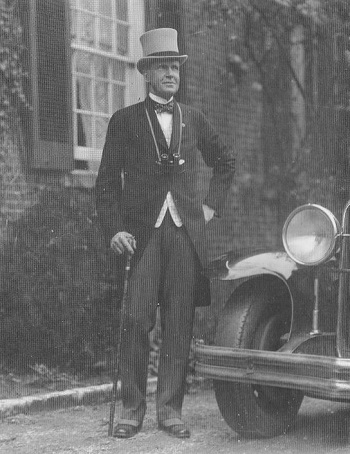
Vaughan’s friend, Richard Ely Danielson, editor of the old Sportsman magazine, wrote of him in the January, 1939, issue of Sporting Life:
“A leader always and anywhere, he shepherded his flock with a gentle, painstaking thoughtfulness. They always knew they could go to Henry, confident that he would give them his unstinted help and cooperation. Not that he was merely a mild apostle—no one who faced or witnessed his righteous wrath could ever forget it. He hated the cheap, the insincere, the selfish, the unsportsmanlike. He was the most democratic of all individuals, a great gentleman.
“At a hunting dinner in New York, Henry Vaughan, to the accompaniment of affectionate laughter and applause, had just finished one of his characteristic speeches. A Virginian brother at one end of the table said thoughtfully: ‘I always think of Henry as the typical New England gentleman, as typifying all that is best in the New England tradition.’ Someone answered him. ‘I know what you mean. But I think you are mistaken. Henry Vaughn is, of course, a great gentleman and entirely a New Englander, but he is not a type or typical of any class. There is only one Henry Vaughan. He is sui generis.’”
Henry Vaughan held the post of President of the MFHA for seven years, until his death in 1938. He suffered a heart attack on board a train to South Berwick, Maine, where he had a home.
Posted March 19, 2018
The material in this article was largely taken from The Norfolk Hunt: One Hundred Years of Sport, Norman Fine, Millwood House, 1995