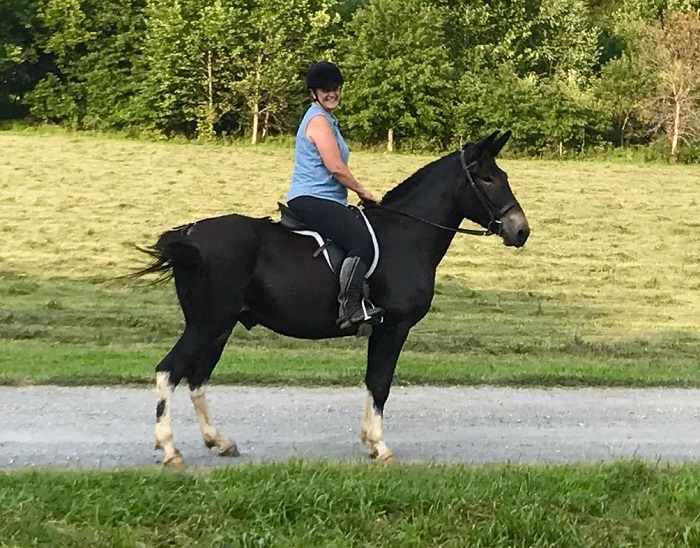
 Moses discovered it was futile to resist.
Fresh Start Farm, both a name and sometimes a working philosophy, is a farm I rent where I maintain my horses as well as boarders. My boarding is limited to retired or laid up horses since I do not want the liability associated with riders on the property. Or the owners, to be perfectly honest. Riding around the farm myself is enough of a liability.
The problem with boarding retired horses is that eventually you lose them to the infirmities of old age. This is what happened to my friend Jan’s big imported Rhinelander gelding Christmas Eve of 2015. JW had been with us for seven years or so before he passed away. The following spring, Jan mentioned that with JW gone she would like to get a rescue. A mule.
Ten minutes after I got home that night I had located two. One a twenty-something mule at Gentle Giants Rescue. The other a five-year-old gelding at a meat broker’s lot. Jan said we would get the “most pathetic.” So in the spring of 2016 the five-year-old black gelding with four high white socks arrived on the farm. In addition to those striking white socks, he also possessed an equally striking weak rear…and won the lottery with both sickle- and cow-hocks. I knew his rear would likely improve some with condition, but those hocks were his forever. When the vet came to do his teeth after quarantine, he said he liked everything “from his knees up.”
He was named Moses after Jan’s husband’s recently departed Jewish grandfather. Moses was extremely friendly and placed in a quarantine pasture. It was a cold spring so he wore a blanket, no doubt his first, without much fuss. He needed groceries and was so lacking in muscle that when he turned he tottered on the edge of falling over completely. His mane was roached and his tail belled, but otherwise he wore the marks of rough handling with a scar from a cable noseband and a curb bit as well as white hair around his dock from a crupper. While giving him a good grooming I found I could easily lift his feet although he was unshod. For twenty-one days of quarantine his job was primarily to eat and rest, both of which he did with gusto.
Although it was obvious he had been doing some kind of work I started from the beginning. Moses had no concept of personal space and the first time I tried to pick up a pile from behind him in the stall with a fork his hind foot shot out so fast I couldn’t believe it. In general he moved so quickly it was intimidating. Bridling and saddling went uneventfully. Lunging was another matter. I have experienced many animals that did not understand the process but never that were so angry about it. Moses charged in at me, kicked out at me, and for the first time in my life I worried that this animal may be too much for me to handle. The whip was the only thing that kept him off me, and a simple touch with it put him into a rage. The look in his eyes was murderous and directed entirely at me. During my long quiet hours at work I surfed the internet watching YouTube videos about breaking mules and training disrespectful equines in general. After getting to the point where I could get one calm circle in each direction on the lunge, I moved on to ground driving.
It was obvious from the marks of wear around his nose and mouth that Moses had been bitted. But when we commenced ground driving it was also obvious that Moses was interested in only one thing. Resistance. Ground driving down the straight farm lane, all I wanted was to stay within the lane and go forward. With mouth gaping open he attempted to bolt, stop, or charge to the left or right. I was finally able to drive him to the end of the lane and back in a controlled fashion. Goal achieved. Anxiety made a quick return; how would I ever steer, and more importantly stop, once I got on?
My first attempt at mounting was probably not the best. Since Moses had accepted the saddle without incident, I simply saddled him up and leaped like a panther from the manger to his back while he was in the stall. During the resulting chaos my mind jumped from fear of dying to fear he was going to leap over the Dutch door and then dying. Not to mention the fear of explaining to everyone from my hospital bed what made me think that was a good thing to do. Luckily with somewhat frantic cries of “whoa” he eventually stopped spinning and I was able to dismount and throw up. Not my best moment.
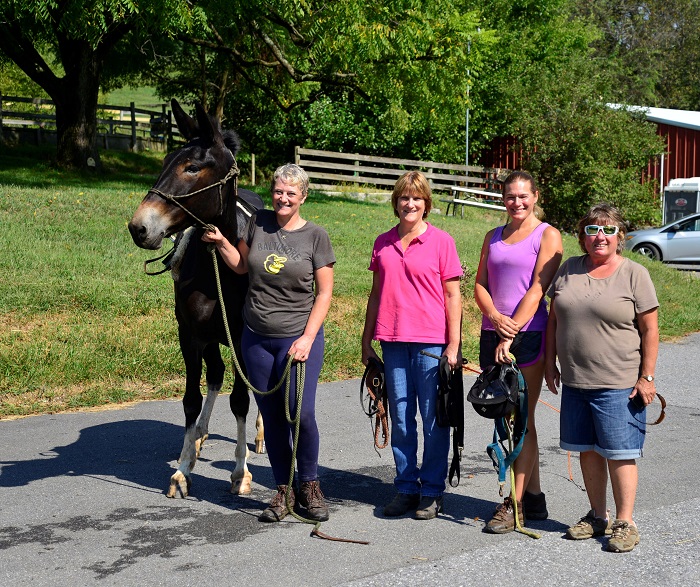 It takes a village.
Due to the way he is put together, my all purpose saddle flaps jutted way too far over onto his shoulders to work. For ninety-eight dollars including shipping I scored a used Wintec dressage saddle off ebay that seemed to leave his shoulders free. Riding in a dressage saddle painfully identified sore muscles in my groin that I previously did not know existed. I believe we hauled him down the road to my friend’s farm three times to use her round pen to prepare for mounted work. Loading alone, I always had one friend helping once I arrived, sometimes more. The day I was lying across the saddle, hubby even came to video the process. Those were unflattering photos depending on which side he filmed from I can assure you. That was the only time he came, finding the noise level produced by us in our collective female enthusiasm to be unbearable. Hubby has an estrogen allergy.
Upon arrival that day, Moses was saddled, then turned loose to B&F (buck and fart). Then came lying across the saddle, proceeding to walking with the rider lying across, then astride. As opposed to the battle of work on the ground, mounted work proceeded quickly and uneventfully.
We always ended up achieving much more than we thought we would. Sometimes he was so unruly that I was not sure we would even get him saddled The biggest problem we encountered was standing tied. Our second trail ride off the farm Moses managed to break either his halter or lead rope three times. Before I could even tack him up. He always came right back to us. He wanted to be with us, just not forced to be. I was learning.
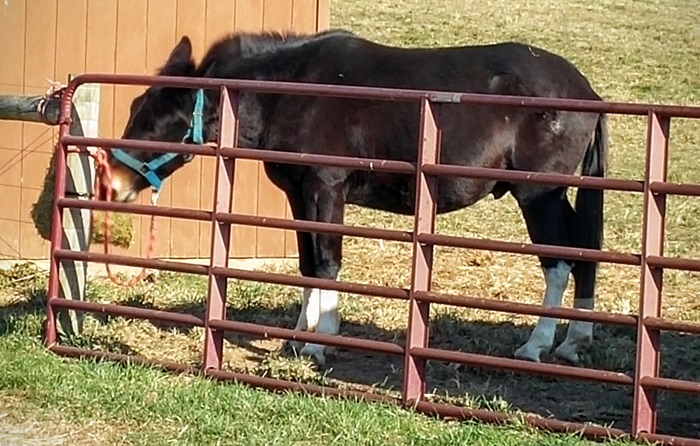 Head-tied to what Lori calls the “patience pole,” Moses studies the knot.
Outfitted with the thickest non-safety nylon draft halter available and tied to a post he spent hours tied while I did chores. He had two choices. He could either continue to fight or eat from the haynet tied to the post filled with chopped forage (at twenty dollars a bag). AKA “horse crack.” The first time he flipped like a marlin on a hook. The vet happened to witness this and said, “You will never get that rope off that post.” I told him it was meant to never come off. And then, and I would swear under oath this is true, Moses studied the knot he was tied with. And that ended any issues we had with tying. It also helped immensely with leading and yielding to pressure in general.
Mounted work progressed exponentially once he was backed. Our first trail ride was scheduled from a friends Thoroughbred farm that backed up to a state park. It also had access to a deep sand ring. Unfortunately we had to navigate the shed row where men ran frantically ahead to close dutch doors to protect their valuable charges when they saw us coming. Moses narrowly missed clocking a yapping Pomeranian into a galaxy far, far away. After watching Moses barrel around the ring and his saddling episode, the rail was crowded with farm employees.
One asked, “But, what are you going to do with him?” My voice may have cracked when I said, “Ride him.” And these are all racehorse veterans who work with fractious and fit Thoroughbreds every day. Friend Darcie, who gallops there, mounted a pony horse after leading me from the ground. She ponied me and then released me to follow in the ring. Everything calm we headed for the trails. Ally, who also gallops at the farm, took the lead from Darcie and rode with me on the pony horse, first leading then just alongside. She looked at me and remarked “Man, you have cojones.”
I am not sure if that made me proud or more scared. Because I don’t consider myself a brave person. Instead I like to consider myself a cautious person. That ride went like clockwork. From that moment, we put as many miles on Moses that we could. Honestly he never put a foot wrong, crossing culverts, narrow wooden bridges, and creeks (jumping the first one). And that was not a big surprise.
I would have to say that despite the fears many have, and I have one friend who will not ride with him, horses either do not notice that he is a mule or mares are besotted with him. Even his bray has not caused any stampedes in crowds. Being a mule has been a non-event where horses are concerned. Like his donkey father, he is very cautious about his footing. Unfortunately he also inherited his donkey sire’s donkey feet. Ally called them “shoe box feet.” From his dam, who we believe was probably a Tennessee Walker, he inherited his movement as well as his terrible hindquarters. Those slouchy hindquarters enable the breed to rock back on their haunches and lighten their fronts for their extravagant gaited action.
Mules are said to be very slow to mature, and in an old US cavalry manual from the 1800s it was said that to try to do anything with a four-year-old mule was futile. And potentially dangerous. To the trainer. You cannot drill a mule the way you can a horse. If you can get one even remotely acceptable effort, move on. Run, do not walk to the next lesson. They have no patience for repetition. Basically everything we asked of Moses prior to backing was a battle. He knew what we wanted him to do. He just was not going to do it. He was a true Jekyll and Hyde who craved human contact yet went ballistic at any hint of direction. He fought each and every hint of restriction.
Now this is just my experience with Moses. It may or may not be typical of mules in general. Never having considered myself a patient person, I am now convinced that I must possess at least a little patience. With Moses you cannot force him to do anything. You must ask, then give him time to think about it. Mules will stop, rather than flee. This tendency to mull things over before proceeding I believe is what has garnered mules a reputation for stubbornness. I find it steady rather than stubborn, and reassuring. He just needs a minute. Moses cannot be rushed or pushed. My approach is to ask and wait. If necessary gently redirect and ask again. A harsh word will stop him in his tracks. He wants to work with you but needs your help to overcome his initial bullish response. How much of Moses’ idiosyncrasies are mule and how much are a response to his treatment in the past, or simply his temperament, I will never know. He obviously is not well bred nor has he been treated with kindness at some point in his journey. Nature versus nurture. It will remain forever a mystery.
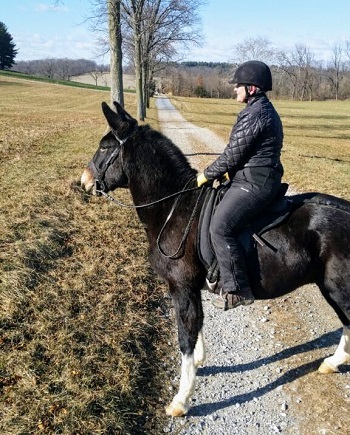 The first-time field hunterMoses hunted for the first time this week on a frigid thirteen-degree day. Always intensely observant, he was all eyes (and ears). He found the hounds fascinating and he strained to touch them. However when asked gently, he backed off. Only one time did he startle mildly when a hound popped out of the hedgerow. After that he always kept one eye and ear in that direction. By comparison, I can say with certainty that at least one of my horses never got used to hounds popping out and reacted to each with the same drama as if it had never occurred before. As if the hounds were aliens dropping from the sky. Moses seemed to understand they could be hidden in there and adamantly refused to let himself be surprised a second time.
I was certainly pleasantly surprised at his attitude out hunting. I was especially worried about keeping him away from hounds. We started out with George, his trailer mate. Moses was intensely interested in the hounds; I do not think his big ears could go any more forward. They probably hurt the day after! He has a fast walk, so we ended up ahead of George and just hooked on to the back of the field. He is perfectly happy being in the back and seems to have no competitive urge to keep up with the horses. Plus the ground was horrific, like concrete. But who knows? Once he figures the game out he may have more of a desire to keep up. On his first day he was perfectly adequate. We even cantered!
On the way in, I was just behind hounds and staff when we came to a creek. The creek crossing was giving the horses fits because it was frozen at the edge. None of them wanted to put a foot on it. Moses just placed one foot on, put his weight on it, and when it broke walked through.
Mr. Smith, who was whipping-in, watched us walk downhill and asked if Moses was gaited. I have often thought he may have been gaited when watching him in the field, but never sure. Mr. Smith said he was “stepping,” so I looked it up. The stepping pace is nearly identical to the pace, except that the hind foot lands a split instant before the same-side forefoot. This eliminates suspension/concussion, and turns it into an imperfectly timed four-beat gait: 1-2-3-4-1-2-3-4. So, apparently he is gaited.
We have slowed his trot down nicely; his canter is still a work in progress. His body goes straight, but head and legs are a different story. Since we started mounting and riding him, he has shown no resistance at all and has come along gangbusters.
Will he ever have the drive and physique to hunt with a really fast moving pack? Maybe not. Perhaps as he figures out the game he will be able to keep up in the second field. Regardless, handling Moses I almost feel as if I am dealing with another person. He needs to understand, and does understand. He needs to be asked. He demands to be treated with respect. His body bears the scars of disrespectful handling, and no doubt when that failed he was discarded into the auction circuit. He has a desire to be with people to a degree I have never seen before with an equine. From an animal that gave me some of my scariest moments, as well as times when I questioned my ability to get through to this beast, as well as my decision to try, he has become a source of constant wonder. After seeing his condition on arrival, Jan had said he did not need to do anything, but we would try. On this journey I am keeping an open mind since he has already done more than we ever thought he could or would. We intend to kick on!
Posted December 31, 2017
Lori Brunnen is a regular contributor to Foxhunting Life. She brightens our pages with her unique brand of humor, observing and sharing those odd, personal moments that resonate with all foxhunters.