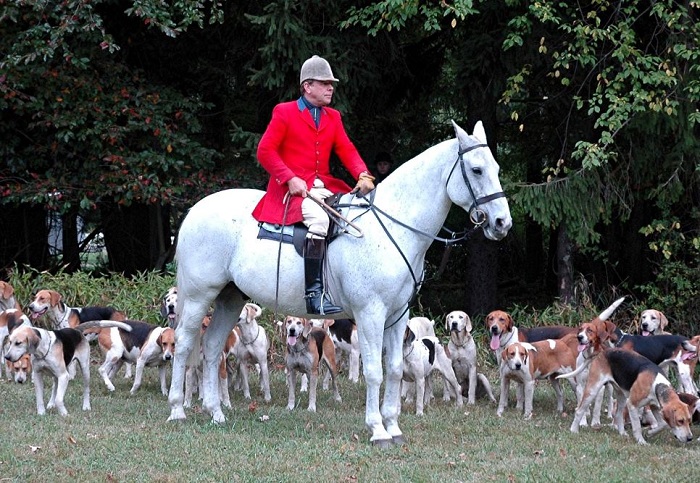
 Hugh Robards and hounds
A reader writes, “We were discussing the proper distance a field of foxhunters should keep between itself and the huntsman. Is there a rule of thumb that can be applied generally? We thought one simple rule might be to keep the same pace and a reasonably constant distance…. so the huntsman would always know roughly where his field is. But would love to hear what the experts say.”
Here is a question for which there can be no simple rule appropriate for all hunting situations. There are too many factors that modify the “appropriate” distance, even during the course of a single hunt.
We asked huntsman Hugh Robards, just retired after a fifty-five-year professional career in England, Ireland, and America, for his opinion. For twenty-seven seasons, Hugh hunted hounds for Lord Daresbury, MFH, at the County Limerick, showing world-class sport to members and foxhunting visitors from all over the world. Even before becoming a huntsman, Hugh whipped-in to some of the most illustrious British huntsmen of the twentieth century, including Captain Ronnie Wallace at the Heythrop and Brian Gupwell, later to become huntsman for the Duke of Beaufort. Hugh writes:
“The question has been asked, ‘How close should the foxhunting field be to the huntsman?’ My one-sentence answer is…as close as possible, providing the the field does not interfere with hounds. There is no simple rule, and different huntsman have differing opinions on this subject. I have always liked to have the field close up so that members can watch and enjoy the hound work, while also observing the huntsman making mistakes at a check!
“For a huntsman to be able to do his job properly and have the field close, it is essential that he has a good Field Master whom he trusts. Not only does the Field Master have to lead from the front, he has to have a certain degree of knowledge as to how the huntsman handles his hounds during the day. He must also, at all times, be aware of the direction of the wind, particularly at a check. The huntsman is not happy if the steam from sweaty horses drifts into the pack.
“It is not always possible, even with the best Field Master, for the field to be up close. The terrain plays a major factor; maybe the country is heavily wooded or perhaps very hilly. Even with these problems a clever Field Master will keep the field in view of the hounds. He does not always have to be on the heels of the huntsman to do this. By paying attention to the wind and by knowing his country intimately, he can get a vantage point, perhaps on a hill, where the field can see or at least hear what is going on.
“If the huntsman is drawing a large, thick covert through which there are but few trails, it is often best for the field not to enter the covert at all. If the fox were to reverse, the huntsman may well find the field blocking his way. The Field Master may more sensibly follow the huntsman’s progress outside the covert on the upwind side.
“Obviously scent conditions play a huge part in the equation, as Mr. Jorrocks explained, ‘Constant only in it’s inconstancy! There is nothing so queer as scent ‘cept a woman.’ The experienced Field Master will soon have some idea of what scenting conditions are like when hounds find their first fox. He will also be aware that scent can change during the course of the day, sometimes with a change in the weather, often as the temperature changes.
“The good Field Master also knows that some areas of land are not as good scenting as others. And there is foil to think of. Land may be foiled by livestock, bonfire smoke, freshly fertilized fields, exhaust fumes from motor vehicles, and many more. The experienced Field Master will recognize situations where hounds might check before it happens, as does the huntsman. When hounds check, he will want to have left the huntsman room to cast his hounds, but still be close enough to let the field see what hounds are doing. He may even be able to get the field onto some high ground for better viewing, yet well out of the way.
“Riding behind hounds on a poor scenting day can actually be most entertaining for those who are interested in watching hounds work. The tenth Duke of Beaufort when hunting hounds on such a day would point out individual hounds to the field that were doing well at a check. He would also try to explain briefly why he thought hounds had been brought to their noses.
“People may think it is easier for the Field Master on a good scenting day. Actually his job is more difficult. Hounds scream away from the first covert into some super country to ride over. Now comes the Field Master’s nightmare; he has not only to keep in front of a galloping field, staying in touch with the hard-running pack, but has also to be aware that hounds could check at any minute or do a sharp turn. To put it simply, he has to be able to pull up the front rank sharply or else they will be on top of the pack, in which case he would have a very unhappy huntsman to deal with.
“I hope that in these few lines I have explained in a small way why there is no set rule as to how close the field should or should not be. Certainly it is a question that is immensely important to the progress of a good hunt, and the experienced Field Master will process all the variables that go into his decision as to how close to follow and where to position the field.
“Much depends on the glorious uncertainty of the day’s hunting. I personally think that the field should be as close as possible at all times providing they do not interfere with the hounds. However, when the field is close to hounds when they check, there should be no talking or laughing to distract the hounds and huntsman. The ancient Greeks believed that talking whilst out hunting was unlucky. If Lord Daresbury saw two people talking at a check, he would comment that at least one of them knew nothing about hunting!”
Posted December 13, 2017