An historical thread runs back in time from the Potomac Hunt (MD) to the Washington Riding and Hunt Club (est. 1913) to the Chevy Chase Club (est. 1892) to the Dumblane Club (est. 1885) to the Washington Hunt (est. 1828). Only the Potomac Hunt and the Chevy Chase Club survive. The latter is celebrating its 125th Anniversary, and the Potomac Hunt was there with horses and hounds on October 1, 2017 to mark the occasion. What follows is taken from the remarks of Knight Kiplinger, who explained the club’s foxhunting roots to its current members.
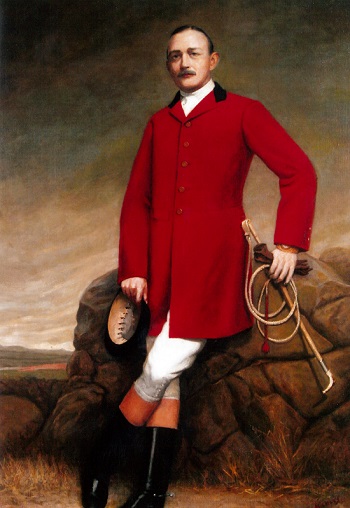 Clarence Moore was MFH of the Chevy Chase Club from 1899 to his death in the waters of the Atlantic in 1912. “A man of staggerying wealth,” Moore was bringing foxhounds back from England when the Titanic struck an iceberg and sunk. He perished after remaining aboard to help women and children into lifeboats. / Image courtesy of the Chevy Chase ClubGood morning. I’m Knight Kiplinger, and it is my privilege to be a member of both the Chevy Chase Club and the Potomac Hunt, which are collaborating today in presenting this exhibition of foxhunting here on our Club grounds. The reason that our celebration with horses and hounds is so appropriate is because the Chevy Chase Club was first founded as a foxhunting club.
Not as a golf club, like Washington Golf in Arlington, which is two years younger than we are but was founded for golf. Not as a tennis club, although tennis came to Chevy Chase in 1895, just three years after our founding. Our club was founded by gentlemen members of the Metropolitan Club downtown, who rode horses for pleasure and for sport. For the first three or four years after the Club’s founding in 1892, its sole activity was riding to hounds across the vast expanses of rural northwest D.C. and Montgomery County, Maryland.
I’d like to take you now through a brief history of the Chevy Chase Hunt and its successors, derived largely from the remarkable 1960 memoir, The Old Days with Horse and Hounds, written by one of our earliest members, Samuel J. Henry.
The first public notice of the founding of our Club was a story in the December 1892 issue of The Rider & Driver magazine. The title of the story was “Washington’s New Hunt Club,” which was “to be known as the Chevy Chase Club.” Other news stories over the next decade or so—in The Evening Star, Washington Post, and sporting papers—referred to our club variously as The Chevy Chase Hunt, Chevy Chase Hounds, and Chevy Chase Hunt Club. That first story said, “A swell hunting club has arisen in the wake of the old Dumblane Club.”
Our new hunt club was founded for two reasons: (1) because the previously most fashionable foxhunting club, the Dumblane Club in Tenleytown, had folded the year before (1891) after a six-year run, and the members missed having someplace local to enjoy their favorite sport; and (2) because the newly formed Chevy Chase Land Company thought a hunt club would be a fashionable amenity for its new housing development. After all, everyone who was anybody in Washington at that time—socialites, diplomats, members of Congress—rode to hounds.
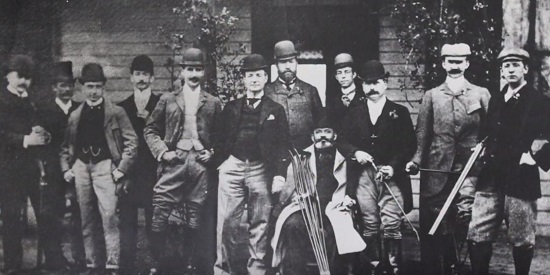 Image courtesy of the Chevy Chase Club
The land company’s founder, Senator Francis Newlands of Nevada, himself a foxhunter, would lend the new hunt club one thousand dollars to get started, plus its first premises—not where we’re standing today, but at a one hundred-acre farm west of here. Newlands—a lawyer who had married the daughter of Senator William Sharon who controlled the Comstock Lode silver mine—would be a co-founder of the new club. (That first home of our Club, Belmont, in west Chevy Chase would eventually become the first Bannockburn Golf Club, and later the Kirkside golf course.)
A postscript on the Dumblane Hunt Club: Its clubhouse was in an 1818 residence, the structure of which is still standing on the grounds of the new American University Law School, near 42nd and Warren Streets, NW. The hunt met nearby under an enormous oak tree, the Dumblane Oak, that is still standing in the back yard of our esteemed nonagenarian member, Ruth (Mrs. Wiley T.) Buchanan, at her home, “Under Oak,” on Nebraska Avenue.
That first news account of our Club’s founding reported that the club would be a “country club with a hunting element.” But the concept of a “country club” was still taking shape in America at the time, and it’s unclear what the members would actually do and play at in the countryside of Washington, D.C.
Golf? As our first club historian, John Lynham, Sr., wrote in 1958, “It is clear that our organizers had no thought of laying out a golf course.” That game wouldn’t appear for three more years, when six holes were opened in the fall of 1895.
Tennis? It seems that a court was laid out by 1895, because in that year the board of governors approved the purchase of some tennis balls.
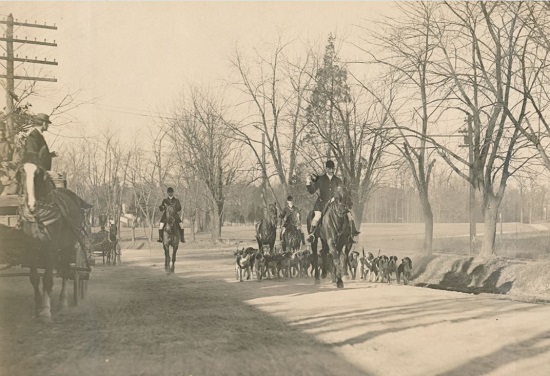 Image courtesy of the Chevy Chase Club
At its founding in 1892, the primary purpose of the Chevy Chase Club was equestrian sports of all kinds, especially foxhunting. The founders had very ambitious—and overly expensive—plans that included a three-quarter-mile racetrack and a huge, formal clubhouse with a grandstand facing the racecourse. But the racetrack wasn’t built at all, and our present stone clubhouse not until 1911. The infield of the racetrack would be so big, the founders told Rider & Driver magazine, that it could accommodate cricket, tennis, and football! Since the racecourse wasn’t built, neither were the facilities for these sports—except tennis elsewhere on the site.
With tennis and golf just beginning to take hold in America, most of our earliest members were passionate horsemen (and horsewomen, riding and foxhunting sidesaddle). Foxhunting flourished, with the pack of hounds kenneled right on our club grounds for fourteen years. Hunts were both live and drag. The Chevy Chase Hunt even imported and kept at here at the Club two Irish stags—not drunken bachelors, but large male deer with broad racks of antlers. The huntsman trained these stags to run off with a long head start, lead the Chevy Chase Hounds on a wild romp across southern Montgomery County, and come back home to the Club later in the day, surviving the hunt to be released and chased another day.
Beginning in 1902, our Club also held horse shows and jumping classes in a big ring across Connecticut Avenue from our property, where the Morgan family of our Club would build their large home.
The Club had a polo team, too, which played matches down on the Mall (reputedly with little distinction), between 1894 and its discontinuation in 1916.
One of the leading forms of recreation in Washington at the turn of the twentieth century, enjoyed by the social glitterati and the common man, was watching horseracing at Benning’s Race Track, near present day Kenilworth Avenue east of the Anacostia River in far Northeast D.C. The most glamorous event at Benning’s each year was the running of “The Chevy Chase,” a steeplechase event open only to Chevy Chase Hunt riders and owners (who, after all, owned the top Thoroughbreds in the region).
A key annual social event at every hunt club is a white-tie hunt ball, where gentlemen members appear in their scarlet tailcoats with collars displaying their hunt’s colors (in the case of the Chevy Chase Hunt, a black collar on the scarlet coat). The Chevy Chase Hunt’s second hunt ball, in 1893, was held at the elegant Wormley’s Hotel at 15th and H Streets, N.W., founded and operated by the city’s prominent African-American hotelier and caterer, James Wormley.
In 1906, as Chevy Chase Village became built up, neighbors began to complain about the baying foxhounds. About that time, Chevy Chase MFH Clarence Moore bought a big place up in Kensington—Rock Creek Farm, the location of the Rock Creek Hills neighborhood today, along Saul Road—and he moved the kennels and stables there. Throughout Moore’s Mastership of the hunt, his huntsman was the very talented Robert M. (Bob) Curran, who learned to handle hounds and horses as a teenager in Tenleytown, working first at the Dumblane Hunt.
Moore was a man of staggering wealth due to two propitious marriages to heiresses. He came to Washington from West Virginia in his twenties, and worked as a stockbroker at W. B. Hibbs and Co., a leading local investment brokerage that later merged into another major D.C. firm, today’s Folger Nolan Fleming Douglas. His first wife was the daughter of a Philadelphia printer and newspaper publisher, Frank McLaughlin. After she died, Moore married one of the richest young women in America—Maybelle Swift of the Swift meatpacking family in Chicago.
They lived large, including building a vast and ornate Embassy Row mansion at 1746 Massachusetts Avenue, NW. (Subsequently the embassy of Canada, it again changed hands and is now the embassy of Uzbekistan.) The mansion cost more than two hundred thousand dollars in 1909, and was designed by Moore’s fellow Chevy Chase Club member Jules Henri de Sibour, the French-American Washington society architect who also designed our new (and present) main clubhouse in 1910-11.
The Moores divided their time between Embassy Row, their Kensington farm, and in the summer their country estate, Swiftmoor, in Prides Crossing, Massachusetts, on the North Shore of Boston.
At Rock Creek Farm, Clarence Moore had a staff of twenty tending to as many as ninety hunting horses and, at one point, a pack of 240 English foxhounds. From the stables and kennels there, Moore and Curran led the Chevy Chase Hunt on chases all over our region, down into D.C. (in Tenleytown, Brightwood and Rock Creek Park) and across lower Montgomery County through Silver Spring, Wheaton, Forest Glen, Colesville, Garrett Park, Rockville and Potomac. The Chevy Chase Hunt also ventured into Virginia, hunting in Langley, Falls Church and Great Falls.
But by 1911, with the increasing suburbanization of our county, foxhunting was beginning to fade at Chevy Chase. When Moore went to England that fall for the English hunting season, he was also looking to buy more English foxhounds—not for our pack, but for the Loudoun County Hunt (VA).
The hounds arrived in America that spring, but Mr. Moore didn’t. Befitting his wealth and social standing, he booked his return to the States on the biggest and most opulent new ocean liner…the Titanic. He was one of 1,503 passengers who perished in the cold seas of the North Atlantic that April night in 1912. However, he acted gallantly in helping women and children into the lifeboats, it was later reported by survivors. His hounds arrived later on a lesser ship.
Mr. Moore’s full-length portrait—which he commissioned and gave to the Club well before his death–hangs in the grand salon of our Clubhouse, over the mantelpiece.
Clarence Moore had been MFH of the Chevy Chase Hunt for thirteen years, from 1899 until his death. He was its driving force, and after his death the hunt limped along for another four or so years. The Chevy Chase Club extended privileges to members of the Washington Riding and Hunt Club, at 22nd and P Streets, NW, which hunted in Rock Creek Park and Montgomery County. But the following year, in 1916, the Chevy Chase Hunt suspended operations, and its riding members joined Washington Riding and Hunt Club.
By 1930, needing more open land to continue foxhunting, the Washington Riding and Hunt Club moved its hounds and horses to a farm near River Road and Bradley Boulevard, between Bethesda and Potomac. It eventually became today’s Potomac Hunt, which, from its clubhouse, stables and kennels near Barnesville, continues to foxhunt across upper Montgomery County, up to the Frederick County Line. I hunted with the Potomac Hunt as a teenager in the 1960s from our farm, Montevideo, in Seneca, and my late father, Austin, continued foxhunting with Potomac into the 1980s, when he was in his seventies.
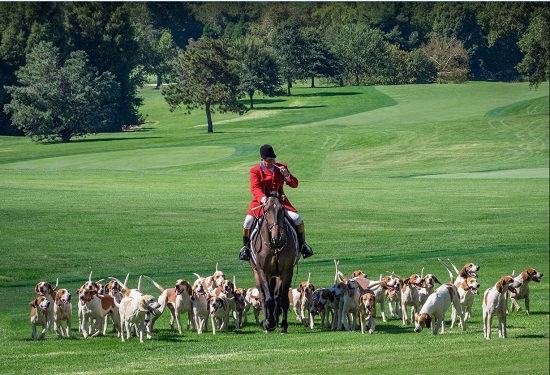 Click the image for a slide show of the 125th Anniversary Hunt Breakfast with members of the Potomac Hunt and the Chevy Chase Club. Here huntsman Brian Kiely brings hounds and riders to the celebration at the clubhouse. / Photo by Pat Michaels
We’re honored to have with us today the staff, hounds, and some members of the Potomac Hunt–the final successor, 125 years later, of our Chevy Chase Hunt. Our deep appreciation to the four Joint-Masters of the Potomac Hunt, Skip and Vicki Crawford and Dick Hagen, who are with us today, and Beverley Bosselmann, who is out of town.
We will now raise a toast to our two Clubs with a stirrup cup. Please join me in one such toast:
To endless years of hounds’ sweet cry,
To thundering hooves, and foxes sly.
We raise a glass to the life we love,
For grass below and sky above.
To the horn that calls us all back home,
To aching muscles, weary bone.
God bless this hunt and every friend.
May hounds run ever o’er this land! *
And a toast, too, to the Chevy Chase Club in its anniversary year. And now, if you look out across our golf course, you will see coming toward us the prize-winning pack of American foxhounds of the Potomac Hunt, guided by huntsman Bryan Kiely, whippers-in Catherine Hanagan and Lindsey Kiely, and Vicki Crawford. Please welcome our friends from the Potomac Hunt!
Posted October 12, 2017
* “A Foxhunter’s Toast” (abridged) by Carla Hawkinson, ex-MFH, Tennessee Valley Hunt
Click for the video of the celebration and for Mr. Kiplingers remarks.
Knight Kiplinger is head of the Kiplinger financial media interests in Washington, DC and serves as editor-in-chief of the company’s publications. He is the author of several books, a frequent TV guest, and public speaker on topics of economic outlook, politics, investments, and ethical business management.