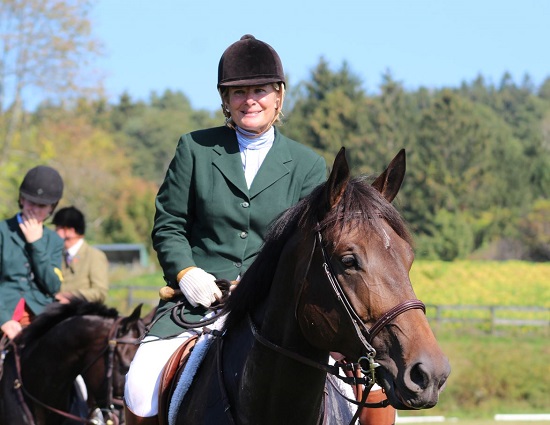
 Nancy Stahl, MFH, and her Joint Masters Parker Gentry and Lelee Brandt welcomed visitors to the gorgeous Millbrook country and made certain everyone was happy to be there. / Karen Kandra Wenzel photo
Foxhounds from five hunts faced off for the second Performance Trial of the Hark Forward season. The trials were hosted by the Millbrook Hunt in their scenic and mountainous country in the Hudson River valley of New York State, just ten miles west of the Connecticut border, ninety miles north of New York City.
Hounds met on Monday and Tuesday, September 25 and 26, 2017 under conditions reminiscent of mid-summer rather than the early days of autumn. Temperatures rose well into the eighties on both days as riders sweltered and hounds struggled to find quarry in the usually productive coverts. Yet hounds worked as a veteran pack and displayed outstanding work during their brief moments of action.
Each competing hunt had selected the seven-and-a-half couples of hounds from their kennels to best represent them. The thirty-seven-and-a-half couples of proven hounds melded quickly into a single pack (more about that later), reflecting positively on every huntsman: Bart Poole from the Essex Fox Hounds (NJ); Marion Thorne, Genesee Valley Hunt (NY); Codie Hayes, Golden’s Bridge Hounds (NY); Don Philhower, Millbrook Hunt; and Sean Cully, Rose Tree-Blue Mountain Hounds (PA).
On Sunday evening, a welcome dinner for visitors and the meeting for judges was held at the home of Millbrook member Stephen Blauner. I was told the retired Wall Street lawyer entertains by employing chefs from the CIA. Huh? No, not that CIA, the Culinary Institute of America, a training school for some of the worlds best culinary professionals, the campus of which is situated in nearby Hyde Park. Some hospitality!
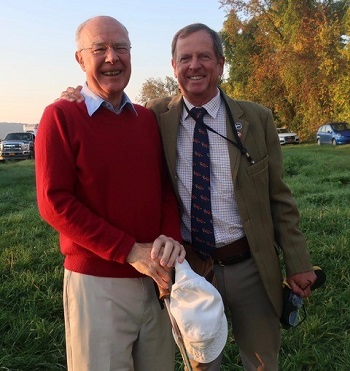 Farnham Collins, ex-MFH, Millbrook, and Epp Wilson enjoy a reunion. / Barbara Smith photoAfter a succulent dinner, Epp Wilson, Performance Trial Chairman for this season’s Hark Forward tour reviewed scoring procedures for the judges. Visiting trial huntsman Charles Montgomery, professional huntsman for the Bull Run Hunt (VA), instructed competing huntsmen how he wanted to organize the pack the next morning. Since the first foxhound performance trial was organized by MFHs Ben Hardaway and Mason Lampton at Midland twenty years ago, no huntsman has served as trial huntsman more often than Charles.
Epp and Charles have been there through all the hound trial growing pains and each have played major roles in figuring out the best scoring procedures for judges to make the competition a fair and valid test of the individual pack hound. Truly, there is no better method than the foxhound performance trial as currently constituted to comprehensively assess the hunting abilities of foxhounds in the field.
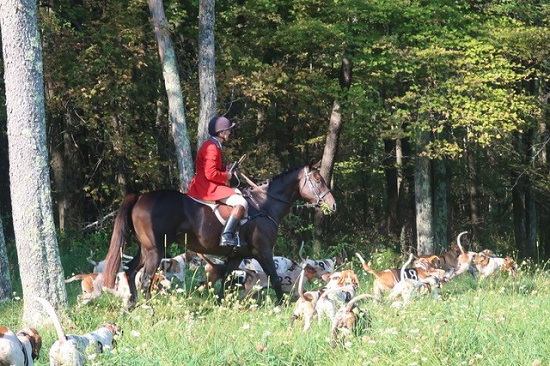 Trial huntsman Charles Montgomery has a twenty-year history hunting hounds in performance trials. / Barbara Smith photo
One thing Charles always wants to do is to find game—any acceptable quarry—as quickly as possible on the first day of hunting. “That’s the best way to meld a group of hounds that don’t know one another into a single pack,” he says. An early find was not to be, however, on this first day of hunting.
In fact the favorite coverts were drawn blank for the first two hours, sun and temperature climbing all the while. Yet that evening Charles was able to tell the dinner crowd that in all his years of trial hunting, this group of hounds melded into a pack faster than any in his memory. It took no more than ten minutes and, with the whippers-in counting hounds frequently, all hounds were there every time they checked. By way of explanation, Charles gave special credit to the five huntsmen who had bred, trained, and brought hounds that were steady, had been well-handled, and were ready for business.
“We brought them together in the trailer just before the meet,” said Charles, “I went in to spend some time with them. I looked and you would have thought they were all of a single pack of hounds. They looked like they could have all been bred by the same huntsman. They stayed together hunting, and acted just like a pack from the start. I’d have been happy to take the whole pack home with me.”
Charles was graciously given leave by the Bull Run Masters to come to New York State and be trial huntsman at Millbrook. Charles’s wife and whipper-in Boo Montgomery remained behind at Bull Run to hunt hounds in his absence. Evidently, Boo showed some decent sport over the weekend as Charles received an email in New York assuring him he need not hurry back!
The first hours of Monday’s hunt were non-productive, as hounds moved from covert to covert and the temperature rose oppressively. The views from the tops were spectacular, revealing the Catskill Mountains in the distance, far across the Hudson River to the west, but game was not to be found. After two hours, hounds finally found a bobcat in a large cornfield and ran it in full cry in the corn for twenty minutes. Most of the large field of seventy-six foxhunters retired to the shade of the woods and listened to the music.
Scoring opportunities were meager for the judges, the action mostly invisible in the impenetrable cornfield. Hounds did own the line, and their pressure as a pack finally pushed the bobcat out of the corn. It streaked into a tight, brambly area no more than forty feet away from the cornfield which led to a swamp. Those lucky few in the right place had a brief view of the bobcat followed by the entire pack in full cry. The judges who were there recorded their scores of the chase for the brief seconds it lasted before hounds and bobcat were once again out of sight. Judge Sean Cully was there.
“I decided to stay put when hounds and staff started running to the east,” said Sean. “Then something came out of the corn at me. It was big…looked like a Boxer dog, but then I saw the tail and I knew!”
The bobcat was lost in the swamp eventually, and Day One was history.
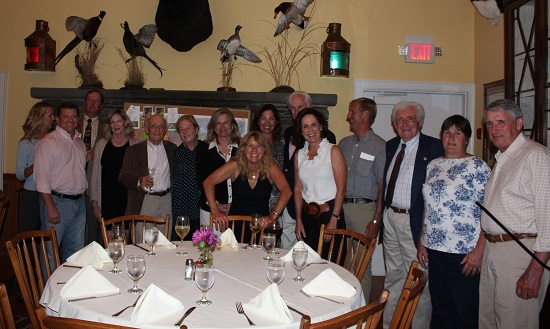 Judges, Masters, and officials (l-r) are Judith Craw, Jeb Blount, Epp Wilson, Barbara Smith, Norm Fine, Jean Derrick, Nancy Stahl, Laura Sloan, Parker Gentry, John Ike, Lelee Brandt, Charles Montgomery, Dick Verrilli, Marion Thorne, Don Philhower. / Karen Kandra Wenzel photo
Dinner that evening was served at the Tamarack Shooting Preserve, and the first day’s scores were announced. Cocktails were enjoyed in a clubby lounge and bar, after which a marvelous dinner of beef Bourguignonne was served to us hundreds seated in a large dining room surrounded by wall-mounted big game trophies from all over the world…including a moose, the size of which would have intimidated Paul Bunyan.
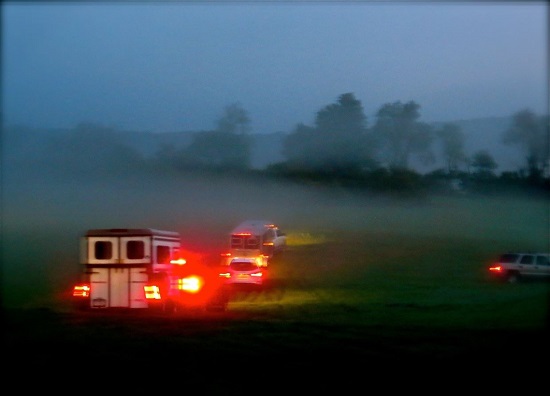 Day 2 was scheduled early to beat the heat. / Patricia Ike photo
Tuesday proved to be a similarly difficult hunting day. The pronounced lack of quarry was baffling to hounds, staff, and the field of fifty-seven riders as they crossed the beautiful, expansive country—some cultivated, some wild, often hilly and steep. Again, hounds worked for nearly two hours before coming upon the drag of a fox. They struggled to hold the scent up and over a large wooded hill. I was fortunate to be driven about for two days by Farnham Collins, retired long-serving Master of Millbrook who knows every square inch of the country, every landowner (we drove everywhere), and also knows how the quarry runs. After determining by radio the direction hounds were headed, Farnham skirted the big hill by road, turned onto a gravel road, and parked. Pointing ahead, he said, “The fox often crosses by those last two telephone poles.”
Sure enough, we soon saw a couple of hounds emerge from the wooded hill onto the road. Walking quietly, I could see just two hounds cross the road. Number 51 put its nose down and worked the verge on the far side. I scored it for Hunting and recorded the time. The rest of the pack were not yet in sight, but we could hear them approaching. The other hound joined Number 51, put its nose down briefly, but soon re-crossed the road to where the rest of the pack was arriving. Number 51, still on the far side of the road, was becoming more enthusiastic, working deeper into the woods, nose to the ground, now feathering energetically. It lifted its head, spoke confidently, and continued working out the line. I scored it for Trailing and recorded the time. By this time other hounds had harked to Number 51, added their voices, and began to run the line deeper into the woods. Damned if it didn’t look like they were about to be off and racing, but scent just didn’t hold.
I just love the hound that recovers the line and sets the pack straight. To me, it’s the most valuable hound in the pack. It’s the hound that can make the difference between a loss and the slow walk back to the meet, or an extended and exciting hunt. It’s the hound that often saves the day at a check after the faster running hounds have flashed over the line and thrown up their heads in confusion. This paragon then comes along in a workmanlike fashion and has the fox sense to know where to look first and how to cover the ground efficiently. It speaks with authority and puts the rest of the pack right. I love to watch a hound like that work, and though I spent altogether about seven hours over the two days watching and listening for hounds, those few moments fulfilled all expectation. The huntsman, I suppose, sees such beautiful hound work all the time, but for us field members it’s always a treat.
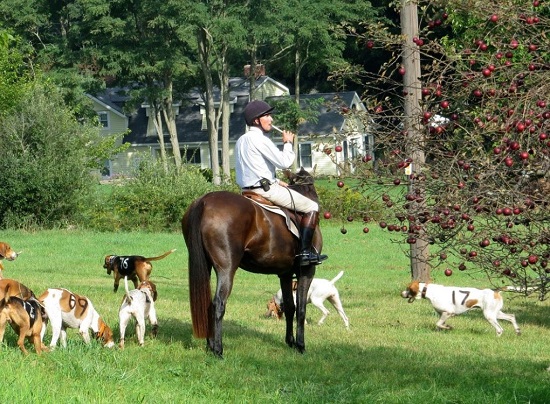 Charles Montgomery collects hounds on Day 2. / Patricia Ike photo
Later, at breakfast, before awards were announced, I related my story to Charles Montgomery, because most of Number 51’s solo work was done just before he arrived with the main body of the pack. Charles smiled, nodded, and said, “Number 51? Yes, she’s my pick for Huntsman’s Choice.”
Ribbons and Championships were awarded at the final hunt breakfast. Mounted judges, in addition to the five huntsmen listed above from the competing hunts, were: Chairman Epp Wilson, MFH and huntsman, Belle Meade Hunt (GA); Jeb Blount, whipper-in, Belle Meade; John Ike, ex-MFH, Millbrook who, with his wife Pat hosted your editor at their lovely old farm; and Laura Sloan, experienced judge and professional trainer now living and hunting in the Millbrook country in the employ of Millbrook ex-MFH Dick Verrilli. Performance Trial Manager Jean Derrick, Field Master from Belle Meade ran the scoring program with the assistance of Barbara Smith from Bull Run.
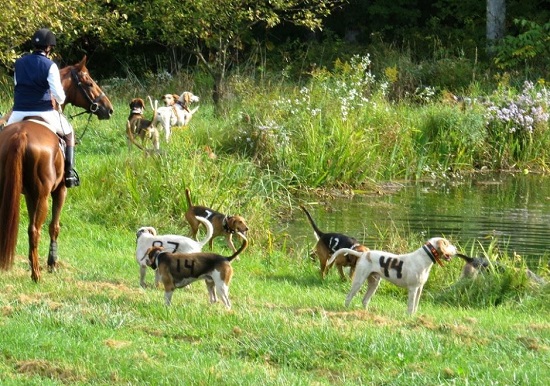 Performance Trial Champion Essex Oatlands (right) cools off briefly with the pack during Day 2. / Patricia Ike photo
The overall top-scoring hound and Champion was Essex Oatlands. Reserve Champion was Genesee Valley Tempo (Number 51). The top ribbons for hunt rankings went to (First) Genesee Valley, (Second) Rose Tree-Blue Mountain, and (Third) Essex. Click for complete scores for all hounds, both days, and overall.
Really folks, think about joining the Hark Forward tour for a least a portion of the season. See new country, old friends, make new friends. Whether Performance Trial, Horse Trial, or Friendship Meet along the way, you’ll find that every host hunt does its utmost to provide the best of sport and hospitality. Certainly, Millbrook Masters Nancy Stahl, Parker Gentry, and Lelee Brandt managed everything they could possibly control to keep everyone happy just to be there.
Posted October 2, 2017
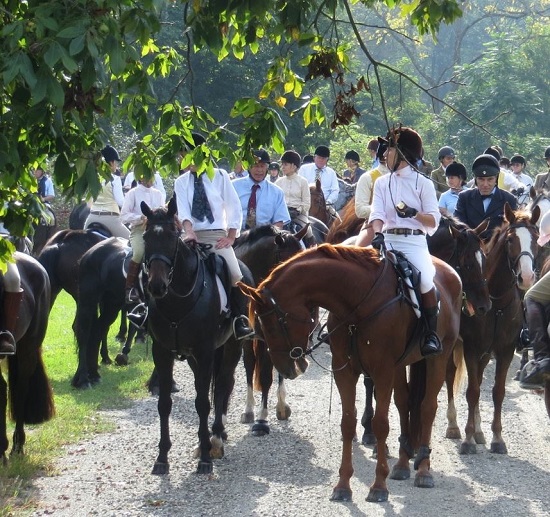 The large field includes Millbrook members, competing hunt members, Masters from several hunts, and visitors on the Hark Forward tour. / Patricia Ike photo