
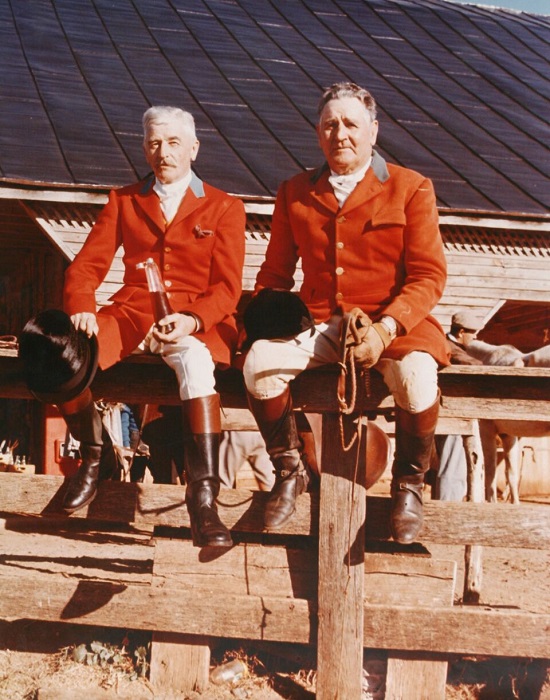
 (l-r) William Faulkner and Farmington huntsman Grover Vandevender share a flask. / George Barkley photo
William Faulkner, two-time National Book Award, Nobel Prize, and Pulitzer Prize-winning author, came to Charlottesville, Virginia from Oxford, Mississippi in the last decade of his life. He arrived two years after his daughter Jill moved to Charlottesville with her husband Paul Summers, who graduated from law school at the University of Virginia and was working as city attorney. Soon, Faulkner, Jill, and Paul were hunting with the Farmington Hunt. Jill would become Master in 1968 and serve in that capacity for forty years.
Faulkner had a reputation among hunt members for being game and fearless to his fences, despite having taken up serious foxhunting only since his arrival. He’d ridden since childhood, foxhunted in Tennessee, and loved it. However, he experienced a couple of serious riding accidents, and died in 1962 at the age of sixty-four from complications arising from a fall.
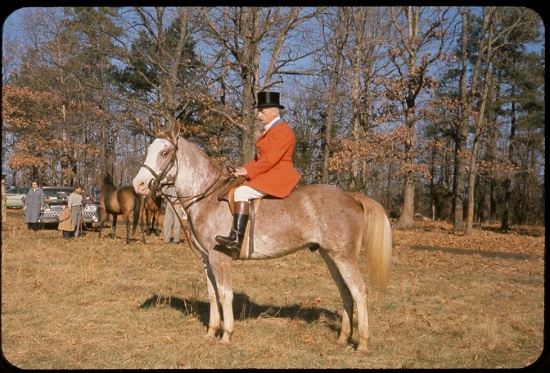 William Faulkner riding Quilter, one of Grover Vandevender’s hunters. / George Barkley photo
In April, 1956, Faulkner had accepted an invitation to become writer in residence at the University of Virginia. He began his work there in February, 1957. Faulkner and his wife Estelle had many incentives to make the move from Oxford, not the least of which was to spend more time with their daughter and to enjoy their new role as grandparents. With the birth of their first grandchild in 1956, the Faulkners were spending increasing amounts of time in Virginia to be near their new expanded family. Jill found a house for her parents on Rugby Road, a short walk from the university grounds.
The Summers rented a cottage on a horse farm as newlyweds and soon became part of the local horse community. Faulkner became a familiar face in the neighborhood, enjoying precious anonymity that had become increasingly difficult at home in Oxford. Having graced the covers of Time and Life magazines, he was famous as an internationally celebrated author and a much sought-after spokesman during the civil rights struggles of the time. At the University, he could walk across the grounds without being bothered; in class he interacted with students and fellow professors with ease; and in the hunting field he was treated as just another rider.
Jill and her father both loved horses, hunting and the land, having enjoyed riding all their lives before ever coming to Virginia. The family owned a farm outside of Oxford, had bird dogs and quail hunted. Faulkner had grown up around horses. As a child, his father owned a livery stable. According to biographical accounts he loved riding so much that he found a way to incorporate riding even while playing baseball with his brothers, navigating the bases on ponies. He bought Jill her first horse while they were living in California in 1944, and the love of owning horses and enjoying riding with his daughter was a profound source of pleasure and pride.
Jean Winslow Craig was an undergraduate student and attended one of his classes in American Literature in 1957. She remembered, “He came in to the class, and the first thing you noticed was how small he was! We were all seated at desks and when he came into the room it seemed like he was almost eye level with the students—couldn’t have been more than about five-feet-three. He had wonderful hair I remember—lots of it, too,” she recalled with a chuckle. “He was very dapper, always dressed in a tweed jacket and tie, and very soft spoken. Few people we knew actually read his books, because unless you were taking a class or something, they were hard to read! Socially, or out riding you just did not talk about his work.”
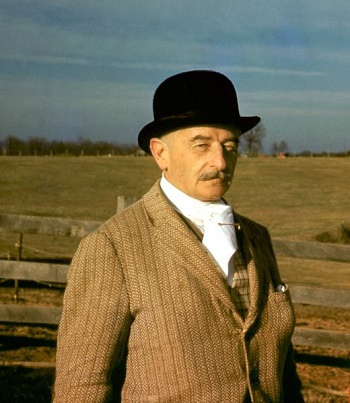 George Barkley photoKnown for his attention to dress, Faulkner always wore a coat even in hot summer weather. Long time Farmington Hunt members and Charlottesville natives Bobbie and Sam Wells met Jill and Paul through mutual friends soon after they moved to town. “We lived in the neighborhood, and I helped them find their first house,” recalled Sam, a retired real estate agent. Starting in the late 1950s Bobbie was teaching riding out at Fox Fields, a popular riding stable that was run by Grover Vandevender, the legendary huntsman of the Farmington Hunt who became one of Faulkner’s favorite people. “We would go by and pick [Faulkner] up to go riding early in the morning, six o’clock,” said Bobbie. “He would be standing out on the curb, dressed in a wool tweed coat and derby hat.” Sam noted that in those days, riding out cross country was centered primarily around Fox Fields (now known as Foxfield). “There were plenty of good, safe riding and hunt horses provided by Grover and his helpers, and riding was fun!”
Riding was a socially inclusive activity enjoyed by men, women, and children of all ages who belonged to the Buck Mountain Riding Club. George Barkley (real estate agent and photographer) was president of the club and also Master of both Farmington (1957-1958) and the Keswick Hunt. Sam recalled, “[Dr.] Harry Hyer [the local family physician who helped care for Faulkner], Luddy Ludwig [professor in the education school], Buddy Shoaf, Bobbie and I, George: we all rode out and you could go anywhere. Will Faulkner was just another member of the group, but you were told, or you just knew, that you just never talked shop, and you did not ask him about his work. Landowners were part of the horse community and we did lots of galloping…jumping coops, going everywhere without any worries at all about having special permission. All the gates were made easy to open [from horseback]. You could go anywhere. It was great fun!”
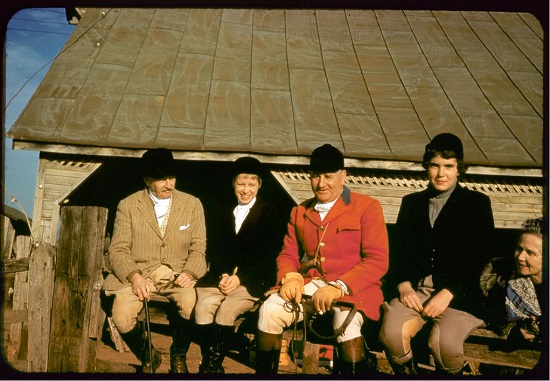 Some of the Fox Fields gang: (l-r) Faulkner, Bobbie Wells, Grover Vandevender, Mary Jordan (daughter of a medical school professor, and unidentified. / George Barkley photo
Missy Haffner Sanford, granddaughter of Berta Jones, one of the first Farmington MFHs, remembers a day when she was nine or ten. “I was going to ride in a pony race at Camp Town [in Ashland VA], and Mr. Faulkner rode with us in the car going down there. I was scared to death. I had never ridden in a pony race. I was going down there on my own. My parents were off doing something else that day, leaving me to go with their friend Ellen Craddock who drove us. Grover had taken the ponies on ahead. Anyhow, there I was in the back seat, not saying a word. Mr. Faulkner was so kind to me. He was telling me stories and reassuring me that everything would be okay. I will never forget how gentle and sweet he was. When we got there, Grover had the ponies waiting for us, and Sam [Wells] helped me get ready for the race, and it all turned out fine, just like Mr. Faulkner said it would. We were all just part of the Foxfield gang and everyone looked out for each other!”
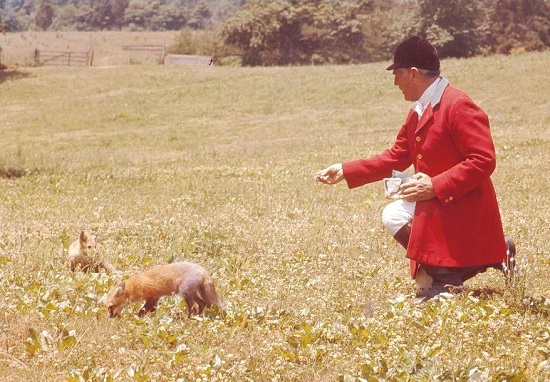 Grover Vandevender could charm even the foxes. / George Barkley photo
Grover was a dedicated hound man and a colorful character with a special way with animals. He tamed a family of foxes that lived near the barn at Foxfield, and George Barkley captured his feeding the fox cubs in wonderful photos taken during Faulkner’s time at Farmington. Stories about Grover and his horse trading and foxhunting prowess are well documented. His charm extended to the people who rode with him, including Faulkner. I met Grover while I was a student at UVA in 1970. Jill was in the early days of her Mastership, and Grover still came out to almost all the meets on foot, walking with a cane. I took a class in Southern American Literature reading Absalom, Absalom at the time, doing research for a paper. I was curious about Faulkner and his life here. After asking one too many questions, my landlady, a neighboring landowner as well, introduced me to Grover. We sat on a bench in front of his store, which is now known as “Hunt Country Store,” in front of the old Farmington Hunt Club house on Garth Road. I asked him to tell me about Faulkner’s riding.
“Before they came here, he rode those shaky tail horses,” Grover said, referring to gaited horses popular in the deep south plantation country. “He knew about hunting, bird hunting down there.” Grover said that Jill and her father learned to ride a little differently in Virginia, and to jump fences so he could follow hounds.
Grover had a motley crew of unforgettable staff to assist with teaching lessons and training the horses—Jessie Matthews, a much loved, long suffering, and mostly illiterate single mother and her two children, Mason and Jean, who lived and worked at Foxfield taking care of both barn and household chores, and Clarentine Collier, who hired on for a reasonable wage during his years as a prison parolee serving a jail term for murder, worked as a groom, training assistant, and driver in the late 1950s. Faulkner and Clarentine had a close bond, according to Sam and Bobbie Wells. “Clarentine loved Mr. Faulkner and looked out for him, took care of his horse, and made sure things went right. Always called him Mr. Will, and he was always Mr. Collier to Faulkner,” said Bobbie.
I remember meeting Clarentine for the first time when he brought a truck load of hunt horses out to a meet—an impressively tall and powerfully built man with swept back grey-blond hair and a gruff manner with the horses. Bobbie explained that although he never rode, he had a good eye and was a good ground man who helped in the ring and doing everything around the barn. Faulkner enjoyed his leisure time and undoubtedly thrived in this environment. With Clarentine looking out for him, he rode out frequently with the other students at the barn, enjoying lessons in the ring and cross-country hacks. Witnesses to Faulkner’s riding skills agree that what he lacked in style he made up for in abundant enthusiasm and willingness to take risk, fully embracing his new passion for mounted foxhunting.
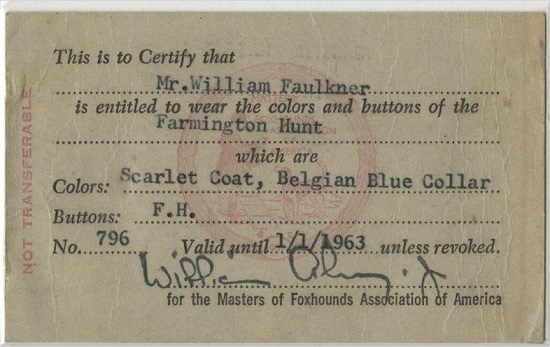 Certification of award of colors signed by MFHA President William Almy, MFH, with a right to revoke, apparently in use at the time. / From the Faulkner Family Collection, courtesy UVA Special Collections Library
In 1960, Faulkner was appointed to the faculty of UVA. He also was awarded his Farmington Hunt colors. Hunting with the smaller groups of people who rode on weekdays in tweed, or on formal hunting days in his scarlet coat and top hat, he could be found up front in the field with his friends and his daughter. He seemed to enjoy the companionship of riding and the sporting life. According the late Gloria Fennell, ex-MFH (1963-1968) who grew up riding at Grover’s and whose mother was a good friend of Estelle’s, he attended gatherings at her family’s home at Gallison Hall in Farmington Country Club. Gloria’s father was a Cuban native who taught in the Spanish department at the University, and gatherings there included a variety of townspeople and academic friends. “[Faulkner] would go upstairs with the men after dinner,” Gloria recalled, “and they would all drink and smoke.”
Sam Wells remembered many a fun party at the Buck Mountain Riding club, with kids playing outside while the adults enjoyed cocktails and conversation. “The riding club was very rustic. We had no plumbing, the building was rough built with two by fours and boards, with a big porch where we all hung out and drank and had picnics.” Sam remembered Estelle, who was a regular at parties with the riding club friends. “She was very personable and friendly, and very attractive,” he said. “Always beautifully dressed, never saw her in pants, ever. She loved people and loved parties.”
In the fall of 1960, Faulkner’s mother Maud died, leaving him with a deep sense of personal loss and with fewer family ties back in Mississippi. He and Estelle had been going back and forth to their home at Rowan Oak in Oxford, but as Jill and Paul had built their own house with a barn about a mile cross-country from the Hunt Club and a guest house for him, he was becoming more firmly established in Charlottesville. They now had a place to keep a few of their own horses, with Clarentine working for them to help with the horses.
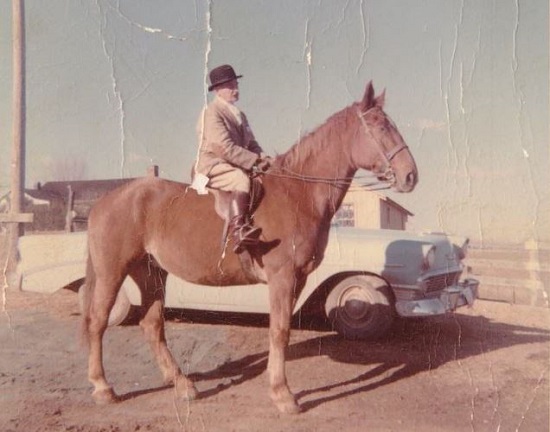 Faulkner on his hunter / Courtesy of Sam Wells, 1960
By 1962, the year of his death, Faulkner was comfortably settled in the local community. He had finished his final book, The Mansion, the last of the Snopes Trilogy of novels, and was still writing. He continued to ride, despite deteriorating health and a history of riding injuries. He kept practicing jumping, both at home at Rowan Oak in Oxford and in Virginia. The late Mary Jo Rives, a lifetime resident, Keswick Hunt sportswoman, and foxhunter, was an avid reader and literary fan. She not only read and appreciated Faulkner’s work, but remembered with awe his willingness to take risks riding in the hunt field. Knowing what a genius he was, and riding with him cross country out hunting was nothing less than breathtaking. Mary Jo recalled that Faulkner was not an expert rider by anyone’s accounts, yet he took delight in the thrill of following hounds and jumping high jumps.
Sadly, complications following a riding accident ultimately proved to be the last, but fatal obstacle. Sam Wells tells the story of the last time he was with Faulkner before he died. “Clarentine and I went with him down to Mississippi to pick up a horse for Jill. She still had two horses down there and they wanted to bring them home.”
Sam described the drive down in an old red, wood sided “Circus Truck” they used for horse transport in those days. Clarentine and Sam met Faulkner at Red Acres to set out on the two-day journey. They loaded the back of the truck with their gear and supplies that included “a stash of Old Crow whiskey—Faulkner’s favorite brand that he said he could not get in Mississippi. Faulkner was ready to go, wearing his tweed coat despite the summer heat. With pipe in hand, he climbed into the cab. “It had a high bench passenger seat, and [Faulkner] sat between us” with Clarentine driving. “His feet didn’t touch the floor. He wore his derby, so his head wouldn’t hit the ceiling when we went over bumps, and he smoked that pipe—ashes spilling out onto his coat. Roads were rough going down there; no interstates in those days.”
The drive was long and uncomfortable, according to Sam, with an overnight stop in a motel in Tennessee midway through the trip. “Faulkner took a room for himself, and he treated us to our own. There was a restaurant where we went to dinner, and he invited us to join him as his guests. We drank, naturally, and it always amazed me how for such a small man he could consume amazing amounts without ever slurring a word or losing an ounce of his dignity. He went through a good bit on that drive.”
Sam said that Faulkner was very quiet, and didn’t talk much or tell stories. On the second day, “He did start laughing to himself,” Sam remembered, “as were going along—sort of out of the blue, then explained what he was laughing at. ‘The Reivers,’ he said. ‘That’s the funniest book ever been written.’” Faulkner had recently published The Reivers, one of his last books.
Arriving at last in Oxford, “a charming little town,” Sam recalled that had not Faulkner pointed to it, the entrance to Rowan Oaks was all but invisible from the road. “He told us to slow down, and then to pull the truck in between what looked like a bunch of overgrown bushes. He said it was to disguise the drive for privacy. He said people would just drive in to the house and look for him in the yard. It was terrible, no respect all.”
Sam described the shabby condition of the barn: “boards and baling twine holding things together.” It was obvious that things had been left in the hands of the tenants. “Estelle was there in the house when we arrived, and we met the two black helpers who worked there—a very tall man and a woman, who made us the most delicious fried chicken I have ever eaten in my life.”
The next day Sam said Faulkner took them on a visit to all his friends who lived around in the country, and introduced them with warmth and good humor. “It was clear he really liked these country people,” Sam said. “The next day, we loaded up Jill’s horse, a witchy little gaited mare, and left, and that was the last I ever saw him.”
On June 17, 1962, Faulkner suffered a serious fall during a ride through Bailey’s Woods that put him in the hospital. His condition worsened to the point that, with Faulkner’s permission, Estelle and Faulkner’s nephew Jimmy made the decision to have him transferred to a private sanitarium for additional care on July 5th. Shortly after midnight, July 6, 1962, Faulkner died suddenly of a heart attack at the young age of sixty-four, according to Robert Hamblin’s biography of Faulkner, Myself and the World.
Faulkner’s life in Charlottesville was brief, but his days spent here left a lasting influence. In 1968 Jill agreed to serve as Master, and continued in that role until her death in April, 2008. Like her father, she was a stickler for dress and proper turnout, and she set the example and enforced the standard for every member of the field. She loved hunting, and in addition to being passionate about the hounds and developing and improving the Farmington pack, she cared about the preservation of the land.
Jill was also dedicated to practicing and improving her riding skills, and the thorough training of her horses. Back in the seventies, she regularly drove her Imperatore six-horse van with young horses down to Sweet Briar College for lessons with riding center director Paul Cronin, who regularly brought his students up to hunt with Farmington. She loved fine horses, and part of their training for her included showing “strictly rinky dink” in local competitions. Not only immaculate appearance, but safety, preparation, good manners, and horsemanship mattered greatly to her. These requirements set the tone for conduct in the field that continues today. The family donated a beautiful trophy in her father’s name, The William Faulkner Perpetual Trophy, given to the Champion Adult at the annual Farmington Hunt Club Fall Horse Show at the Barracks.
After her death, her son A. Burks “Bok” Summers took over her position as Joint-MFH. During Bok’s tenure in that position, B.J. Korol, a devoted Farmington member and friend of Jill, established an award in her honor in 2010: The Jill Faulkner Summers Annual Award for the member who consistently is best turned out, upholding the high standards set by our former MFH. As new generations of members and first-time foxhunters join the Farmington Hunt field, it is good to remember that their experience is not new. It was here, in this same neighborhood only a few miles from town that a sixty-year-old riding student took to the sport in the twilight of his busy and productive professional career. Faulkner had a passion for hunting and riding, and through the memory of all who met him, his legacy endures.
Posted August 3, 2017
While teaching at the University in 1959, Faulkner added a codicil to his will, creating the William Faulkner Foundation which “among other things,” wrote biographer R.W. Hamblin, “would bequeath to the University of Virginia all of the manuscripts remaining in his possession.”
To celebrate the fiftieth anniversary of Faulkner’s association with the University, an extensive exhibition of these manuscripts and various personal items (including his tweed jacket and typewriter) were on display this spring and summer. The exhibit closed in mid-July, but visitors are always welcome, and the collection can be seen by appointment. For details and visiting hours contact the Special Collections Library at the University of Virginia. For more information about the William Faulkner Family Collection, visit www.library.virginia.edu. Contact curator Molly Schwartzburg, [email protected]
For more information about the Farmington Hunt, visit www.farmingtonhunt.org
Elizabeth H. Sutton is a member of the Farmington Hunt and lives in Charlottesville, VA. She can be reached at [email protected]