
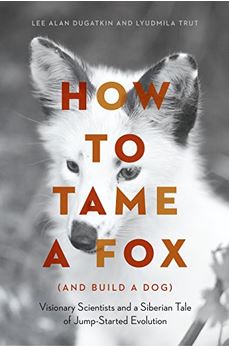
 How to Tame a Fox (And Build a Dog) by By Lee Alan Dugatkin and Lyudmila Trut, The University of Chicago Press, 2017, 216 pagesIt is accepted science that dogs evolved from wolves about fifteen thousand years ago. One can imagine, back in primitive times, certain needy wolves sidling up to man for food and shelter. Or orphaned cubs being saved by primitive families. In those relationships that proved successful, both wolf and man discovered advantages. Even disregarding love and companionship (those were harder times), the wolf was assured access to food and shelter in all seasons, and man discovered a hunting partner that contributed to his well-being and that of his family. The domesticated wolves, genetically disposed to the relationship, bred with others so disposed, and succeeding generations over the millennia evolved into purpose-bred dogs.
But just how did that evolution occur? It hasn’t been recorded. What if you could speed up the process and witness it? Two Soviet geneticists tried to do just that. They wanted to try to breed foxes as friendly to people as dogs, and this is their story—“part science, part Russian fairy tale, and part spy thriller,” says The New York Times Book Review.
In 1959, Dmitri Belyaev and Lyudmila Trut, wishing to witness the process of domestication, began working from silver fox breeding farms in Siberia. They selected the most docile animals for the experiment, bred them, and crossed to other docile examples as they could find. Fifty-five generations later, within a decade, they had calm, friendly foxes with wagging tales and floppy ears. Their book describes the changes through the generations that produced this domestication.
In only four generations they produced a fox that began to wag its tail. Succeeding generations became more dog-like in other ways, such as having curly tails, floppy ears, spots, and increasing willingness for human companionship.
The book tells also of the obstacles to their experiments—a hostile Soviet political climate that forced their research to remain secret for their own safety, indeed for their lives.
Belyaev died in 1985. Trut continued as lead scientist in this extraordinary undertaking. She partnered with scientist/historian/writer Dugatkin in producing what the New York Times calls a “sparkling new book” celebrating the bond between human and animal.
Posted June 26, 2017