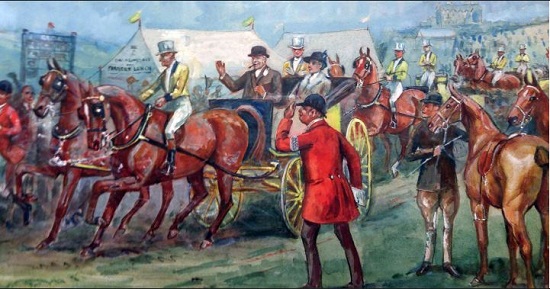
 The Earl and Countess Lonsdale Arriving From Barleythorpe, With Party for the Hunt Chases, 1893. Cuthbert Bradley (English, 1861-1943). National Sporting Library & Museum. (His livery, carriages, automobiles, and other accouterments were canary yellow for all occasions.)
On a lovely spring day in 1885, two gentlemen sat on their horses near the statue of Achilles by Richard Westmacott in London’s Hyde Park. The gentlemen were well acquainted. Hugh Cecil Lowther, the Fifth Earl of Lonsdale (1857-1944) and Sir George Chetwynd, (1849-1917) were both sportsmen and moved in similar circles. Both men were waiting to meet someone—Lillie Langtry. The famous actress had accidentally agreed to ride with both Hugh and George on the same morning. And in the absence of a graceful way of escaping the predicament, Lillie had simply stayed home.
Both men soon discussed their situation and were dismayed to find they were waiting for the same person. And in short order, both men argued, then came to blows for Lillie’s affections, despite the fact that both men were married, and it was widely known that Lillie was the mistress of the Prince of Wales. When their horses bolted from under them, the gentlemen continued their fistfight in the dust. It didn’t go well for Lonsdale, as Sir George managed to headlock Lonsdale before both men were separated—bloody and swearing. London was full of the news of the fight, and to add insult to injury, Queen Victoria summoned Lonsdale to personally express her displeasure with his conduct.
The episode was one of many points of scandal in the early life of Lord Lonsdale. Lonsdale was the most colorful sportsman of his day, and in many ways he represented a call-back to the dashing (and often scandalous) archetype of the eighteenth-century sporting gentleman. He loved his hunting, and spent years as Master of Foxhounds to the Quorn and the Cottesmore hunts. He was instrumental in legalizing and legitimizing the sport of boxing in Britain. He was an enthusiastic patron of horse racing, becoming a senior steward for the Jockey Club. And for the early portion of his life, he had a knack for generating scandals that dominated newspaper headlines in both England and the United States.
In fact, after a dramatic and highly-publicized scandal involving an affair with actress Violet Cameron (and an alleged attempt at dueling with her estranged husband), Lonsdale went into a temporary, unofficial exile as part of a science expedition to Canada. Trekking across the Yukon, Lonsdale nearly died several times and returned a hero with an extensive collection of Inuit artifacts, now in the collection of the British Museum.
Despite his past, Lord Lonsdale grew increasingly popular, partly through his talent for self-promotion and partly through his willingness to spend his money freely. He earned the nickname “The Yellow Earl” for his adoption of canary yellow as his signature color. His livery, carriages, automobiles, and other accouterments were bright yellow on all occasions. All eyes were on Lonsdale when he arrived at the races, often to greater applause than the royal family. The “Yellow Earl” moniker would last, becoming the title of a 1966 biography of Lonsdale by Douglas Sutherland.
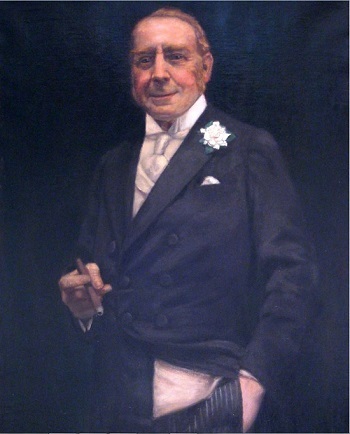 Lord Lonsdale, 1926, W. Howard Robinson (English, 1864-c. 1939), oil on canvas, 50 1/4 x 30 1/2 inches. National Sporting Library & Museum, gift of Russell Arundel, 1975.Through the early 20th Century, Lonsdale’s presence in sport and popular culture was larger than life. A collection of books on sports was branded the Lonsdale Library, he donated the Lonsdale Belt which is still awarded to boxing champions today, and lines of sporting clothing and cigars would end up bearing his name, too. In addition to these, Lonsdale was the founding president for the National Sporting Club, founded the Automobile Association, helped found the Blue Cross, and even served briefly as chairman for the Arsenal soccer club.
In April, 1944, Harry Worcester Smith sent an editorial to the New York Times to commemorate Lonsdale on his passing. Worcester Smith believed he was “the great gentleman of his time.”
“The Passing of the Earl of Lonsdale, Great Britain’s leading sportsman’s peer, at Oakham, Rutland, at the age of 87 on April 13 brought sadness to many a sportsman’s heart. The writer saw him at his best when hunting in Leicestershire and his Lordship was the Master of the Quorn. His home pack was the Cottesmore and he must have spent twenty or thirty years of his life as a Master of Hounds in that country about Melton Mowbray where hard riding is the rule, not the exception.”
Lonsdale’s extravagant spending (combined with the closure of the Cumberland coal mines that had produced his family’s wealth) effectively destroyed his family fortune. After his death, Hugh’s brother Lancelot, the Sixth Earl of Lonsdale, sold off the remainder of his possessions in the largest English country house sale of the 20th Century.
Today, a collection of Lord Lonsdale’s sporting books resides in the F. Ambrose Clark Rare Book Room at the National Sporting Library & Museum (NSLM). The collection was originally assembled by Frederick Henry Luth (1844-1918), and after his death it was acquired by Lonsdale. After the Earl’s death in 1944, the collection was acquired by the Arundel Foundation and donated to NSLM in 1975.
Posted May 3, 2017
John Connolly is the George L. Ohrstrom, Jr. Librarian at the National Sporting Library & Museum in Middleburg, Virginia. He is responsible for the care of the entire Library collections, spanning over 350 years of history of equestrian sport, fly fishing, wing shooting, and other field sports. Published with the permission of the NSLM.
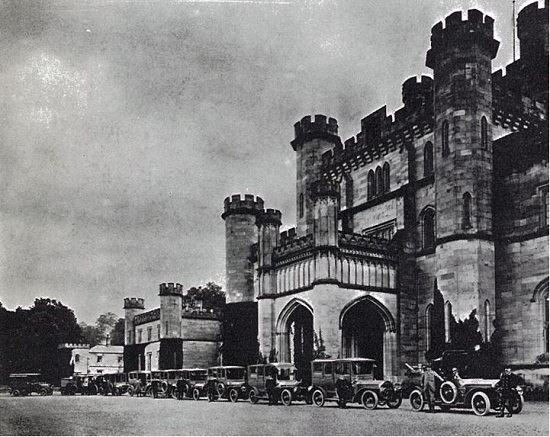 A parade of cars at Lowther Castle, 1910. All the cars were painted canary yellow, Lord Lonsdale’s signature color. From The Yellow Earl, by Douglas Sutherland.