
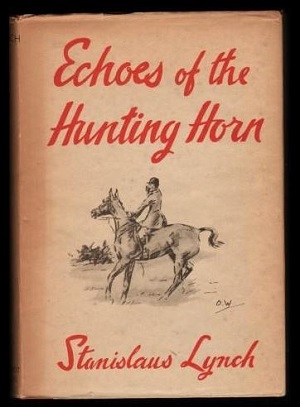
Another short story from the author’s Echoes of the Hunting Horn. Every foxhunter with warm blood will relate to the jumble of self-accusations tumbling through the author’s mind after getting tossed.
 Hounds are running hard for the past twenty minutes. Not a semblance of a check. The pace is terrific over a magnificent line of country with big sensible banks. One fairly-wide river, the honest variety, no slime or sponge-like edges; not a trace of wire anywhere. Horse never put a foot wrong since the Gone-Away . . . blowing somewhat now, though; last big wall took some negotiating. It seems to have thinned the already select field to a mere dozen. Thank Heaven for the down-hill gallop after that last stiff hill; horse’s wind feels easier now. Out on the left, riders are heading for a gate. It seems a long way off, and this wall does not seem such a terrifying rasper. Come on, old Challenger, the wall will save time. Steady now, not so fast. Slower still, slower I say, Hup! Over! God bless us, oblivion.
Chill water soaking into one’s shoulder-blade proves sufficiently uncomfortable to warrant investigation. Hazily one realises the ground is sodden with surface water, and it seems peculiar one should have chosen such a resting-place. Gloves drink vast quantities of icy liquid as one rises hurriedly. Portions of once-immaculate breeches feel and look like over-saturated blotting paper. Hoof-beats thunder far away on the left as late arrivals pour through the gateway in a long stream.
Startlingly, one recognises a familiar horse. There he is, three fields away, charging up the opposite hill, running on like the game creature he is, right behind hounds. Reins flapping with a careless rhythm round his shoulders and neck, stirrups bouncing with
spasmodic treachery, eager to free themselves, and here, a long way behind, is the young fool who should be on his back controlling those rebellious leathers.
To catch the horse is the primary impulse, and although running after him is sheer mirage-chasing, still nothing can be gained by standing alone in the heart of the Irish countryside. Out on the left, the last of the riders are pounding along, and since the
moving object on foot is evidently not a hospital case, they keep pounding along; pillion-riding being unheard of in the hunting field.
Trudging forlornly in the wake of the disappearing hunt one has ample opportunity for an agonizing analysis of past happenings and for appalling speculations in grim forebodings of the future. Vividly, one remembers that confident charge at the wall, horse going for his work so gallantly, even if a little too eagerly, not sure of what happened then. Must have hit the wall or something, then that horrible moment when he seemed to crumple up and everything went hazy: wet ground, horse gone. Heaven alone knows where he is now. Great old Challenger! He would have tried it had it been a house gable! Both knees are probably ruined.
Stirrups have fought free of holders and are lost in some field. Reins are surely over his head by now and are trampled and torn to uselessness. If he went with hounds through the Upper Wood he is sure to break his leg in some rabbit burrow; the first barbed wire fence he encounters will cut him to pieces, and there is tarred road somewhere near, with a ghastly drop. He has probably jumped on to it and broken his neck.
Sorry, Challenger, boy! Sympathy is a fine lot of good to a murdered horse! Compelled to jump a colossal wall when every sane person rode towards the gate. How people would talk later! Senseless, head-strong, foolish; oh, endless employment of bitter, but justified adjectives. And here is their overwrought recipient trudging achingly towards the nearest farm-house; a stinging pain in the neck and shoulders, the loam of half a parish on his clothing. “God help you, sir, did you fall? ” asks a labourer good-naturedly. In one’s present condition one feels like answering peevishly that one was run over by a bicycle. The seemingly stupid question does not merit such rude response, for its tone implies a sympathetic enquiry if one is hurt. “You may take things easy, sir. I think they have killed him behind the wood. I told my gossoon, Jamesy, to fetch your horse, an’ he should be back any minute.”
This was reassuring news which helped to dispel a nightmare that was rapidly running amok. Much to one’s astonishment and relief, Challenger’s only injury is a bleeding, but superficial over-reach, with its not unusual accompaniment, a missing foreshoe. “Sure
there could be nothing wrong with his knees,” said Jamesy’s father, re-corking the bottle of disinfectant.” He never touched the wall. ‘Twas the soft landing tumbled him: an old spring it is; had you taken the jump a few yards further up you had grand firm landing.
But he’s a great horse, sir a great horse! The third I ever knew to clear that wall and I’m no youngster.” Having thanked these good people, one starts homewards lighthearted and proud. Yes, proud of mud-stained clothing. Proud of ruined head-gear. Proud of Challenger. The third horse to clear that wall in the biggest part of a century!
Posted January 16, 2017
http://www.foxhuntinglife.com/foxhunting-horse-a-hound/foxhunting-books/1261-tally-ho-the-fox