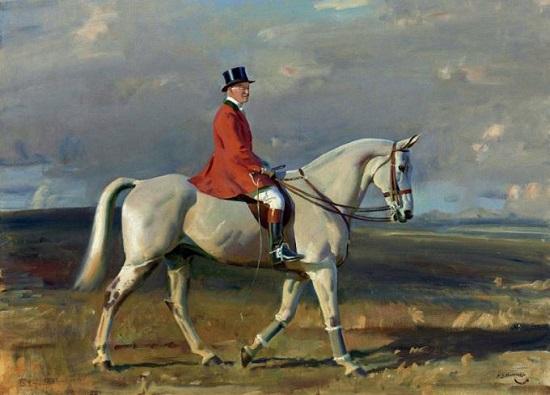
 Portrait of Harry La Montagne on a Grey, by Sir Alfred James Munnings
A 1920s work by famed equestrian artist Sir Alfred Munnings is estimated to fetch between $300,000 and $500,000 when it goes under the hammer at Christie’s in New York later this month. Titled, Portrait of Harry La Montagne on a Grey, the painting will be auctioned on October 26 during Christie’s sale of 19th Century European Art.
Munnings stayed with Harry and Beatrice La Montagne at their house, the Villa Regina in Pau, southern France, during the autumn of 1923 to paint Mrs. La Montagne’s portrait on horseback. This followed a recommendation to Munnings from Baron Robert Rothschild who described her as “a good-looking, smart, American woman. The well-turned-out lady was supplied by her devoted husband with superb horses.” (Sir A.J. Munnings, The Second Burst, Bungay, 1951, p. 100).
The portrait was such a success with the husband that he commissioned the artist to execute a portrait of himself. “Christmas was drawing near, and La Montagne, feeling Christmassy, and cheered at the sight of the portrait of his wife in a silk hat and habit, on a bay horse, distant snow-clad mountains and all, wanted me to start on him in scarlet, on a grey. Breaking the news to my wife she replied she didn’t mind how long I stayed. ‘Make hay while the sun shines,’ said she.” (Munnings, op. cit., p. 101).
Munnings adopted a traditional format of a huntsman riding to hounds and transformed the usually static image into one filled with animation and spontaneity. By positioning the subject high on the horizon, he has created a sense of monumentality which is accentuated by the contrast of the vivid, rolling sky with the light grey colour of the horse. His mastery of equine anatomy emphasizes the strength of the horse and imbues a sense of nobility. The muscles are beautifully delineated, and he has convincingly portrayed the graceful strides of the horse as it covers the loosely-painted ground. The horse’s head is sensitively articulated and displays an exquisite expression of alertness and intelligence.
Posted October 17, 2016
Adapted with permission from HorseTalk.co.nz.