
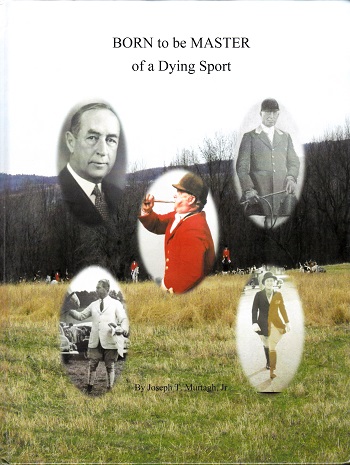
 Born to Be Master of a Dying Sport by Joseph T. Murtagh, Jr., ex-MFH, 2016, 287 pages, illustrated, $45.00 plus $5.00 shipping. Purchase direct from author by clicking on this email address: [email protected]. Inscribed, signed copies may be requested.What follows is an excerpt from Jody Murtagh’s new memoir, Born to Be Master of a Dying Sport. The book tells the unvarnished story of the ups and downs of a man trying gallantly to keep his hunt and his heritage going in a changing world and his love for the Penn-Marydel foxhound, a breed formally established by his maternal grandparents.
A Penn-Marydel is a true American hound that was a derivative of hounds that came to America from England and France in the early 1600s with the settlers of the time. These settlers came to what we now call the Eastern Shore regions. One such family with which I am very familiar—the Jackson Family—settled around 1682 in the Maryland family seat, Jackson’s Choice, a three hundred-acre tract on the Eastern Bay shore opposite Lower Kent Island, patented to Richard Jackson by Lord Baltimore in 1664.
In 1697, Richard Jackson, Jr. bought a 130-acre tract called Folly Neck in Murderkill Hundred of Kent County, Delaware, to which he moved from Maryland.
According to the history of the Jackson Family, some members stayed in the area and eventually my maternal grand-parents, Mac Roy Jackson and Gilder Jackson, established a kennel on the Jackson Farm near Dover, Delaware. Through the era, M. Roy Jackson was Master and huntsman of the Rose Tree Fox Hunting Club in Media, Delaware County, Pennsylvania. Later, he was Master and huntsman of his private pack, Kirkwood Kennels, and at the Radnor Hunt Club from 1929 to 1944.
All through Roy Jackson’s life (1876–1944), he and his brothers kept the kennels near Dover. He raised and traded hounds from the Eastern Shore area up into the hunts in the Chester and Delaware County areas of Pennsylvania. Thus was derived eventually the name Penn-Marydel hounds, which was incorporated in 1934 by Mr. And Mrs. M. Roy Jackson with the assistance of Walter M. Jeffords, a former Master of the Rose Tree Foxhunting Club. Jeffords later established his own pack, Andrews Bridge Foxhounds. Also participating were Mr. William H. Aston, MFH of the Eagle Hunt, and John B. Hannum, Jr., a member of Rose Tree, at one time hunting his own pack at Theodore, Maryland.
The Penn-Marydel hound became very popular in the areas of Chester and Delaware Counties, especially with many farmer packs like the Kirk Hounds, Crawford Twadell’s Hounds, the West Chester Hunt, and many more. Roy Jackson became an ambassador for the Penn-Marydel, traveling to and becoming very involved with the Golden’s Bridge Hounds (NY), and the Fairfield County Hounds (CT). He integrated Penn-Marydel blood into those packs, which have remained tried-and-true Penn-Marydel packs to this day.
Along the way, these sportsmen established what I think is the difference between an American foxhound and a true Penn-Marydel hound. Over a long period of time, these gentlemen zoned in on several attributes well-suited for the Pennsylvania, Maryland, and Delaware areas where they were hunting.
One such trait was a very steady and good nose, probably due to some of the harsh winter conditions such as ice and snow. Secondly a great voice, sometimes called a booming voice, needed in those large wooded coverts in Pennsylvania. Thirdly, a mild demeanor which in my estimation gave the Penn-Marydels their biddable characteristics to suit many situations. Lastly, the trait that makes the Penn-Marydel stand apart from all of the other foxhound breeds is what I call the look of the Penn-Marydel hounds.
In truth, in the 1960s, American hounds and Penn-Marydel hounds looked very similar. They should have, because they all came from the same stock originally. Later, American hound breeders went a different way with a more refined look and in my estimation were a little more influenced by the conformation/showing aspect of hunting.
After studying the Penn-Marydels as I have, it is obvious to me that the early breeders were not as much worried about the conformation of their hounds. Although the likes of Mr. Jackson’s Kirkwood Kennels, the Radnor, and the Rose Tree Fox Hunting clubs did do well at the early shows. I think that the true sportsmen were more interested in the stamina and “true to the line” ability of their hounds, since most of these early huntsmen hunted their hounds six days a week. Especially Mr. Jackson and the Eastern Shore hunts.
Most, if not all of the “true to the line” Penn-Marydel Masters and huntsmen bred for hounds that could stick to the line of a fox in all conditions. While staying together in those large coverts, and not having to be pulled back together at every check or turn of the quarry. I know that Penn-Marydels have gotten a bad rap for being slow and mundane. However, many Penn-Marydel Masters and huntsmen loved to be able to hear and see the work of their hounds without having to kill themselves trying to stay right on top of their charges all the time. This is where the nose and voice come into play in that hounds can not only follow a fox’s line without a lot of checks and lost time, but their big voices help them keep each other and staff and members in touch even in hard country to traverse.
Don’t get me wrong. The conformation aspect is important in the running/stamina ability during the chase. The showing aspect has had a positive bearing on the attributes of our hounds, their looks and hunting ability, especially in this day and age of coyote chasing.
I admit that in my early years as MFH and huntsman of the Rose Tree, we got the picture. If we were going to pursue the showing aspect of the sport and have any summer fun, we could no longer breed for strictly the running aspect. We had to step it up a notch because the likes of Andrews Bridge, Golden’s Bridge, and a few more were making us looks sick in the show rings.
So step it up we did and spent several years zoning in on conformation while still keeping to the old attributes: nose, voice, and the look. After about five years—around the year 2000—I could see quite a difference in the quality of what we were hunting and showing. The year 2004 was what I would call a real turning point for the Penn-Marydel breed. The shows were becoming increasingly competitive with more and more clubs fine-tuning their breeding programs. All the while, many clubs were inquiring about why the PMDs were becoming more and more popular as true hunting hounds. Whether it was more and more PMD clubs were traveling for joint meets, or maybe some eyes had been opened by the now popular foxhound performance trials. I think it was all of the above, and to top it off Rose Tree Fox Hunting Club had come up with an earthshaking moment in history at the Virginia Foxhound Show.
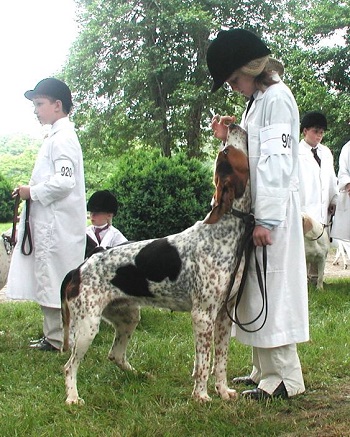 In 2004, Rose Tree Needy 2001 becomes the first Penn-Marydel to be judged Grand Champion Foxhound at Virginia. Needy was shown and handled by 12-year-old Cody Hayes, grand-daughter of the author. Today, Hayes is the professional huntsman at the Golden’s Bridge Hounds (NY). / Lauren Giannini photoA foxhound b*tch, Rose Tree Needy ‘01, shown by a twelve-year-old youngster, Codie Jane Hayes, my grand-daughter, had blown away the competition. For the first time in foxhound history, a Penn-Marydel had won the Grand Championship of the entire show. It was very special to the PMD community in that the judge, C. Martin Wood, MFH, the most renowned judge in the U.S. had put his stamp on the PMD Champion.
One other reason that the Penn-Marydels have become so popular is because foxhunting has changed dramatically with the spread of the coyote in most territories from the Northeast all the way down through Virginia into Florida. It has so drastically changed the chase from a red fox’s meandering territorial tour to at most times a frenzied nightmarish chase that will take you out of your territory and put most huntsmen into a world of living on the edge, not knowing what is coming next.
So, here’s the rub: how can we slow things down to where the huntsman can still control his hunt. Some astute hounds men have thought to just breed to those slower Penn-Marydels and all will be fine. The problem is, however, that since many of us have bred up to improve conformation, the modern PMDs are no longer the slow hounds they were supposed to be.
Fortunately, there are still some Penn-Marydel packs that didn’t get carried away with breeding for speed. If I were to start anew, I would certainly seek these hunts out. The reason this theory of slower hounds might work is that the coyote only goes as fast as he is pursued.
Of late, another great Penn-Marydel hound has come to the forefront. Golden’s Bridge and Andrew’s Bridge put together a mating of two PMD hounds that produced Golden’s Bridge Phoenix 2012. Phoenix even topped Rose Tree Needy ‘01 by winning Grand Championships at both Virginia and Bryn Mawr.
As an interesting note, Both Phoenix and Needy go back eight generations to an outcross made by Robert Crompton, MFH, Andrew’s Bridge Hounds in 1986 to Dumfrieshire Dempster 1983 and Dumfrieshire Porter 1980. Both were bred to pure Penn-Marydels and their get are now registered as pure Penn-Marydels.
As a true-to-the-line Penn-Marydel man, I can report that I hunted Rose Tree Needy and I can attest that she was the ultimate true PMD in all aspect of her hunting ability. Further, the Golden’s Bridge Hounds are being hunted by my grand-daughter Codie Hayes, and she has informed me that Phoenix is a good, steady PMD running in the top ten of the pack. But maybe not quite as good as her cohort Needy!
Posted October 13, 2016
This article was extracted from Born to Be Master of a Dying Sport by Joseph T. Murtagh, Jr., ex-MFH, 2016, 287 pages, illustrated. Click to purchase Murtagh’s memoir. Price $45.00 plus $5.00 shipping. Inscribed, signed copies may be requested.