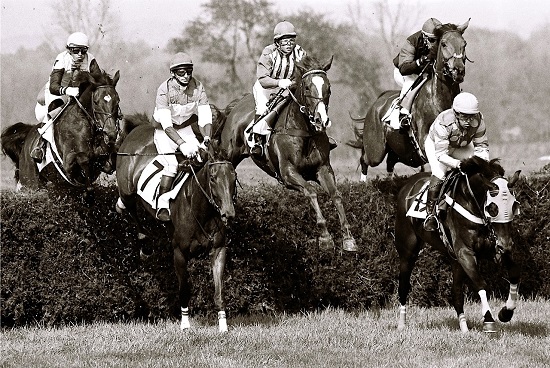
 Peter Walsh (number 7) in the Swan Lakes Stakes, 1993 Virginia Gold Cup Races. Lonesome Glory (white blaze, Blythe Miller up) went on to win the race and capture his second Eclipse award that year. / Douglas Lees photo
In 2014, Peter Walsh, ex-steeplechase jock, served as Field Master and hunted with both the Piedmont Fox Hounds and the Orange County Hounds, neighboring packs in Virginia. He was hunting five days a week and working as Farm Manager for Milton Sender, a field member of both packs. In the off-season, he played golf avidly.
Today, Peter Walsh is still hunting with both packs, still managing the farm, and still playing golf avidly. It would almost seem as if nothing had changed…except that between then and now, Peter lost his right arm.
Peter remembers little of that horrendous day in February, 2014. He was hunting at the Deep Run Hunt (VA), on a relatively green horse when the horse’s bridle broke. The horse panicked and galloped blindly into the nearby woods. Peter had no way of checking or controlling the runaway; he just tried to stay on. Riders that followed to help discovered him lying unconscious and bleeding near a broken tree.
He was air-lifted to the Virginia Commonwealth University Medical Center in Richmond where his injuries were tallied: a broken neck, broken jaw, thirty broken or fractured bones (including fourteen ribs), nerves mashed. He was in surgery for hours, in the hospital for two weeks, another week in rehab, and more than two more months at the MedStar Washington Hospital Center to continue recovery from severe head trauma. Months later, after his discharge, he still walked about in a body brace, neck brace, and sling for his right arm.
Fortunately, the broken neck didn’t result in paralysis, but the nerves controlling his right arm had been damaged so severely that, as the months passed and the healing process continued, he never did recover the use of it. By last season, he had already returned to the Piedmont and Orange County hunting fields. He rode one-handed, right arm strapped to his body because it wasn’t serving him. So in January of this year, Peter decided to have the arm removed.
At his core, Peter is a superb athlete. Born in Dublin, Ireland, he followed a career as a steeplechase rider. He competed in big races in Ireland, England, and America, including the Grand National Steeplechase at Aintree. He moved to the U.S. in 1985 and met his wife-to-be Haley in Unionville, Pennsylvania where she was working with horses in the farm across the road. Peter moved to the Middleburg area in 1985 and continued racing, married Haley in 1990, and is now the father of three college kids, Hayden, the oldest, and twins Emma and Liam. He retired from racing in 1999 and took over the management of Sender’s farm and along with it the responsibility of procuring and training a stable of field hunters sufficient for both men to hunt with both packs. Which they did, until that dreadful day.
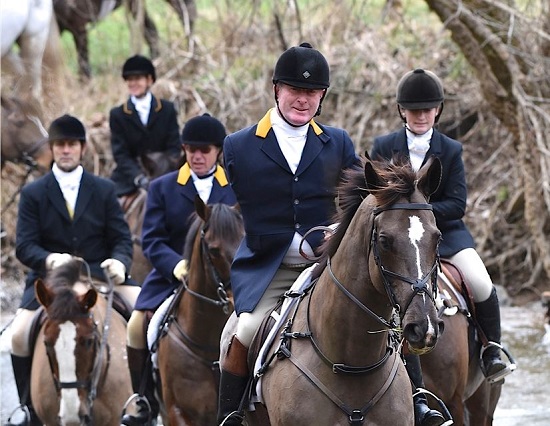 Peter (foreground) hunting with Piedmont in 2015. / Douglas Lees photo
Weeks and months of recuperation and rehabilitation followed, accompanied by pain and uncertainty. But his progress was unquestionably accelerated by the fitness and athleticism he brought to the ordeal. As Peter resumed most of his former activities, he kept wondering how he could play golf again. In an early rehab session back in 2014, his local physical therapist, Del Wilson, also an enthusiastic golfer, put a putter in Peter’s hand. He placed a gadget on the floor representing the cup, which automatically returns the ball to the putter if it goes in. To Wilson’s amazement, Peter kept putting it in the cup, one-handed. That got Peter thinking that, perhaps, he could play golf again.
Wilson connected Peter with Mark Guttenberg, a PGA of America professional at the Raspberry Golf Academy at Bull Run Golf Club in Haymarket, Virginia. Guttenburg had experience working with disabled golfers, especially military veteran amputees. Guttenburg changed Peter’s equipment, changed his swing, and gave him lessons.
Before the accident, Peter’s golfing handicap was eight. He’s already got it down to twenty, and he’s working it down. He can drive the ball 150 yards, and he has moved back to the senior tees. His friends are still teeing off behind him, and they tease him some, but that’s OK with him. He’s playing, he’s improving, and he’s loving it.
“He’s an Irish steeplechase jockey,” said Haley to Leonard Shapiro, writing for Golf Digest. “He’s not afraid of anything.”
Posted September 17, 2016
A similar article recently appeared in Golf Digest.