
Extracted and condensed from Memoirs of a Foxhunting Man, Part Seven, Chapter II.
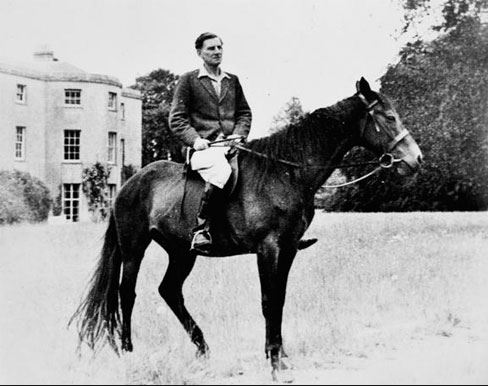 British author and war poet, Siegfried Sassoon
October arrived; the drought broke with forty-eight hours’ quiet rain; and Dixon had a field day with the new clipping machine, of which it is enough to say that the stable-boy turned a handle and Dixon did the rest. He had decided to clip the horses’ legs this season; the Ringwell was a bad country for thorns, and these were, naturally less likely to be overlooked on clipped legs, which also were more sightly and dried quicker than hairy ones.
Resplendent in my new red coat, and almost too much admired by Aunt Evelyn and Miriam, I went off to the opening meet by the early train from Dumbridge to Downfield. Half an hour’s ride took me to the kennels, where I joined an impressive concourse, mounted, in vehicles, and on foot. The sun shone after a white frost, and everyone was anxious to have a look at the new Master. My new coat was only a single spot of color among many, but I felt a tremendous swell all the same. Familiar faces greeted me, and when we trotted away to draw Pacey’s Plantation, old Mr. Dearborn bumped along beside me in his faded red coat and blue and white spotted birds-eye cravat. “This horse ought to have one of you young chaps on his back!” he exclaimed. “Jumps too big for an old buffer like me; never known him to put a foot wrong, clever as a cat—(hold up, will you!)…his clever hunter having tripped badly on some stones.
He presented me to an affable person on the other side of him—Mr. Bellersby of Cowslake Manor. Mr. Belleby was mounted on a fidgety, ewe-necked, weak-middled, dun-coloured mare. He had a straggling sandy beard and was untidily dressed in new clothes which looked all wrong. He had a mackintosh coat rolled up and strapped on the back of his saddle. He wore moss-green worsted gloves, and his mare’s bridle had a browband of yellow and black striped patent leather.
Mr. Dearborn remarked, when we lost sight of him in the crowd outside the covert, that he was a queer fish to look at, but a very warm man in Mincing Lane. “Made a pile of money out in the East; just come to live in our country; built a billiard room on to his house, I hear; sort of man who might be good for a fifty pound subscription. Fear he’s no horseman, however. That dun of his gallops like a train till she gets near a fence, and then digs her toes in. I know all about her, for he bought her in the summer from a neighbor of mine. Pity he didn’t ask my advice. I’d have let him have this one for a hundred and twenty. Absolute patent-safety, this one; jump a house if you ask him to!”
Now it so happened that the new owner of Cowslake Manor provided the liveliest incident that I remember out of that day, which was “badly served by scent” as the local scribe reported in the paper. A fox was found in Pacey’s Plantation. The majority of the field hustled around the outside of the covert, but I thought to be clever and went through a grassy ride. A short distance in front of me galloped Mr. Bellerby; his hat bouncing on his back, suspended by its string; and he was manifestly traveling quicker than he had intended. Someone in front pushed through the gate out of the Plantation, and while we neared it the open gate was slowly swinging back again. It was uncertain which would win, Mr. Bellerby or the gate. I stole past him on his near side, got there just in the nick of time, and retarded the gate with my left hand. Mr. Bellerby bolted through the aperture, narrowly avoiding the gate post with his right knee. It was an easily managed exploit on my part, since I had Cockbird well under control, and, as usual, he understood what we were about every bit as well as his owner. Mr. Bellerby continued his involuntary express journey across a ridge-and-furrow field, bore down on a weak hedge, swerved, shot halfway up his mare’s neck, and came to a standstill while Cockbird was taking the fence in his stride.
After Mr. Pacey’s fox had got into a drain half a mile further on, Mr. Bellerby reappeared and besieged me with his gratitude. He really didn’t know how to thank me enough or how to congratulate me in adequate terms on what he persisted in describing as my “magnificent feat of horsemanship.” It was, he asserted, the most alarming experience.
Embarrassed by his effusive acknowledgments I did my best to avoid him during the rest of the day, but he was constantly attaching himself to me, and everybody who happened to be near us had to hear all about my marvelous feat of horsemanship.
“Not a second to spare! I really think Mr. Sherston saved my life,” he ejaculated to Sir John Ruddimore, a stolid and rather exclusive landowner who followed the hounds very sedately with an elderly daughter. The local big-wig listened politely to the story; but I felt like a fool, and was much relieved when I saw the back of Mr. Bellerby as he tip-tupped away to Cowslake Manor after pressing me to accept a cheroot about eight inches long out of a crocodile-skin case.
Posted July 14, 2016