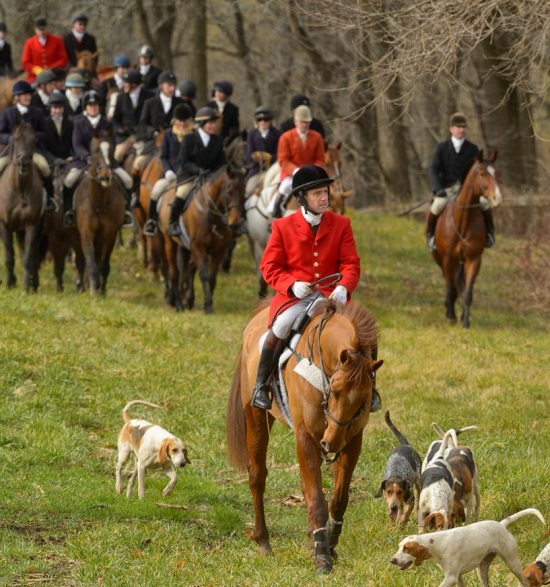
 Huntsman Ivan Dowling implemented a daring — and successful — hound breeding experiment for Mr. Stewart’s Cheshire Foxhounds. / Jim Graham photo
“I’d spent several minutes trying to describe my job as huntsman to a friend” recalled Ivan Dowling, the forty-two-year-old recently retired huntsman for Mr. Stewart’s Cheshire Foxhounds (PA). “The friend looked at me and said, ‘Ivan, you mean you’re the guy on the place mat?’”
Dowling cringed a bit and smiled, “Yea, that’s me.”
Dowling is a native of Loughrea, County Galway, Ireland. An equestrian since childhood, Ivan Dowling first came to Mr. Stewart’s Cheshire Foxhounds in April of 2003 as first whipper-in. He went back to Ireland in March of 2004, but by February 9, 2005, Ivan had taken the horn and ascended to the position of huntsman. He has served six Masters in twelve years and bred scores of hounds.
His father was a dentist who died in a tragic accident at Loughrea when he was twelve. Dowling’s uncle Noel Mullins* became a father figure to the young Dowling and would travel across Ireland each weekend to take his nephew hunting. At the time, Mullins was head of marketing for the computer services company IBM Ireland, but he has been associated with horses all his life, hunting with the Galway Blazers from an early age. Mullins hunted two packs of beagles and also hunted a mounted pack for over twenty seasons.
The Blazers became a passion with the young Dowling. He cared for not only his pony but his uncle’s horse as well. He did most anything to be near the The Blazers. There he befriended Willie Leahy,** long time Field Master for the hunt, who mentored Dowling as well.
Dowling went off to college and took a corporate job in England. For a while he was content. “I knew something was missing in my life. I went in to my superior’s office and said, I’ve got to go. She thought I meant for an early weekend. But, when I went out the door it was for good, and I never put on a tie again except for weddings and funerals.” He headed back to Ireland and to the horses with which he’s been raised.
Eventually, Dowling found his way to New York after the hoof-in-mouth epidemic limited the amount of available work. He broke horses and worked as an amateur whipper-in for the Stone Valley Hounds. There he whipped-in to John Tulloch. It was Tulloch who would bring him to Unionville, Pennsylvania and the Cheshire hunt. When Tulloch left the Cheshire, Dowling again headed back to Ireland. Russell Jones, MFH, had seen something special in his former whipper-in and traveled to Ireland to bring him back. “Russell gave me a huge leg up,” Dowling said. “He stood by me all the way. He always had my back and supported me. He believed in me.”
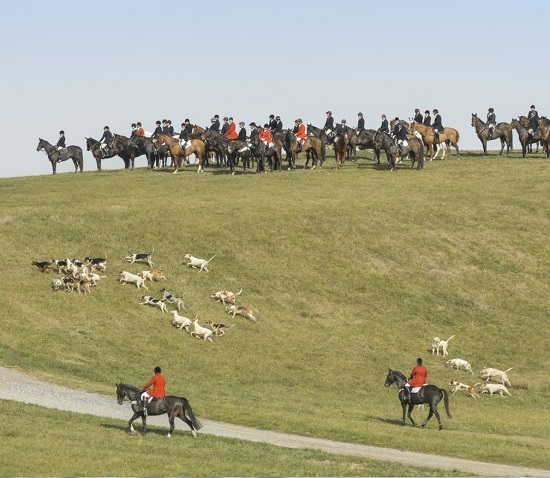 Dowling with staff, field, and his pack of Old English/Penn-Marydel crossbreds. / JIm Graham photo
John B. Hannum, Jr.—the son of Mrs. Nancy Hannum, MFH who watched over the Cheshire foxhounds for more than fifty years as Master, after taking the horn from her step-father W. Plunkett Stewart who founded the pack in 1912—said about Dowling, “He was a passionate huntsman, and he loved his hounds. He has the ability to make the day exciting for the field as well. We are so blessed with open country and beautiful fences. Dowling challenged the country and challenged his hounds in that country. In doing so he brought us all along for a wonderful ride! Even when conditions were tough he demanded the best from his hounds and got it, and the field was better for it. You always knew, though, that his hounds came first. He cared about the followers, but above all he wanted to satisfy his hounds.”
“Ivan helped make the change from the pack of traditionally-bred English hounds that I grew up with to the current pack of Penn-Marydel crosses less difficult. He worked at it and truly gave it his all. He never held back,” said Hannum, who in his own right is the Chairman emeritus for Mr. Stewart’s Cheshire Foxhounds.
For Dowling, that adjustment in hunting hounds was two-fold. Hunting hounds in the Americas was hound oriented, while hunting hounds in Ireland was focused on getting them across the countryside. “We were hunting coyote in New York, not foxes,” Dowling said. “It was a huge transition. I’m nothing but not adaptable, so we made the change. I loved working with the hounds.” said Dowling.
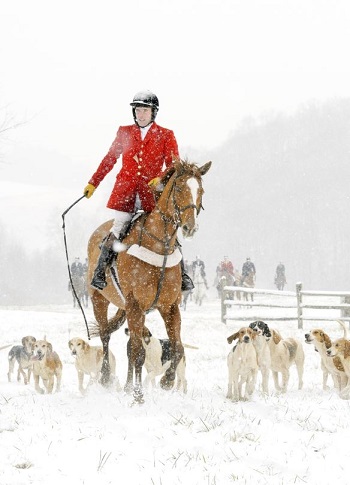 Penn-Marydels were bred to hunt a climate that swings from freezing to ninety degrees Fahrenheit. English hounds were bred to get forward on the line and give sport to a fast-riding field. Dowling and the Cheshire wanted all that in one foxhound. / Jim Graham photo“In Ireland I never knew anything like an American hound or Penn-Marydel hound existed. I was used to English hounds—the difference being their voice and scenting ability. The Penn-Marydels could hunt in conditions from eighty or ninety degrees during cubbing season to snow storms during winter, and these hounds still ran. I wanted to breed a pack and take them back to Ireland. With the English hound, you have to be tough. Discipline and hard work is what they respect. The American hound on the other hand is the complete opposite—shyer. You couldn’t raise your voice to them. You had to be quieter in the kennels.
“I had to change everything while hunting them. English hounds would cast forward to where they think the fox might have gone. The Penn-Marydel hound would try back to the spot they might have lost scent. The English hound was bred to depend upon the huntsman to guide them, where the Penn-Marydel had been trained to work on it’s own. The Penn-Marydel hound was hunting scent, not the fox. All they knew was what was in front of their nose. And that came from generations of hunting on foot.
“The struggle I found at Cheshire was having two different types of hounds and trying to get those hounds to hunt a bit more forward. My number one thing was to be true to the hounds, at all cost. I had to juggle this and that, between landowner, managing staff, and communicating with the Masters and the field. But in all of it I needed to be true to the hounds at all costs. I bred them to do this, and I needed to let them do it. We’ll draw every inch of the country and apologize for it later! By going back over foiled ground and letting them cover it, you were telling the young hounds that you have to figure out where the fox went. After a while their work ethic was better. Hunting hounds is an art, not a science. It’s a bit of show business in a way. It’s a juggling act, but, if you do right by the hounds everything will fall into place.”
And fall into place it did. For twelve years Dowling bred and hunted hounds for Cheshire. He not only supervised the hunt staff, worked with the Masters and members of the hunt and landowners as well, but, he also worked closely with different conservancies and preservation organizations in the area to keep land open. The basis of Cheshire Country was some of the original ground that became a large part of what is now the Brandywine Conservancy. To Dowling, the hunt not only has created a community within itself but a far reaching community that extends throughout the countryside. “The spinoffs in the horse business are enormous: feed vendors, veterinarians, the racing community, and on and on. It all stems from the hunt.”
Catherine Ledyard recalled Dowling’s work. “From the first time Ivan hunted the Cheshire hounds on a brutally windy winter day over a decade ago, to the last sunny Saturday that I was with him in March of 2016, his serious commitment to his hounds was ever present,” she said. “He trusted them and allowed them to work things out, suspecting their success would result more readily from intrinsic motivation than from interference from him. More often than not, Ivan’s hounds were correct and his smile, as he would go flying by to accompany them on the chase, was testament to his pride in and love for them. Over the years, the clear affection and dedication that he showered upon the Cheshire beauties brought us fabulous sport and a lot of wagging tails.”
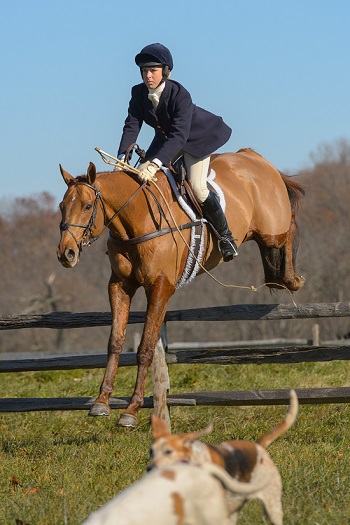 First whipper-in Stephanie Boyer leaves the Cheshire as well to become Dowling’s partner in marriage and business. / Jim Graham photoThe language of a huntsman is a combination of calls on the horn and sometimes odd utterances that sound primeval or foreign. The purpose is always to communicate with hounds, to encourage them, to direct them, to honor them. A stark demonstration of the commitment given to hounds by Ivan Dowling was the music of his horn. From the coaxing chirps at the start of a draw to the heart stopping “Gone Away” that he would miraculously execute while galloping at full speed, Ivan learned and mastered every call a huntsman is required to know. There is no more beautiful nor mournful sound than the concert he would provide at the conclusion of a day’s hunting. “Going Home,” played through Ivan’s horn, was a melodious tribute to the sadness of ending the fun and a heartfelt homage to the hard work of the hounds.
As Dowling now passes his horn and hounds off to new huntsman Barry Magner, he said, “I never lost the passion for hunting hounds. I’ve never taken for granted how lucky I was doing what I loved. I’d totally found my calling. I know that I would have been nothing without my great whips and help all the way. In so many ways I didn’t work for twelve years!”
Dowling and Stephanie Boyer, his exceptional long time whipper-in at Cheshire and soon-to-be wife, will together hangout their own shingle in Unionville, Grey Lake Stables, LLC, training and selling quality foxhunters, timber horses, as well as retraining off the track Thoroughbreds.
Posted June 25, 2016
* Sporting photo/journalist Noel Mullins is a regular contributor to Foxhunting Life. Click to visit his website and view his books and articles.
** Willy Leahy is also well-known for his quality field hunters and his popular pony-trekking vacations in Ireland. He is an uncle to Tony Leahy, MFH, Fox River Valley Hunt and First Vice President of the MFHA of America.
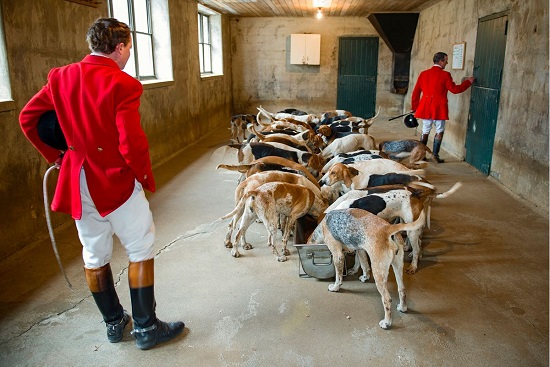 Jim Graham’s symbolic photo captures new huntsman Barry Magner (left) remaining with hounds as Dowling departs .
The author of this article is an enormously talented professonal photographer. Click to visit his website.