Back in the late 1950s, Deirdre and her friend Sarah, both just nineteen, came to America. The pair had left Britain, where post-war ration books were still in use. Sarah was to train horses and riders for Jamie Kreuz at Bryn Mawr Farms outside Philadelphia. Deirdre was to work for the Insurance Company of North America in Philadelphia and help Sarah on weekends. What follows is Part III of their adventures, which have included Part I: “How to Bridle a Green Field Hunter,” and Part II: “The Witch With Warts.”
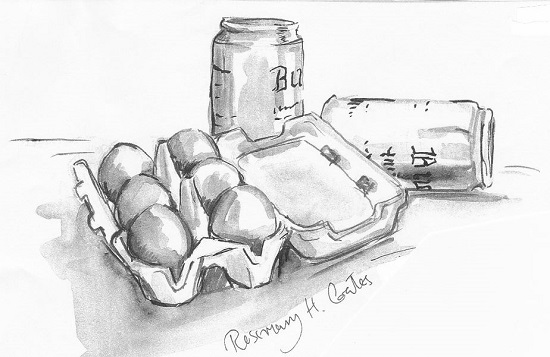 Illustration by Rosemary Coates
We had not been long in the States when Pink Gin arrived at Bryn Mawr Farms. Billy, who mucked out for us, was, as usual, the first to find fault with him.
“He do get drunk, he do. Proper beer-swiller he be. And he eats eggs and molasses with all his feed. Lord, if only I could eat like that!”
Pink Gin (not his real name) was a timber horse with a record of wins. Since most timber racing is in the spring, pre-season training often means blizzards and temperatures averaging ten degrees Fahrenheit. This was one of the reasons for the high-calorie diet that included beer and eggs.
Pink Gin’s first race meeting was the Radnor Hunt Races, where he showed huge promise. He was a very ‘straight-legged’ horse, which is the best way we felt we could describe him, and it showed in the way he tackled his fences. He leaped the timber with the most enormous enthusiasm. For us on the frigid ground, our enthusiasm was far from enormous. In our agony, we had reached the point where we could no longer think straight. To get us Brits used to the ice storms and howling gales, we’d been asked to keep watch at one of the fences in case a horse fell. I can clearly recall being handed tumblers of bourbon at the end of the day which finally returned some feeling to our toes.
As timber horses do a great deal of traveling, a lot of work went into not leaving anything behind. There were clothes for the riders and the horses, horse trucks with gas in them and all lights working, so the State cops would not give us a fix-it ticket. All the packing, checking, and re-checking—usually late at night after the normal daily routine was over—was done in a haze of cigarette smoke, saddles, and drinking. Every horse had its own pet needs. Each horse was done up in leg bandages, a hundred bandages in all; twenty-five tail bandages; thirty-five pairs of stirrups; twisted bits, jointed bits, egg butts, gags, and anti-lugs; twenty double-bridles with forty bits to be cleaned; scamperdale pelhams; dropped nose bands; breast plates with running martingales; hock boots, kneecaps, and dusters. The list read more like a bag of tools for skinheads out on a rampage. Further down in the trunks were scrapers, needles, sweat sheets, bib straps, curb chains, poll guards, cruppers, croppers, dock sponges, lip straps, whips, and twitches. But the general level of flurry, passion, and elation made light work of it all, and we would eventually hit the road.
Sarah and I were still very much newcomers to the States when a van load of broodmares from the farm was to go down to Virginia. We wanted to go along for the ride.
We helped Jamie load the mares for the ten-hour journey. The nine-horse trailer entered the ice-covered Schuykill Expressway (pronounced ‘Shookill and known to the locals as the “Sure Kill Expressway” because of the amount of accidents recorded on it). Many hours later, still sashaying and sliding on icy roads, we rounded Baltimore on the Beltway.
The further south we traveled into Maryland and on to Virginia, the colder it got. West of Washington, at Harper’s Ferry, we stopped to put extra rugs on the horses. It was ten degrees Farenheight in the trailer where the mares were, and it was here that the Shenandoah and Potomac rivers met. Both rivers were frozen from bank to bank into tumultuous masses of ice. The ice was making noises like a train derailment, and to hear ice moving like this was an extraordinary new experience for us.
There was still an hour to go before we got to the barns where we were to leave the mares, and Billy, who had been made to come as well, was grizzling. The freezing temperature in the trailer caused my shins to ache from the cold. Above us the moon highlighted it all.
Harpers Ferry was to be our coffee stop and we saw a typical display of American ice creams for the first time. You would think we had had enough ice for one day, but ice cream to our eyes was very different from icicles. We have never forgotten tucking into our first American ice cream sundae. Starting with two bananas sliced, then three dollops of ice cream, then butterscotch fudge, then marshmallow, then more fudge. It’s a wonder we were not ever sick. What was more interesting was that we were allowed to order what we liked for our sundae, so we could ask for heaven on a plate, or nearly.
Posted May 8, 2016