
What follows is the author’s Introduction to his forthcoming book, Chappie: color cover, black and white illustrations, about 6 x 8-1/4 inches, $45.00 USD (price includes postage), release date August, 2016. Fifty copies will be printed; half are already pre-sold. Click for purchase instructions.
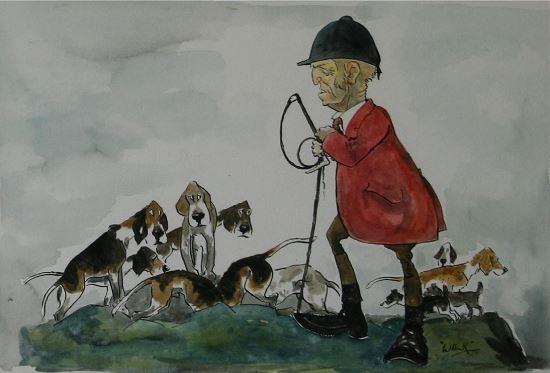 Chappie, painting by Wilk, reproduced with permission
One morning in the early 1960s, a young lad took a day off school to go hunting; he had planned it down to the smallest detail. Hounds were meeting in the Troutbeck valley at 9:30, but that was on the other side of the 1601-foot-high fell known as Wansfell Pike. As usual he left home about 8:15 am but instead of heading for the playground near the church to meet his mates and play football, he turned left at the Salutation Hotel and took the road for Wansfell.
The time he should have started school saw him climbing the track about half way up the fell, and sometime after 9:30 he crossed the summit and stopped in the shelter of the wall to look and listen. The sound of hounds carried up to him on the breeze, and to his surprise they were running. (Later he found out that hounds had got on to a traveling fox literally on being loosed.) The fox took a straight line up the valley, crossed the road which ascends to the summit of the Kirkstone Pass and “holed” in the underground series of bunkers known as the Broad How Borran, high above the Troutbeck valley.
Some while later the lad arrived at the borran, short of breath, worn out, and thirsty, the sandwich he had quietly made the previous evening and slipped into his trouser pocket, long ago eaten…his school uniform woefully inadequate for the high fell, his uncovered legs glowing a healthy red, his school shoes so wet they squelched with every step he took. The huntsman standing alone on the borran greeted him with a word and a smile as the lad slumped on a nearby rock.
“Stiff climb, yon,” the huntsman said, indicating the slope the boy had struggled up with his walking stick, “hasta gitten thy breath back?”
The lad was no longer gulping in air and, after composing himself, replied to the affirmative. He looked around, “Where is everyone?” he asked.
“Only us,” was the reply. “Bruce [the Master] had to go out, and yon buggers (again he indicated with his stick down the valley to where several cars were parked, their occupants leaning against the roadside wall) don’t want to get their shoes dirty.”
The young lad looked at the borran entrance where a desultory hound was still baying, the others appearing to have lost interest. “Is it deep in, then?” he asked, suspecting that was the reason for the lack of interest on the part of the hounds.
“Aye,” was the reply, “bad spot for terriers, we will have to leave the bugger.”
The lad shuffled on his rock; he was starting to get cold in the biting autumn wind. “What are we doing?” he asked.
The huntsman thought for a moment, “I’ll teck t’ hounds into them bracken beds in t’ bottom, by t’ beck,” he replied, “good spot to find yan; thou stay here and if one tries to get in, shout like hell and throw a stone at it.”
With that he summoned his hounds and cast them into the bracken beds lower down the fell. During the course of the morning three foxes got into the borran, despite the best efforts of the young lad to keep them out. He ran around so much that when the huntsman returned to the stone heap by the borran he noticed the lad had a sweat on. They sat together on the rocks for a few minutes and the huntsman finally asked a question which had been on his mind for some while.
“Shud tha not be at school?” he asked.
The lad walked home, his shoes still squelching, with the huntsman and his hounds, to the inevitable bollocking from his parents and the second installment at school the following day.
But that’s the day I treasure, for I’d spent it with my hero, the legendary Anthony Chapman.
Posted April 10, 2016
Anthony Chapman was born in 1914 at Rydal near Ambleside. He became whipper-in to Ernie Parker of the Coniston Foxhounds in 1932 and huntsman in 1944. Chapman retired thirty-two years later in 1976 and passed away in 1982. Click for more of Ron Black’s fell hunting stories, reports, and books from Cumbria.