
Nostalgia: a sentimental longing or wistful affection for the past, typically for a period or place with happy personal associations. Tradition: the transmission of customs or beliefs from generation to generation.
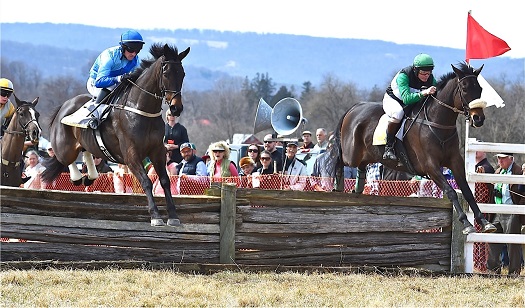 Up close and personal at the 2014 Piedmont Point-to-Point / Douglas Lees photo
Few events embody more fully the combination of nostalgia and tradition as does a day of point-to-point racing sponsored by the local foxhunting club. These races are a living link back to the days when fast horses flew over open country while the local folks cheered them on.
The running of the first hunt point-to-point is believed to have been hosted by the Warrenton Hunt (VA) on March 24, 1934. This was a time when Lowell Thomas narrated Movietone newsreels, which often featured updates on horse racing to the delight of a national audience. On that March day in ’34, an unassuming yearling colt, who would soon capture the imagination of the entire country, was frolicking in his pasture in Lexington, Kentucky. His name was Seabiscuit.
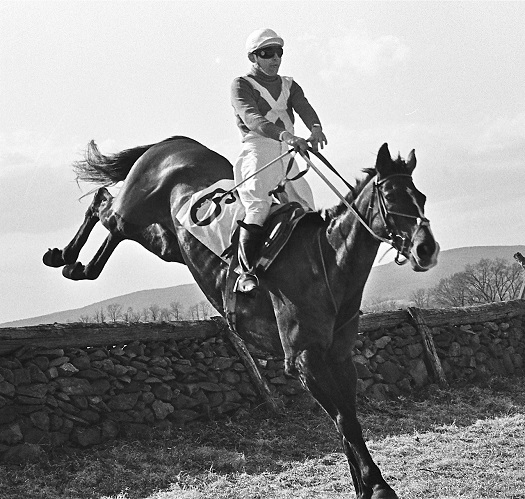 The late Dr. Joe Rogers, MFH riding King of Spades at the Piedmont Point-to-Point in 1971 / Douglas Lees photo
Some things have changed since those days, but much remains the same. At the core, what drew people to the hunt races all those years ago still draws folks today. Tailgate parties abound: tasty food and drink, the company of good friends, a beautiful outdoor setting, and an action-packed schedule of horse racing up close and personal. It’s partying, throwback-style.
Many of the attendees are, of course, part of the horse community themselves. Members of the local foxhunting clubs always turn out in large numbers. But you need not know a forelock from a fetlock to enjoy every minute of the event.
The more dedicated followers of the sport recognize how these races have transitioned into a different format over the years. Today, the races are not actually run from “point-to-point” as they were when competitors chose their own route from the starting point to the finish point. (They chose their line based on their knowledge of the country and their horse, the shortest line not necessarily being the best choice.) Today the course is an irregular circle with the start and finish lines in the same general area. And the jumps, while similar to the natural obstacles faced in the early days, are manmade replicas.
The profile of the participants has also varied to suit different needs. In one sense, the change has come full circle. To understand this requires some background on the difference between point-to-points and sanctioned races. The latter are largely the domain of professional and semi-pro “amateur” jockeys riding high value racehorses under strict rules established by a national governing body. But, historically, “steeplechasing” (riding from one church steeple to another on the distant horizon) was a way for foxhunters to compete against each other for fun, challenge, and bragging rights. (The first person to ride a horse inspired a revolution in transportation. The second person inspired competition.)
Over time, though, the intensity and governance of this type of racing increased. Consequently, those who wanted to ride their own horses during foxhunting season and then have some fun racing against each other between seasons were frozen out.
So, in the good-old can-do fashion for which foxhunters are famous, members of the Warrenton Hunt hosted the first cross-country race in modern times for hunting men and women designed to fill this void.
And fill the void it did! The May, 1934, issue of *Polo* magazine called this first point-to-point “one of the most sporting days one could hope to witness or take part in.” Fourteen of the boldest men and women from the Warrenton and adjoining hunts started at Jeffersonton in Culpeper County to run six miles across ditches, streams, the Rappahannock River, and countless fences to finish beside the stables of R.C. Winmill’s “Clovelly” on the Springs Road. Still part of Warrenton’s hunt territory today, “Clovelly” stands directly across from Elway where the club’s kennels are located.
Despite the six miles of cross-country racing, the finish was closer than many six-furlong sprints at your closest flat track. The first to jump in and land on “Clovelly” were the great race rider Bill Streett and the equally great Sterling Larrabee, Master of Old Dominion Hounds, only about three lengths apart. They battled through the crowds to the finish line where Larrabee’s Harkaway had a little more left and just beat out Street’s Independence Boy by a short length.
Warrenton’s initial success in 1934 started a movement that swept quickly through the Virginia hunting country. Other local hunting clubs soon followed suit, each with its own cross-country course for an “old-fashioned” point-to-point race meet.
Today, most hunt point-to-points are run on a specially-constructed course rather than cross-country, and spectators are afforded a panoramic view from their tailgate spots on a nearby hillside. While the participants are once again made up mostly of professional riders and non-hunted horses, with just a few actual foxhunters still in the game, these races haven’t lost their “old-fashioned” flavor. Nor are the finishes likely to be any less exciting than when Sterling Larrabee narrowly edged out Bill Streett. This may be the more casual “point-to-point” format, but it also serves as an excellent warm-up for horses that will be competing for hefty purses in the sanctioned races to be run later in the season.
Perhaps the most striking difference between the hunt point-to-points and the late season sanctioned meets is the “small town” intimate ambiance of the hunt meet compared to the “major event” atmosphere and crowds of, say, the Virginia Gold Cup. Both have their appeal, and the contrast is worth experiencing.
Click for information and for the full schedule of point-to-point and steeplechase racing in Maryland, Virginia, and the Delaware Valley. Click here for the schedule of sanctioned meets along the entire East Coast.
Posted April 1, 2016
A similar article by J. Harris Anderson first appeared in Fauquier Now.