
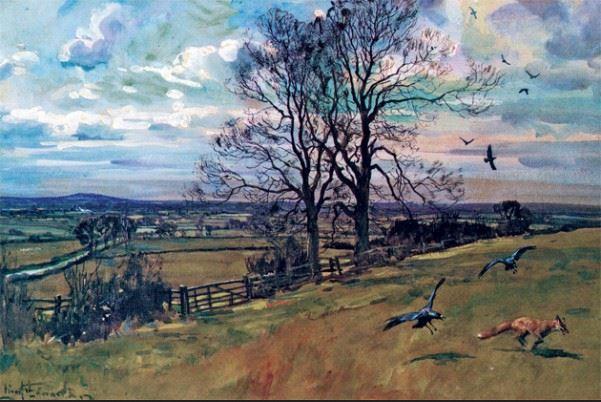
 The Mockers, 1925, by Lionel Edwards, gouache (click painting for a larger version)
In a recent Country Life article, Michael Clayton proclaims The Mockers by Lionel Edwards to be his favorite painting.
Clayton is former editor of Horse and Hound, author of numerous books, and well-known as Foxford for his long-running series of hunting reports in “Foxford’s Hunting Diary.” Clayton has probably hunted with every hunt in the UK over his long career as a sporting correspondent, and has personally known certainly all of the British contemporary artists of note. Because I respect Clayton’s opinion, because I’ve loved Lionel Edwards’s work ever since I first started hunting, and because I was sufficiently struck by the drama of the scene, I thought that Foxhunting Life readers might appreciate the painting as well.
“I have seen foxes ‘mocked’ in this way by birds,” says Clayton in the Country Life article. “It symbolises just how tough nature can be.”
Indeed, the fox is not only running from a pack of hounds, seen as mere white dots in the far distance at the left, but is being cruelly mobbed by the diving, swarming crows. The masterful rendering of the landscape under a somber sky, typical to the English Shires, was one of Lionel Edwards’s special talents. What was not so typical was this view of quarry and birds in the foreground, with horses and hounds—Edwards’s usual subjects—mere suggestions in the background.
The term, “mocking,” also caught my eye. I’ve never seen it used that way; I’ve always been more familiar with the term, “mobbing,” to describe a flock of birds harassing a predator and loudly marking its presence to the world.
Lionel Edwards (1878–1966) was a prolific painter of foxhunting scenes and produced racing, shooting, and angling works, as well. He was a foxhunter himself, and his obituary in the London Times noted that “his remarkable ‘eye for country’ was that of a man who sees the landscape from the saddle.” This painting, The Mockers, finished in 1925, is based upon one of the artist’s fast, on-the-spot pencil sketches, as were many of his works.
Edwards painted numerous commissions, wrote nearly thirty books, and illustrated many more including editions of Black Beauty, Lorna Doone and The Black Arrow. He also illustrated articles for the leading British sporting magazines.
The son of a doctor, Edwards grew up in North Wales. He acquired his love of foxhunting from his father, but was just seven when his father died. He showed artistic talent early, drawing horses. Though he was headed for a career in the Army, his innate talents pointed elsewhere, and his mother allowed him to study art in London. At nineteen he became the youngest member of the London Sketch Club. He married in 1905 to an equally enthusiastic foxhunter, and the couple moved from London to the Shires. Edwards is said to have hunted with nearly every pack in Britain.
Upon the outbreak of World War I, Edwards volunteered as a Remount Purchasing Officer along with Cecil Aldin and Sir Alfred Munnings—his contemporaries in sporting art.
Lionel Edwards became a member of the Royal Cambrian Academy of Art in 1926 and the Royal Institute in 1927. Watercolor was his favorite medium, although in his later years he worked more in oil. He was still painting at age eighty-eight when he suffered the stroke that ended his life. Edwards died at home on April 13, 1966.
Posted December 16, 2015