
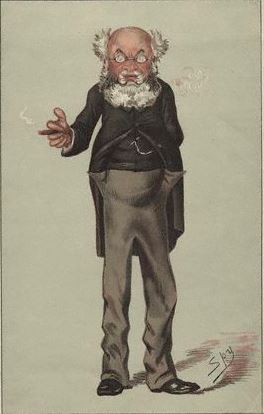
 Anthony Trollope by Spy in Vanity FairIn 1971, Michael Hart, a student at the University of Illinois, conceived the most wonderful notion. He had access to a computer that was part of the government-sponsored research network that ultimately became the Internet. He set himself a goal to make the ten thousand most consulted books available to the public, digitally, by the end of the twentieth century. He plucked a copy of the Declaration of Independence from his backpack, and it became the first Project Gutenberg e-text. Hart named the project after the German printer Johannes Gutenberg, who revolutionized the printing press.
Today, there are about forty thousand texts in the Gutenberg collection, including works by Somerville and Ross, G.J. Whyte Melville, and other superb writers of foxhunting stories. Many are in the public domain and may be downloaded and freely reproduced. Periodically, we select a favorite and extract a selection both for your enjoyment and as a reminder of the wealth that Project Gutenberg keeps in store for us.
With this year marking the bicentennial of the birth of Anthony Trollope, a popular English novelist of the Victorian Era who tucked foxhunting scenes into most of his novels, we offer an excerpt from The Duke’s Children (1880), the last volume in his Palliser series.
Trollope had an unhappy childhood and an unsuccessful early career with the Postal system in England. In debt, he was relieved to be transferred to Ireland as a postal surveyor, where his salary and travel allowance went much further than they had in London. He took up fox hunting, which he pursued enthusiastically for the next three decades, and he found the Irish to be pleasant company. “The Irish people did not murder me,” he wrote, “nor did they even break my head. I soon found them to be good-humoured, clever—the working classes very much more intelligent than those of England—economical and hospitable.”
From Chapter LXII, “The Brake Country”:
“You’ll cross the ford, Fowler?” asked Mrs. Spooner.
“Oh yes, ma’am; we couldn’t draw the Daisies this afternoon if we didn’t.”
“It’ll be up to the horses’ bellies.”
“Those who don’t like it can go round.”
“They’d never be there in time, Fowler.”
“There’s a many, ma’am, as don’t mind that. You won’t be one to stay behind.” The water was up to the horses’ bellies, but, nevertheless, Mrs. Spooner was at the gorse side when the Daisies were drawn.
They found and were away in a minute. It was all done so quickly that Fowler, who had alone gone into the gorse, had hardly time to get out with his hounds. The fox ran right back, as though he were making for the Duke’s pernicious wood. In the first field or two there was a succession of gates, and there was not much to do in the way of jumping. Then the fox, keeping straight ahead, deviated from the line by which they had come, making for the brook by a more direct course. The ruck of the horsemen, understanding the matter very well, left the hounds, and went to the right, riding for the ford. The ford was of such a nature that but one horse could pass it at a time, and that one had to scramble through deep mud. “There’ll be the devil to pay there,” said Lord Chiltern, going straight with his hounds. Phineas Finn and Dick Rabbit were close after him. Old Fowler had craftily gone to the ford; but Mrs. Spooner, who did not intend to be shaken off, followed the Master, and close with her was Lord Silverbridge. “Lord Chiltern hasn’t got it right,” she said. “He can’t do it among these bushes.” As she spoke the Master put his horse at the bushes and then—disappeared. The lady had been right. There was no ground at that spot to take off from, and the bushes had impeded him. Lord Chiltern got over, but his horse was in the water. Dick Rabbit and poor Phineas Finn were stopped in their course by the necessity of helping the Master in his trouble.
But Mrs. Spooner, the judicious Mrs. Spooner, rode at the stream where it was, indeed, a little wider, but at a place in which the horse could see what he was about, and where he could jump from and to firm ground. Lord Silverbridge followed her gallantly. They both jumped the brook well, and then were together. “You’ll beat me in pace,” said the lady as he rode alongside of her. “Take the fence ahead straight, and then turn sharp to your right.” With all her faults Mrs. Spooner was a thorough sportsman.
He did take the fence ahead,—or rather tried to do so. It was a bank and a double ditch,—not very great in itself, but requiring a horse to land on the top and go off with a second spring. Our young friend’s nag, not quite understanding the nature of the impediment, endeavoured to “swallow it whole,” as hard-riding men say, and came down in the further ditch. Silverbridge came down on his head, but the horse pursued his course,—across a heavily-ploughed field.
This was very disagreeable. He was not in the least hurt, but it became his duty to run after his horse. A very few furrows of that work suffice to make a man think that hunting altogether is a “beastly sort of thing.” Mrs. Spooner’s horse, who had shown himself to be a little less quick of foot than his own, had known all about the bank and the double ditch, and had, apparently of his own accord, turned down to the right, either seeing or hearing the hounds, and knowing that the ploughed ground was to be avoided. But his rider soon changed his course. She went straight after the riderless horse, and when Silverbridge had reduced himself to utter speechlessness by his exertions, brought him back his steed.
“I am,—I am, I am—so sorry,” he struggled to say,—and then as she held his horse for him he struggled up into the saddle.
“Keep down this furrow,” said Mrs. Spooner, “and we shall be with them in the second field. There’s nobody near them yet.”
Posted November 13, 2015