All civilized societies adopt rules of etiquette and conventions that allow individuals to interact without conflict. By the same token, unique activities, and especially those involving a measure of risk (motor driving, sailing, foxhunting), develop of necessity their own unique rules and conventions to help assure a safe and pleasant outcome at the end of the day for all participants. Thus, the courtesies and conventions of the hunting field, developed over the centuries, aim to produce an environment in which an exuberant sport may flourish pleasurably and safely. As each new season begins, it is never inappropriate to remind ourselves of the courtesies we owe to our landowners, Masters, staff, hounds, and fellow field members.
Landowners
If there is one single overarching concept to understand about foxhunting, it is that we are guests on someone’s land and enjoy our sport solely through his/her goodwill. Without the landowner’s hospitality, there is no hunting. The question is: How do we maintain that goodwill? We answer that question every hunting day in the way we treat our landowners’ land, crops, and livestock.
• In general, commit no act that might test the landowner’s goodwill.
• Greet the landowner cheerfully and respectfully if you should see him/her.
• Arrive at the meet early enough to get tacked up and mounted before hounds move off. The Master does not want latecomers straggling over the landowner’s country, and the huntsman does not want latecomers heading the fox if it has circled back. If you are unavoidably late, stay to the roads after mounting up and wait for the best opportunity to join the field.
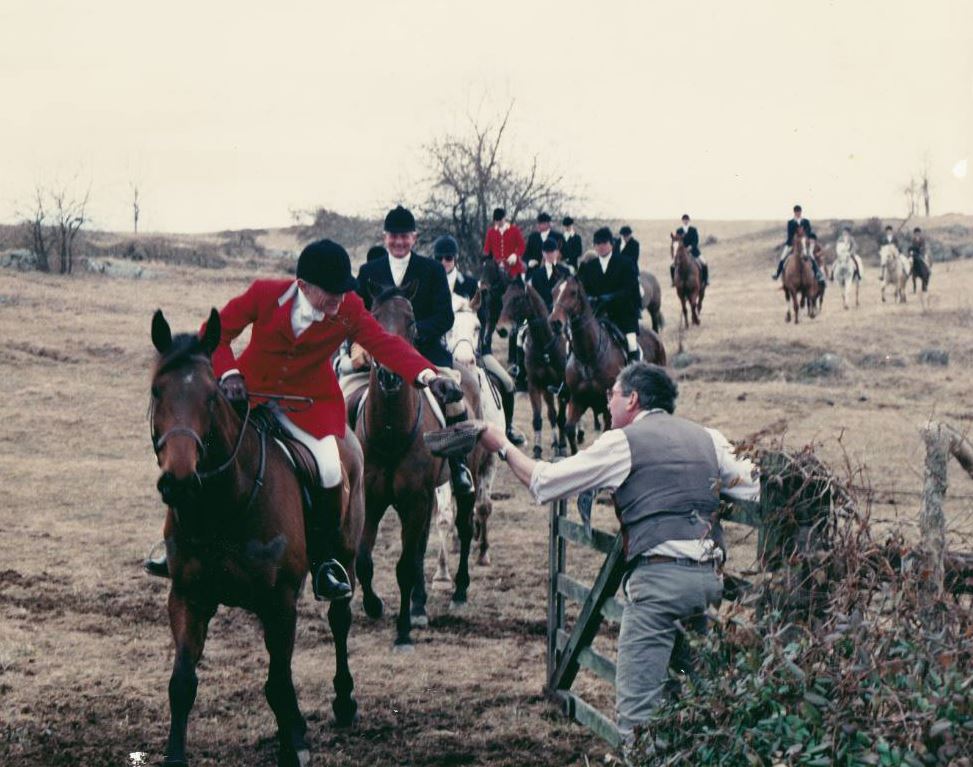
• All gates should be left as you find them. Closing a gate that was open might deprive livestock of their access to water. Leaving a gate open that was closed may allow livestock to escape or mix improperly with other stock. When in doubt, close the gate and tell the Field Master what you have done.
• If the field is passing through a gate, listen for the command as to what to do with the gate. If it is to be closed, you will hear, “Gate please.” If it is to remain open, you may hear no command at all, but you may hear, “Gate open.” In either case it is important that you acknowledge with a signal that you have heard the command. Likewise, if you are giving the command to those behind you, be certain your command is acknowledged. That is the only way to be certain the command was heard.
• If a gate is to be closed, it is the responsibility of the last one through to close it. It is common courtesy for one or two riders near the back to remain behind to help if necessary and to keep the gate-closer’s horse company.
• Never leave a gate for the second field or the hilltopping field to deal with unless they are close enough to acknowledge their understanding of what must be done.
• If a fence is damaged and cannot be repaired on the spot, advise the Field Master immediately so he or she can make appropriate and timely arrangements for its repair.
• Stay to the edge of all crop fields and seeded fields. If field members are crossing a pasture, it is best to spread out rather than erode a single track across the field.
• Slow down if livestock are running. Walk past dairy cattle. Walk past livestock during the calving, foaling, or lambing season. Do not ride between livestock and their offspring.
• Do not jump fences unnecessarily. You might break one and needlessly create a situation you have to resolve.
• Keep up with the field. If you are having difficulty keeping up, ask to be excused and fall back to the second field or the hilltopping field. Neither Master nor huntsman wants to see riders or small groups strung out across the country. The Master is concerned about the landowner, and the huntsman is concerned that if the fox doubles back it might be headed and the hunt spoiled.
• Unless you have specific personal permission, do not hack across private property on your own. Permission granted to the hunt does not bestow similar privileges on individual hunt members.
• Do not litter. Carry used food wrappers back home in your pocket.
• If you choose to leave the meet early, ask the Field Master if you may be excused and ask his advice regarding your route back to the meet. In general, you should hack back on the roads so as not to disturb any covert yet to be drawn.
• Do not sweep manure from your trailer at the meet. The landowner does not need your mess, nor should he have to worry about your horse’s de-worming regimen.
Master and Staff
The Master is the ultimate authority on any hunting day. His or her word is the law.
• Greet the Master politely upon arriving at the meet. Thank him and thank the staff at the end of the day. When departing, it is correct to say, “Goodnight,” even if it’s still morning!
• Don’t talk to the huntsman during the hunt. His attention is and should be elsewhere.
• Never come between the huntsman and his hounds.
• Don’t crowd the huntsman or his hounds.
• Don’t pass the Field Master. Follow, but don’t press. He is constantly revising his planned route based on how hounds are running, what the huntsman is doing, and how the terrain is unfolding.
• Be quiet when the Field Master stops. He is listening for hounds.
• The whippers-in and the huntsman have the right of way. Always defer to them and allow them room to pass. When standing, always point your horse’s head toward them as they pass.
• Never talk to a whipper-in during the hunt. His huntsman demands that he keeps his full attention on the hounds and the quarry. Any distraction at the wrong moment that causes him to miss something he should have seen can irretrievably ruin a hunt.
Hounds and Quarry
• Hounds always have the right of way.
• The worst crime one can commit in the hunting field is to allow one’s horse to kick a hound. You must do everything in your power to train your horse against this vice or punish your horse immediately if he commits such a crime.
• Never ride ahead of hounds or ahead of the quarry. Never get between hounds and the quarry.
• When hounds are drawing for a fox or casting after a check, remain still and quiet so as not to distract them.
• In general, never speak to a hound. That is the job of the huntsman and whippers-in.
• If hounds come near to you, turn your horse’s head toward them.
• If you view a fox, never startle it with a holloa. Its scent will change, and hounds will be confused. Wait quietly until it is some distance from you, then tell the Field Master what you have seen. Let the Field Master make the decision whether or not to holloa. If hounds are hunting well, the huntsman will not want to lift them and will not want them distracted.
Your Fellow Field Members
• Do not bring an unprepared horse into the hunting field. Of greater concern than the danger to yourself is the danger you pose to other innocents.
• If your horse is fractious or out of control, remove him from the hunt field immediately. Don’t bring him back until you have solved his problems.
• If your horse kicks out at other horses occasionally, braid a red ribbon into his tail and keep him in the back of the field. If he cannot be cured of the vice, find another job for him away from the hunting field.
• If someone is riding too close behind, and you are afraid your horse may resent it, place one arm behind your back, forearm horizontal at the waist, palm out. This is a universal warning that your horse might kick. Likewise, if you see the rider in front give you such a signal, fall back.
• Do not allow your horse to nuzzle, nip, or rub the rump of the horse in front of you. Even a non-kicker can be provoked to kick.
• Do not coffee-house and chatter while hounds are hunting, even if you are far removed from the pack. Other field members are trying to watch and listen.
• When warning other riders of holes or other hazards (i.e., ’Ware hole, ’Ware wire, etc.), turn and speak loudly enough to be heard only by the riders immediately behind you. Do not shout the warning so as to distract hounds. Point to the hazard with your whip, crop, or finger. If the warning has been repeated several times before you arrive at the hazard, and you think the people behind you are already alerted, it may only be necessary for you to point at it.
• When queued at a jump, be certain the rider in front of you is safely over before you jump.
• If your horse refuses a jump, go to the back and allow the other field members to jump ahead of you and go on. Everyone wants to keep up with hounds, and it is rude to prevent them from doing so if your horse is being obstinate.
• Before bringing a guest to your field, seek permission from your Master. If you bring a guest, introduce him to the Master as soon as possible. Your guest is your responsibility. Acquaint him with any local protocol and stay nearby to assist him.
Visiting
• If you wish to visit another hunt, contact the hunt secretary to determine what you must do to receive permission to hunt.
• It is not correct, when visiting another hunt, to wear the colors of your own hunt without the Master’s permission or the Master’s specific invitation to do so. Customarily, gentlemen and ladies wear black (also navy blue if a lady) frock or regular hunting coats when visiting.
• Seek out the Master and introduce yourself as soon as possible.
• Seek out the Field Secretary and pay your capping fee and sign a release form before you get on your horse. It is appreciated when your payment is enclosed in an envelope bearing your name and address.
Posted September 15, 2015
This article is a permanent resource on the Foxhunting Life website under the “Resources” dropdown menu. Click on “Etiquette.”
The article was adapted from Norman Fine’s “Introduction” to Hugh Robards’s Foxhunting: How to Watch and Listen, The Derrydale Press, 2006 with permission. In his book, Robards engagingly informs foxhunters, new or experienced, how to more fully absorb the drama of the hunt. What is the huntsman doing? Why does he do that? What about the whippers-in? The Field Master? The hounds? The fox? What problems do each encounter in the field during the course of a typical hunt? What decisions must they make? Robards’ book is available here.