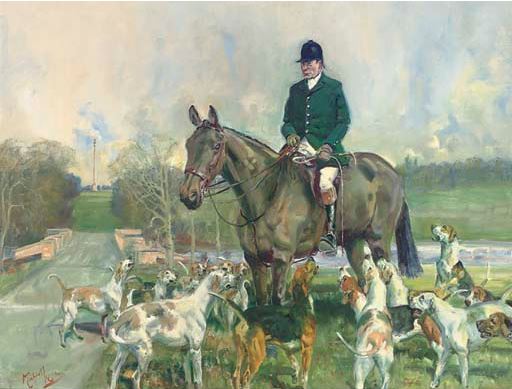
 Captain Ronnie Wallace with hounds while Master of the Heythrop / Oil portrait by Michael Lyne
Captain Ronnie Wallace, MFH was the undisputed dean of British foxhunting and a frequent and popular visitor to the U.S. He was a genius in the art of venery and in his uncanny breeding sense. He was arguably the English breeder most influential in the development of today’s modern English foxhound.
It’s been thirteen years since Captain Wallace died in an automobile accident at age eighty-two, yet whenever hunting conversation turns to amazing feats of hound work performed by a superb huntsman, I’m reminded of an astonishing story that illustrates Wallace’s supremacy.
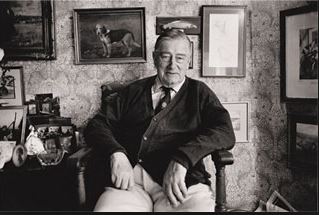 Wallace was obsessed with hunting from the start. At age seven, he was hunting his own pack consisting of terriers, beagles, and a Labrador retriever. At age sixteen, he was the youngest ever to be appointed Master of the Eton College beagles. He proceeded to set records in the field that have never been approached before or since. He was, for twenty-five years, Master and huntsman of the Heythrop, that period subsequently referred to in England as the “new golden age of hunting.” For the last twenty-five years of his life, he was Master and huntsman of the Exmoor. During a full life of hunting, he had also been Master of the Christ Church beagles, the Ludlow, the Teme Valley, the Cotswold foxhounds, and the Hawkstone Otter Hounds, which he particularly adored.
His goal was perfection—always—in breeding and in performance. Wallace was revered by his countrymen, whom he served for over twenty-two years as chairman of their Masters of Foxhounds Association, after which he was made president for life.
Robin Roderick-Jones wrote, “Perhaps the most graphic description of Wallace’s unique skill comes from Michael Clayton, the editor of Horse and Hound who, having hunted with practically all the 196 packs of foxhounds in the United Kingdom, is better placed than most to make comparisons:
“It was toward the end of the day and there were not many of us left. Ronnie stood at the side of the wood and said, ‘Shut up all of you. Stand absolutely still and I want to hear no halloa-ing. Not a sound.’
“With that he disappeared into the covert with his hounds. Foxes came out in all directions but not a single hound. I was astonished; this was quite incredible. Eventually a fox emerged, presumably headed in the direction that Ronnie wished it to go and then came the pack; hunting as one they swept off like a carpet. I don’t remember seeing Wallace and we had a fast and brilliant twenty-five minutes round the Evenlode Vale, hounds catching and killing their fox just in front of us. I looked up and the Master of the Heythrop trotted through a gateway, dismounted, told the bitch pack that they’d been ‘rather good girls.’ It was an astounding performance and one that I have never seen matched….[N]obody else could do that. (Ronnie Wallace: The Authorized Version, Quiller Press, London, 1992)”
Captain Wallace possessed the self-confidence to remain always open to new ideas and new bloodlines, and he is surely the Englishman most responsible for the introduction of American bloodlines into the English foxhound.
Hugh Robards, ex-MFH, now huntsman of the Middleburg Hunt (VA) was second whipper-in to Captain Wallace at the Heythrop in the 1960s. “For me, there will never be another man like him,” Robards wrote. “Certainly no man will ever match him in the hunting of the fox or in organising a country. He has done more good for foxhunting than any other man alive or dead.” (Foxhunting in England, Ireland, and North America, The Derrydale Press, 2000)
C. Martin Wood III, MFH and huntsman of the Live Oak Hounds (FL), a protege and disciple of Wallace’s breeding theory and hunting practices, said, at the time of Wallace’s death, “A great era in the history of foxhunting has closed. Starting just after World War I through to the present, men like Isaac Bell, the Tenth Duke of Beaufort, Newton Rycroft, Sir Peter Farquhar, and Ronnie Wallace transformed the English foxhound into the beautiful, active animal it has become.”
Posted July 17, 2015