
In juxtaposition to these times of fast and affordable air travel to and from England and Ireland for hunting holidays, here’s a look back to a 1924 account of a leisurely (and dramatic) father-daughter sea voyage—their first—to go foxhunting on the other side. It was also a different era for world events, as readers will note.
Author Charles D. Lanier was MFH of the Fairfield County Hounds (later the Fairfield and Westchester Hounds) from 1915 to 1921. His seventeen-year-old daughter, referred to as “B,” was Becky Lanier, later Becky Sharp, MB of the Nantucket Beagles, and still later Joint-MB of the Nantucket-Treweryn Beagles, who, along with her husband Joint-MB David “Bun” Sharp passed away in 1987.
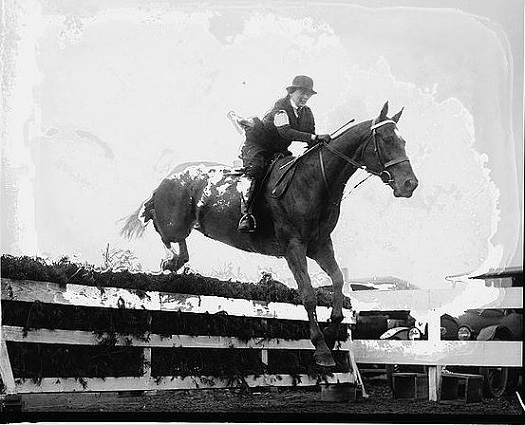 Becky Lanier, 1920
What follows is a condensed version of Chapter 1, “Outward Bound,” from Charles Lanier’s We Go Foxhunting Abroad: A First Venture with the Irish Banks and English Downs published in 1924. Subsequent chapters in condensed form will appear through the remaining summer months.
We sailed from New York on the President Roosevelt on January 19th, with more than two months before us to try the foxhunting of the Old Country.
The adventure had been talked of for two years, but not as a very real thing. I had not been away from work so long for thirty-nine years. There were a hundred reasons why the thing could not be done and only one why it should be done—that we wanted to go off and have a good time together. The final and deciding impulse came in B’s retirement from “showing” our hunters, in which she had been accumulating more or less notoriety since she was nine years old. We had had a lot of fun together in this, but with B seventeen years old and coming to be a young woman, it seemed better to close the chapter.
We had never hunted on the other side; we were the greenest and most self-conscious of travelers; we knew no one in the hunting countries to be invaded; we took no horses nor even a saddle; a small bundle of letters of introduction, scarcely half a dozen of them to people having any active affiliations with horses and hounds, some addresses of English and Irish worthies reputed to have hunters for hire, and kits of hunting apparel of sorts,—formed our entire sporting capital.
It was really a very juvenile expedition, despite my years—very like two youngsters starting westward, on there own, to be cowboys and fight Indians. But it had the quality of its defects—the imagined things beyond the horizon, the tang of uncertainty, the sense of palship, the feeling that whatever came of it would be something new to our experience.
As nearly as we had a plan it was to go, after a day or two of shopping in London, to the South of Ireland to hunt there with one pack or another through February; then March in the South of England with the Cattistock, the Blackmore Vale and the Duke of Beaufort’s, with a hasty pilgrimage to the Grand National on March 28th as a finale. A day or two with one or more of the “fashionable” hunts in the Midlands simply to give B the sensation of viewing one of these elaborate functions with four or five or six hundred riders in the field, was tentatively on the program, but we were quite aware that with such crowded fields two stray Yankee strangers would see little of hounds, or of the English countryside and country life, such as we hoped to view with the provincial hunts where hounds might be just as capable and Masters and the smaller fields just as keen as any in the “Shires.”
The Roosevelt we had selected [through a recommendation] and because of the very moderate rate at which we secured two splendid staterooms and a bathroom between, one room for B and the faithful Sara and one for me. A steady, orderly 7-day boat she proved to be, with a hospitable, cleancut American captain, a table loaded with food of great variety and good quality and personal service difficult to obtain on the “floating palaces” and “ocean greyhounds” proper. In consequence of a letter from Cliff Mallory to someone occupying a seat of the mighty, we found ourselves very much cared for in every way. We were seated at the Captain’s table, along with Judge S. of Buffalo and his wife and mother and Baroness Wrangel, wife of the General commanding the last White Russian Army, the one crowded off the tip of the Crimea by the Bolshevik hordes on that last dramatic night of organized resistance to Lenine and Trotsky.
It seemed rather an anticlimax that such a romantic figure, fresh from indescribable perils, hairbreadth escapes and hardships of every sort, recited to us very convincingly, should succumb to seasickness among the first of all on board and be utterly miserable throughout the voyage. She assured us that the horrors of the Crimean campaign and embarking 130,000 soldiers in a single night, when the Wrangel army was pinched off the peninsula, were unconsidered trifles compared to the roll of the Roosevelt.
There was some excuse for her; after two days of moderate weather a howling nor’west hurricane overtook us and shrieked for three entire days, with squalls, every half hour or so, of blinding snow and sleet. The Captain disappeared from the passengers’ ken; porthole were screwed tight for the entire time and wardrobe trunks, cavorting about the staterooms, did all the dancing that was indulged in on board. It was a case of tying oneself in one’s bed. When the captain reappeared, he made us feel better by estimating the hurricane at 100 miles an hour, with “more in the squalls.” He added that it was by far the hardest blow he had known in his twenty-five years of seafaring, and that he was frankly uncertain at times what to do in the matter of the ship’s engine speed; trying first full speed and then losing his nerve and going to half, and vise versa.
Quite the most dramatic sea sight of our lives came in the midst of it, when there was a report that we were passing another ship. The few who had ventured topside crowded to the deck windows, or to those that had not been smashed by the big combers.
For a few moments a blinding snow squall shut us off from everything but the crest and trough of one mighty sea; then, as quick as one can say it, the storm veil lifted for a moment, brilliant sunshine appeared on an utterly white waste of ocean heaved into waves a quarter mile from crest to crest; and as we rose on one of these—there, with every detail distinct, pitched and wallowed a great Cunarder, engines scarcely keeping her into the wind, screws racing out of every wave, and seemingly close enough to throw a stone onto her decks—though doubtless she was actually a mile away. It was one of those visions of an instant, of such beauty and drama as to live with one forever.
I have the well-earned reputation of being the second worse sailor living. When in 1905 I had boarded the Blucher at Hoboken, I became actively ill on my way to the stateroom while the ship was yet steadfastly secured to her dock.
So much more unnatural, then, was it that I did not have one squeamish moment during our big storm nor at any time in our travels, not even in the notorious Dover-Ostend crossing, when we thrashed into the teeth of a northeaster, and only two passengers appeared for lunch. On the contrary, I ate three good meals a day on the Roosevelt, walked five or ten miles on deck in the afternoon, enjoyed every moment of the voyage, and none more than when, after dinner (preceded by a salt water plunge), I would light a pipe in my stateroom, cock up my legs to brace the trunk into reasonable equilibrium and listen to B read about “The Master of Ballantrae” or “David Balfour.”
This state of rude health is not important or interesting, except for the fact that it sounds the keynote of our entire adventure. We were in luck at every turn; things that never had been good before were good on this trek; things that always seemed hopeless became enjoyable; things that were pronounced impossible came to pass, and tangles apparently inextricable straightened out as if magic were at work.
In intervals of Robert Louis Stevenson, we read the galley proofs of Harry Worcester Smith’s forthcoming book describing his sporting invasion of Westmeath, in Ireland, in 1912, when he took over his American hounds to hunt that country as Master—the only instance, I think, of the use of American hounds in the United Kingdom. He had thoughtfully sent us these advanced proofs and they are worth mentioning because the very detailed and voluminous account of his Irish experiences form excellent instruction for any foxhunter planning to hazard the Irish banks.
The volume is always keenly enthusiastic and full of details useful to a sportsman, with now and then a story carrying the true Irish tang. As for instance: a gentleman was in a hot “burst,” accompanied by a favorite groom on a young horse. The groom went down over an atrocious bank in a very bad-looking spill, indeed, and lay still as death while his horse got up and galloped away. The gentleman rode back and called out, “Eamonn, are you hurt bad?” “Yes, Sor,” yells back Eamonn, “I’m unconscious.”
We reached Plymouth harbor near midnight on Saturday; there was quite a wait while the tender took off 6,000 bags of mail; when we set foot on Albion, we found ourselves, at 1:30 Sunday morning, faced by the railroad strike, no sleeping car on the night train to London, and any subsequent movement of rolling stock highly uncertain.
We secured two coach compartments on the train and proceeded to make ourselves as comfortable as possible for the night trip. B, swathed in her new coonskin coat, rolled over on a seat and was asleep before she finished rolling. I bundled up my feet and legs in rugs, Sara shrank in a corner away from the cold and thus we spent our first night in the United Kingdom.
Posted June 25, 2015