
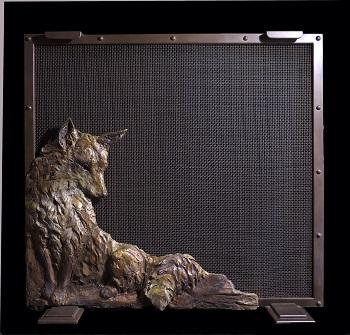
 “I felt that the story of the Zennor fox needed to be remembered,” writes Michigan artist Maureen Riley. “It tells the story of a fox, but more than that it tells of a sportsman’s love for a good day of sport and a sense of fair play.”
Maureen Riley is a sculptor and painter who has been steeped in the sporting life from an early age. She learned about gun dogs from her grandfather and about sculpture from his friend, Walter Midener. Shooting, fishing, and horses have always been a part of her life, and country sports are at the root of her art.
From her studios in Michigan, Maureen has exhibited her work at Safari Club events and at international exhibits in both Milan and Portofino, Italy. Her work has also been shown at the Smithsonian. She is a member of the Society of Animal Artists and the National Sculpture Society.
Maureen has just created an interesting new platform from which to present her bronze works—a fireplace screen that serves as a blank canvas for her limited edition and custom relief sculptures. Her first design on this “blank canvas” is titled the “Zennor Fox.” The work was inspired by a 1913 foxhunt with the Western Hounds near Zennor Hill in Cornwall. Here’s the conclusion of the hunt as written by a participant, the renowned English equine artist Sir Alfred J. Munnings.
“… I cannot leave out of these reminiscences the story of an end to one of these hunting days, when a fox ran to the cliff. It was a late afternoon in December. A small group of dismounted hunt followers and the huntsman, Tom Mollard, stood looking down where the fox had gone.
The cliffs were not steep, or difficult to descend, and soon the whip Jack and I had descended below, where the fox was curled up on a high rock, silhouetted against the sea behind him. Before I could stay his hand, Jack had flicked the fox with the lash of his whip, and with a sharp bark it jumped into the sea.
There were we watching the fox swimming for his life, and being lifted with a swell almost onto the rocks, and then dragged back again in the backwash until a wave, larger than the rest, landed him safe and there he clung. As the water left him, he looked like a small greyhound, with his sodden coat close to his side. The fox shook himself. Springing up to the next ledge, he climbed on and up, until finally he went into a wide crevice of the cliffs.”
‘Come on, Mr. Munnings,’ said Jack. ‘Let’s go and get him out.’
‘No, Jack, we don’t. That fox has run for his life and has saved himself. We’re going to leave him alone.’ I replied.
‘What will Tom say?’ he asked.
I replied that I didn’t care.
When we met Tom at the top of the hill, his response to Jack’s story of the events was, ‘That’s the last time we’ll ever let Mr. Munnings go down after the fox.’
Those who stood above watching the escape of the fox agreed with my sentiments. Seeing the fox struggling in the sea below, their suspense, they told me, became almost unbearable, and they felt like shouting for joy when they saw him saved by the large wave. What would Tom Mollard have thought of this expression of human weakness in the followers of the chase?”
Sculptor Maureen Riley has chosen to depict her Zennor fox quietly sitting on the fireplace screen, warming itself by the fire, a happy ending for a game fox.
Posted May 21, 2015