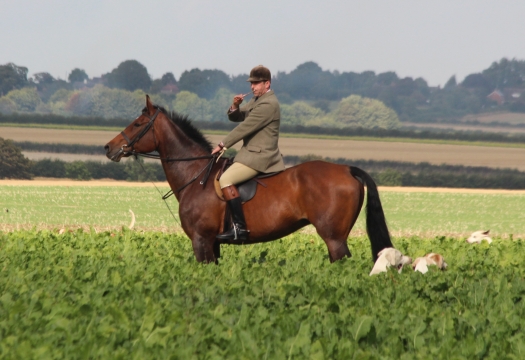
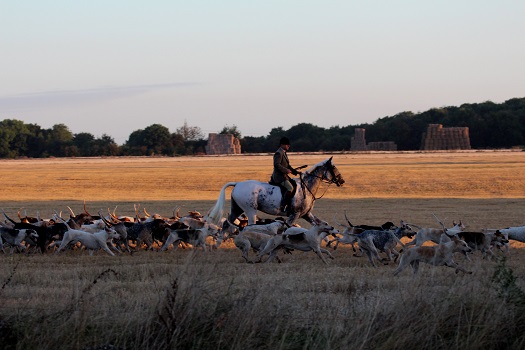
 Master and huntsman Adam Esom and the South Wold Foxhounds midst the sugar beets in Lincolnshire. / James Barclay photo
Join James Barclay—an ex-Master of five English foxhunts—for a personal and revealing tour of elite hunting establishments through Middle and Eastern England. Part 2 to follow.
This last summer has been one of the busiest for a while with a fair share of weekends spent judging various Puppy Shows, which is always a pleasurable thing to do, but sadly does nothing beneficial for the waistline! It is always nice to look at hounds during their restful period, and we can soon start to gauge what there is coming on from behind the scenes and start to assess the breed’s general standard.
On that note, it is a great relief to see a lot of nice hounds about, as there was a time after that dreaded day in February 2005 when the Hunting Act became law that many packs cut right back to a minimum. However, to see that confidence returning is most reassuring to all of us who take the breeding of the Foxhound seriously.
Now the time had come to dust off the camera and get out there and firstly to take some early morning pictures of hounds on exercise. This is a wonderful time of year as, given the blessing of some good weather, harvest starts to move, and with those dewy late summer mornings and a hint of mist in the air, our countryside comes to life in a way any true hunting man knows. So visits to Badminton, Belvoir and the Bicester were a particular pleasure this year, as last summer, I had decided to cover most packs in the Eastern Counties as well as the Midlands.
The combines began to roll in Lincolnshire and Nottinghamshire somewhat earlier than normal this time, whilst the West Country was blighted by wet weather coming in over the Welsh Hills. This delayed their start dates considerably, but gave us up here a clear advantage in being able to kick on during the last week in August. As a result, it has been a fascinating informal season of touring during which I went out with twenty-one packs in just two months, the last of which on the morning before the first of six Opening Meets!
South Wold
The season started for me with the South Wold Hounds meeting on the neighbouring farm to my home here in Lincolnshire. Although virtually all draft hounds, for reasons well beyond the scope of our story this day, they have jelled together well under the watchful eye of their Joint-Master and huntsman Adam Esom. Many an expert could be deceived into thinking that they had been bred by the same person for a considerable number of years. When, however, a huntsman is fortunate enough to have the golden thread between himself and his hounds, he or she will soon bring out all that is best in the pack.
Hounds are in many ways are not too dissimilar to children. They must be given the opportunity to gain confidence and develop, whilst learning right from wrong. To achieve this it is important for their boss to have patience, and it is here that word has been put into action and worked. On this the first morning, they went out in what was a bad scenting time and hunted with patience whilst producing a very good start to the season.
The large numbers of people hunting during the early part of this season is most encouraging to see, none more so when I visited the Blankney two days later. They have new Masters here who are most enthusiastic to do the job properly and keep the standards high. Philip Stubbings has hunted these hounds for a considerable number of seasons, and it is fascinating to watch the way he hunts them. (More on that later, when I return to the Blankney.) For now though, it is important to recognise the considerable support and help Philip has given Adam in reviving the breeding fortunes of his neighbouring South Wold Hounds by furnishing him with some exceptionally good drafts.
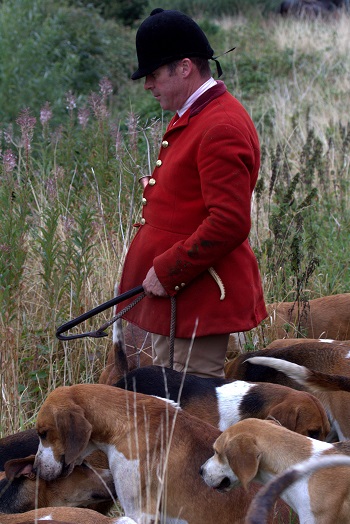 Belvoir huntsman John Holliday and hounds / James Barclay photoBelvoir
A day or two later it was off to the Belvoir for their Aswarby meet. The Plein family and their Keeper Robin Nunn are always most welcoming. There could hardly be a better place in the British Isles for young hounds to be able to learn their trade, and with their experienced huntsman John Holliday at the helm, it was a pleasure to observe them being handled in a way which achieved maximum results. It was on a second day in the early part of September when I was to see their Pure English (also known as Traditionally-Bred or Old English) hounds, noses to the ground, hunting hard and well as a pack.
There have always been long discussions (and arguments!) about the Pure English hounds (such as those at the Belvoir) versus the Welsh (such as those I was to see two days later with the Bicester and Waddon Chase, a pack of hounds which, though Modern English, have a goodly amount of Welsh in their genes). Comparing the two was fascinating. The pure English bitches at the Belvoir are quick. They fly on with speed, yet turn accurately with the line. The Welsh crosses certainly seem to add lower scenting abilities as well a voice.
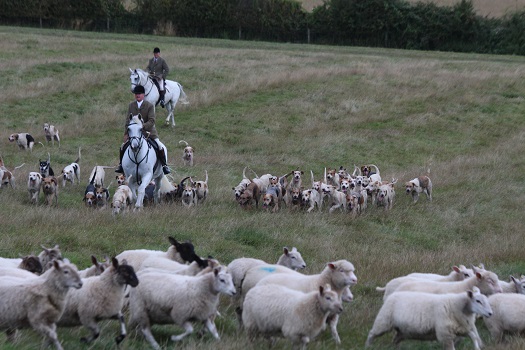 Huntsman Patrick Martin and the Bicester with Waddon Chase foxhounds in Buckinghamshire / James Barclay photo
Bicester with Waddon Chase
The Welsh influence was introduced to the Bicester by Captain Ian Farquhar, with lines going back to the Plas Machynlleth Miller line via New Forest Medyg and the Vale of Clettwyr line when he brought their Falcon and Fairy down from the Welsh hills! Many amusing stories abound about the hunting abilities of these rough-coated hounds. The long and the short of it is they have nicked in and hunt very well, and are pretty smart in their looks.
Back when the Captain was hunting the Bicester one day, a nice hunt was had, hounds had caught the fox, but they were some hounds short in the count. Brian Pheasey, his wonderful First Whipper-in and kennel huntsman eventually came up with the missing hounds, and the Captain turned round to him. “Where the bloody hell have you been Brian?” he demanded! With which came the reply, “Getting your bloody old sheepdogs out of the covert, Sir!”
Back to these times, a day with the Bicester with Whaddon Chase is always of interest, but with Patrick Martin hunting them even more so. Patrick has been kennel huntsman and huntsman here for twenty-one seasons, and hunting as a whole could not have had anyone more dedicated to the job. The style of his hounds hunting compared to that of the pure English may be different, but there is no doubt they are both effective.
To finish a morning back at the kennels is always interesting, but to hear Patrick talk about his time in hunt service, whilst feeding his hounds and treating any lame ones, was well worth listening to. He has seen great changes in the Bicester country such as new railroad lines and new highways, yet good sport is maintained.
 Huntsman Paul Larby and the Grove and Rufford foxhounds on Ossington Airfield in Nottinghamshire / James Barclay photo
Grove and Rufford
Whilst I was a Joint-Master of the Grove and Rufford, I always found it interesting to note huntsman Paul Larby’s intuition in not only hunting hounds, but breeding them as well. Paul had been first whipper-in at the Heythrop whilst I was there back in the very early 1980s. It was quite obvious even then he was going to be a successful huntsman, and when he departed to hunt the Eggesford it all became clear. He was given a nucleus of good Heythrop draft hounds when he left, and it is interesting to note that it is the breeding of those drafts that he has hung onto for the last thirty-five years, wherever he has been. So, seeing the results and winning at all the major hound shows is certainly a feather in the man’s cap. However, to see them hunting recently in their somewhat difficult Nottinghamshire Country is another.
Nose, drive, and cry are the all important ingredients in the makeup of the foxhound, and Paul’s hounds seem to have pretty well all of them. This is also somewhat due to keeping the old Grove and Rufford lines going, which undoubtedly had a decent low scenting ability. There will be pure English and Welsh going way back, but nothing immediate, so to watch and observe their style again in a hard country, which includes disused coal mines and power stations, lends a great credit to their performance.
One thing stands out a mile, whether it be the Grove and Rufford, Belvoir, the Bicester with Whaddon Chase, or any of the other packs I have been too. When the flag is down and the formal season commences, girths will have to be tightened and hard riding will be necessary to keep with them.
Posted December 24, 2014
James Barclay is a regular contributor to Foxhunting Life. A Master of five different hunts in England over a period of thirty years, he was born to the job. Members of his family have been Masters of the Puckeridge continuously since 1896. Click to visit his website and FaceBook page.