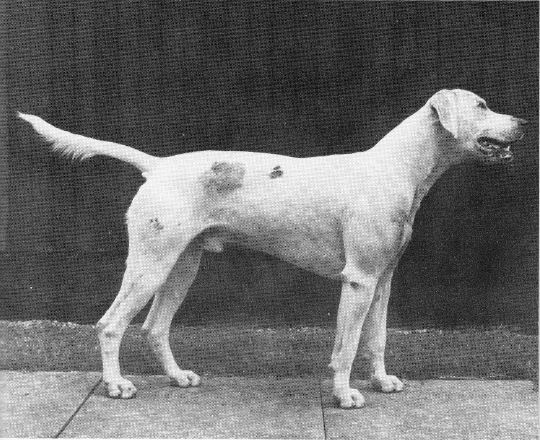
 Modern English Foxhound: Duke of Beaufort’s Monmouth 1977 by New Forest Medyg 1969
 Peterborough winner of the early 1900s — thick and ponderous — an example of the style of foxhound favored at the time.
Thousands of foxhunters and hunt supporters are expected to turn out in England and Wales on Boxing Day. Young and old, riders and spectators alike, entire families together for the holidays tumble out-of-doors the morning after Christmas for these traditionally celebrated meets.
“It’s the highlight of the season which starts in November,” said Peter Swann, MFH of the Curre and Llangibby Foxhounds in Wales. “This year we are expecting forty riders to take part and around five hundred spectators and supporters to join us on the green.
In Wales, the Curre and Llangibby and the Monmouthshire Foxhounds trace back to the 1600s and 1700s. The Curre remains of particular significance to foxhunters because we still see and enjoy the results of Sir Edward Curre’s bloodlines in our own Crossbreds and modern English foxhounds to this day.
It was Sir Edward Curre who provided Isaac “Ikey” Bell, father of the modern English foxhound, with the Welsh blood and the pale coloration of his breeding that has been preserved and carried on by forward-looking breeders in England ever since. Bell’s vision of the foxhound finally prevailed over the thick and ponderous, black-and-tan colored foxhounds that were fashionable early in the twentieth century. Bell’s efforts to breed lighter and more athletic foxhounds fell so afoul of the foxhunting establishment of the time that leading Masters would cross the street to avoid having to greet him.
The first recorded history of the Curre goes back to the late 1700s. In 1845 Edward Curre of Itton Court took over the Mastership of the hunt which became known as the Itton. In 1868 Mr. Curre turned the pack over to Master and huntsman Charles Lewis when the latter’s Chepstow Hounds joined with the Llangibby. In 1888 Mr. Lewis separated the packs once again, and Edward Curre became Master (1896 to 1930) and made it a private pack in his name. The most recent Curre and Llangibby amalgamation took place in 2000…for the second time since 1868!
Sir Edward Curre was a pioneering breeder and is responsible for breeding the pale coloration said to offer better visibility of hounds working at great distances in open country. His Danger 1915 sired the celebrated Brecon Paragon 1923 who appears in the pedigree of nearly all the best modern English foxhounds of today.
Danger is described by Daphne Moore (Foxhounds) as “a broken-coated dog, with a great reputation for courage and activity. It is said that wherever possible, he would fly his fences in the course of a hunt rather than waste time by going through them.” His was “some of the toughest blood of the day,” not then fashionable, as we have noted, but “full of Lord Henry Bentinck’s superlative bloodlines.”
Boxing Day meets generally take place in the center of a market town or on a village green. Traditionally, the Curre and Llangibby hounds meet on Devauden Village Green.
“It’s a good chance for families to walk off the Christmas puddings and get outdoors,” Peter Swann added. “Our riders range in age from members of the pony clubs to the retired; we have a good cross section of people from a range of professions.”
Although there have been many changes in how hounds are hunted since the passage of the Hunting Act of 2005, Mr. Swann says that the Curre and Llangibby remain an intrinsic part of the rural community. Indeed, when Boxing Day crowds are tallied across England and Wales, as is done each year, it will only affirm that mounted foxhunting lives on in the land of its birth!
Posted December 22, 12014
Sources include Ruth Mansfield’s article in the South Wales Argus, Baily’s Hunting Directory, and Foxhounds by Daphne Moore.