Fascinated by our summer series of articles about the WWI war horses on the occasion of the centennial of that horrific conflict, Noel Mullins, a regular contributor to Foxhunting Life, sent us this story that he wrote for this year’s Souvenir Programme of the Dublin Horse Show. Noel is a Member of the Royal Dublin Society Library & Archives Committee. His story is about Gladeye, a field hunter that went to war, survived, and returned to jump at the Dublin Horse Show in 1926.
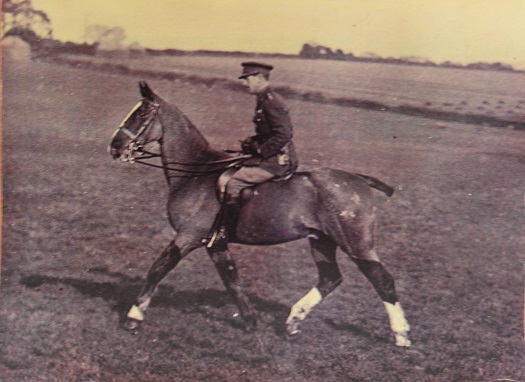 War Horse Gladeye and Brigadier Walter Brooke
This year marks the centenary of World War I, and ceremonies around the world remember the nine million human casualties lost in the conflict. But it is often forgotten that eight million War Horses also lost their lives, going through the most terrifying experiences known to any living creature. War was declared on the July 28, 1914 and was expected to end by Christmas 1914, but sadly it lasted another four years until November 11, 1918.
Probably the two most well known Irish War Horses in history were Emperor Napoleon’s white horse Marengo and the Duke of Wellington’s Copenhagen who met at the Battle of Waterloo. Both are said to have been purchased at an Irish horse fair. War Horses in the mounted cavalry units were deployed in many battles in the first years of WWI, amongst them, the battles of Mons, First and Second Battles of Ypres, Festubert, Aubers Ridge, Marne, Vimy Ridge, the Somme Hill, and Cambrai.
Remount Depots in Ireland
Irish War Horses also played their part in many other wars including the Crimean War and the Boer War. This year is the centenary of the use of the Royal Dublin Society Ballsbridge Grounds as a Remount Depot. On the August 4, 1914 the RDS Showgrounds in Ballsbridge were requisitioned by the British Army for the Army Service Corp Remount Service (ASC). That service was responsible for the provisioning of horses and mules to all other army units.
The Remount Depot at Lusk, County Dublin was already in existence and well established before WWI. There is a record of images of training exercises taken there in 1905. Military exercises also took place at the Bull Wall, and trench warfare was practiced at the Royal Dublin Golf Club.
A typical Remount Squadron consisted of two hundred soldiers who were supplied with up to five hundred horses at a time for training. In 1914 the British Army had four Remount Depots in place, Dublin in Ireland, and Woolwich, Arborfield and Melton Mowbray in Britain. Animals were obtained during the war by compulsory order in the UK, and by purchasing horses also from Spain, Portugal, India, China, New Zealand, and from North and South America. As the war expanded other Remount Depots were established in the UK like Shirehampton, Romsey,Ormskirk, and Swaythling, a collecting centre for horses trained at other centres for shipping overseas. Remount Depots were also set up in the Middle East.
It would appear that the RDS Remount Centre was what was known as a Base Remount Depot, receiving horses purchased by cavalry officers and from specialised horse dealers on farms and at horse fairs around the country. Interestingly British, French and German buyers often competed for horses at fairs. Both the RDS and Lusk had distinct advantages as locations to the British Army. Both had hundreds of stables and exercise paddocks, and they were also close to railway stations for shipping horses out at both the North Wall and Dun Laoghaire.
Light training was conducted at the RDS Showgrounds, but the main battle training was done at Lusk where an extensive farm had the facilities for more intensive training combined with the use of Rogerstown Estuary which was located a short distance from the stables near the village of Rush. Various military exercises were conducted, like swimming horses and their riders across the estuary and fording it with pontoons and boats. Horses were also trained to lie down to avoid enemy fire.
To the Front
Upon completion of training, horses were shipped out from the ports of Dublin, Belfast, Waterford and Cork. From there they either went through Swaythling or Melton Mowbray or on to the south of England for France. Horses were assigned for various duties: mounted cavalry, reconnaissance, and transportation. But after the first two years of the war it became apparent that, although for centuries mounted cavalry were an important weapon in military strategy, times had changed. The traditional tactics of the cavalry were crushed by the new technology of tanks, aircraft, tear gas, barbed wire, caltrops, machine guns, and miles of trenches. The casualties were so horrific that on the Western Front horses were instead deployed to move tons of ammunition and supplies to the front and take casualties back to field hospitals. As the Eastern Front and Middle East theatres of war were more open, mounted cavalry there remained an important battle strategy.
Gladeye Returns to Ireland
It is estimated that sixty-five thousand horses were purchased in Ireland during the war, and as was the practice only a few of the survivors returned home. One such horse was Gladeye, a chestnut with three white socks who started life foxhunting with the Cork and Meath foxhound packs and showjumping with his then owner Jerry Rohan in Cork. He went on to hunt with the Duke of Beaufort Hounds, and jump in Richmond and Olympia in the UK. He was owned by Brigadier Walter Brooke, originally from Castleknock in County Dublin, who later published a book Gladeye the Warhorse, Collins, 1939.
In the book the horse tells how he was foaled in County Galway in 1909 out of his dam called The Flirt—hence his name Gladeye! Brigadier Brooke joined the war in September 1914 where he was A.D.C. to General Sir John Kerr. Gladeye served in France, Egypt, and in Salonica, and surprisingly he and his cavalry officer found time to hunt in Flanders and in Bulgaria.
After the War
Gladeye competed in the Royal Dublin Horse Show in 1926, as that year’s Catalogue confirms. He was shown as a veteran War Horse at a show in Olympia and met the then Princesses Elizabeth and Margaret who presented him with sugar lumps. He died at the ripe old age of twenty-nine years.
Major General Brooke and his wife Dorothy founded the well known horse charity Brooke Hospital after seeing the plight of war horses working on the streets of Cairo in the 1930s. The charity has eight hundred people working in the field in eleven countries in Asia, Africa, North and South America, and the Middle East. The Blue Cross is another organisation that is a legacy of WWI, and they are seen providing a service for horses at every race meeting in Ireland, and also at the RDS during Horse Show Week.
To date there is no monument to honour the bravery of Irish War Horses as there is in most other countries. But the War Horse Memorial in London carries this emotional inscription: “Most obedient and often most painfully they died — Faithful until death.”
Posted September 27, 2014
More of Noel Mullins’ work is available on his website.