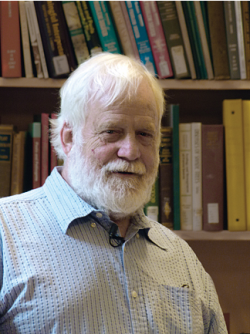
 George L. Ohrstrom III / Matthew Klein photoEver since 1888, the Blue Ridge Hunt has pursued foxes through the Shenandoah Valley of Virginia—a verdant, rolling grassland dotted with small woodlands, perhaps fifteen miles across, nestled between the Blue Ridge Mountains to the east and the Allegheny Mountains to the west.
The Shenandoah River flows northeasterly along the eastern edge of the valley, passes under the western slopes of the Blue Ridge, and empties into the Potomac River at Harper’s Ferry, W.Va.—a confluence described three centuries ago by Thomas Jefferson as “one of the most stupendous scenes in nature.”
Home to a mostly rural population, the Shenandoah Valley has long been a destination of unsurpassed beauty to vacationers and sightseers. The northern part of the Valley that is home to the Blue Ridge Hunt also finds itself to be an object of lust to developers from Washington, D.C., and Northern Virginia to the east and the nearby city of Winchester to the west. While many landowners find it hard to resist the potential financial windfall from development, others believe that to relinquish such natural beauty to untrammeled development would be a crime against nature.
Along with its sister landscape just to the east of the Blue Ridge—Virginia’s Piedmont—a passionate calling for preservation has rallied many of its citizens to battle. Few, however, have responded like George Ohrstrom III. The scope and creativity of Ohrstrom’s efforts locally, nationally, and internationally earned him the MFHA’s Conservation Award for 2014.
“As a master,” said Linda Armbrust, a Blue Ridge jt.-MFH , “when I think of George Ohrstrom, I think of Camden—one of his properties in the very heart of the Blue Ridge Hunt country. Camden is a conservation showpiece—large, well maintained and well foxed. It provides great sport, and some of my very best hunts have been centered around this spectacular covert. Without George’s hospitality, a lot of good hunting would be lost to us and memories would be fewer.”
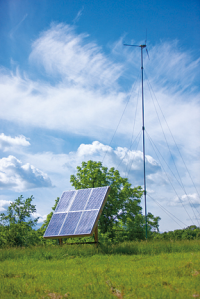 A combination of wind and solar technologies power Camden Farm. / Matthew Klein photoOhrstrom’s Camden Farm is powered by a hybrid system of wind and solar technologies and serves as a conservation show-piece with meeting facilities for instructional purposes. The property is maintained in a natural state, unlike many of the surrounding farms that graze livestock, which likely accounts for its productivity in holding foxes!
Mrs. Matthew “Winkie” Mackay-Smith, who won this award in the MFHA’s 2007 Centennial Year, has worked on local projects with Ohrstrom in the Blue Ridge Hunt country and is an admirer of his many endeavors. “George is a member of a family that has been dedicated to conservation,” noted Mackay-Smith. “The Ohrstrom name is national byword in conservation.”
Ohrstrom’s family was instrumental in the formation of the renowned Piedmont Environmental Council, dedicated to the protection of the beauty and history of Virginia’s Piedmont in the face of intense developmental pressures from Washington, D.C., Northern Virginia, and the Dulles Airport Corridor.
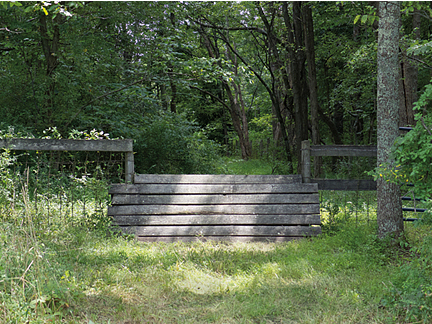 A well-maintained coop into the Camden covert / Matthew Klein photoAlthough Ohrstrom grew up in New York City, Virginia has been in his blood since childhood. He recalls time spent playing outside on his grandfather’s farm in The Plains, near Middleburg. “There was a stream that ran through his property,” said Ohrstrom, “and us kids were always in there. I think that’s where my love for the outdoors really started.” Today, Ohrstrom serves as co-chairman of the PEC’s Board of Directors.
His Personal Journey
In 1983, Ohrstrom and his wife moved to Clarke County, Va.—home to the Blue Ridge Hunt—and there he began his own personal journey of conservation service that is staggering in its scope. Ohrstrom takes a macro approach to conservation by his participation, support and even creation of organizations dedicated to preserving land and water resources, the maintenance of habitat for all rural flora and fauna, and the use and promotion of wind and solar power as alternative energy sources.
Ohrstrom serves 11 different conservation initiatives in positions of leadership. He’s a founder of three: the Downstream Project, DownstreamNetwork.com, and Shenandoah Ecoventure. He’s president, chairman or co-chairman of five: Clarke County Conservation Easement Authority, Clarke County Humane Foundation, Clarke County Planning Commission, Friends of the Shenandoah River and the PEC.
He’s also a board member of the Blue Ridge Wildlife Association and executive producer of Everybody Wins!, an educational venture for the prevention of stream pollution by livestock.
Certainly the first step for any conservationist is personal commitment, and that’s why Ohrstrom placed all of his real estate holdings in perpetual conservation easement. His three farms (500 acres) plus his family farm in The Plains (1,500 acres) total 2,000 acres in easement.
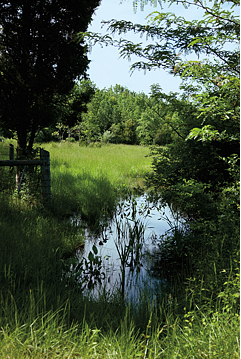 “We all live downstream.” / Matthew Klein photoThe Shenandoah, And Beyond
The saying goes, “We all live downstream,” and Ohrstrom believes that’s true. “The hope is that people will educate themselves and stand up and become a voice for downstream issues because they are exceedingly important to all of us,” he said.
So he founded The Downstream Project, a non-profit corporation, to develop the use of state-of-the-art computer graphics, video and social media in bringing issues of water quality into wider popular focus. The Downstream Project offers technical assistance in these disciplines, as well as personal services to organizations needing to publicize their own water issues.
As its inaugural project, The Downstream Project produced the 50-minute documentary entitled Shenandoah, Voice of the River. Nearly two years in the making, the film examines the history, ecology and beauty of this treasured natural resource and the potentially devastating impacts on its future. Ohrstrom personally funded much of the film as the executive producer.
In 2009, The Downstream Project created the Shenandoah Ecoventure, sponsoring three students and a professor from Shenandoah University on a 28-day wilderness education adventure. Incorporating rigorous study and research, the journey started with a 14-day hike of the Shenandoah National Park section of the Appalachian Trail. Then they made the return trek by canoe, along 60 miles of the Shenandoah River. The students reported their observations to groups at Shenandoah University, as well as local high school classrooms via Web video and personal journals.
The organization leaders have just produced educational videos on stream-side livestock exclusion and soil and water conservation. Each is available in DVD and on Downstream full-featured website, www.thedownstreamproject.org.
The Downstream Project has received a grant to establish a web-based conservation network within the Chesapeake Bay watershed, exploring the shared benefits of social media among conservation partners in the Shenandoah Valley and beyond.
 The Blue Ridge foxhounds across Camden Farm / Matthew Klein photo
Making Alliances
Ohrstrom had a secondary purpose in founding the Downstream Project: He uses it as a vehicle for fostering alliances and working in concert with other conservation organizations. Current projects have involved extensive cooperative agreements with the U.S. Department of Agriculture and the National Conservation Resource Service in the development of educational videos on soil conservation.
His Downstream Project formed a community partnership called C Spout Run with Clarke County and several regional organizations including Trout Unlimited, Friends of the Shenandoah River and the PEC. The objective is to use innovative multimedia communication tools, as well as conventional approaches, to develop a locally supported management plan for the Spout Run watershed and to inform and inspire successful watershed planning processes in other Shenandoah Valley communities. The partnership recently received a large grant from the National Fish and Wildlife Foundation to continue this work, aiming to remove Spout Run from the impaired-waters list.
With other concerned citizens, Ohrstrom started the Community Consensus Coalition in the early 1990s in Frederick and Clarke Counties—the counties share opposite banks of the Opequon Creek—in response to the increasing development of the local Opequon watershed. The Opequon is the primary source of water in Frederick County, which was then rapidly developing as a lower-cost outer suburb of Washington, D.C. Coalition leaders engaged stakeholders to examine the direction in which sensible development should occur.
Both Spout Run and the Opequon Creek course through the Blue Ridge hunting country.
Taking Flight
The Blue Ridge Wildlife Center was established in 2004 for the rehabilitation of injured wildlife in northern Virginia, and Ohrstrom is a member of the Board of Directors. BRWC has grown rapidly and now provides rescue services for nearby parts of West Virginia and Maryland.
BRWC has been especially successful in developing techniques for reintroducing recovered wildlife into their natural habitat. With its ten years of experience and unique facilities, the center now rescues and rehabilitates more than 1,700 mammals, birds and reptiles each year.
Ohrstrom was responsible for the construction of the Center flight cage, one of only two on the East Coast. This facility allows birds to begin flying again after their broken wings have been stabilized and mended. The flight cage is large enough for owls, hawks and even bald eagles to resume flying and build the strength and endurance to be released to the wild.
Last fall, the BRWC staff released a bald eagle that had been struck by a vehicle and suffered two broken wings. The BRWC veterinarians mended the wings, nursed the eagle back to health, introduced it into Ohrstrom flight cage to fly and strengthen, and finally, with a crowd of excited onlookers lining both sides of the Shenandoah River near Low Water Bridge in Front Royal, BRWC Founder Belinda Burwell, DVM, removed the eagle from its crate and flung it skyward. It soared across the river directly over the rapt crowd and, to their applause, continued its flight until disappearing into the wood line.
Internationally, Ohrstrom is also a supporter hrough the Ohrstrom Foundation of the Smithsonian Conservation Biology Institute, especially the Cheetah project, which is focused on researching and understanding the reproductive difficulties of this increasingly rare and majestic predator.
There is scarcely an aspect of conservation or preservation in which Ohrstrom hasn’t participated, donated funds to, served politically, or innovated. As Linda Armbrust concluded in her remarks when accepting the award for Ohrstrom, “The Blue Ridge Hunt is indeed fortunate to have George Ohrstrom, not only as a landowner, but also as an active social subscriber.”
Posted February 27, 2014
This article was also published in The Chronicle of the Horse, February 24, 2014.