
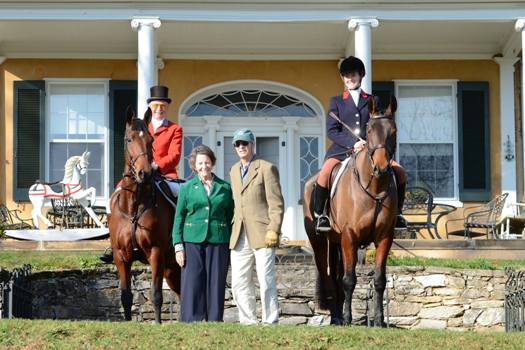
 l-r: Organizer Peter Cook, Blue Ridge Hunt; hosts Hettie Mackay-Smith Abeles and Dr. Matthew Mackay-Smith; Denya Dee Leake, honorary whipper-in, Old Dominion Hounds, step-granddaughter of Alexander Mackay-Smith / Liz Callar photo,
It’s been nearly seventy-five years since Alexander Mackay-Smith’s Farnley Farm in White Post, Virginia was home to a herd of some fifty Cleveland Bays. In his travels, Mackay-Smith had discovered the ancient breed of coach horse in the northeast of England and became convinced they would make ideal field hunters. He imported breeding stock, encouraged Tom and Marilyn Webster of the Idle Hour Stud to buy and stand Rambler’s Renown (who was to become North America’s leading sire of Cleveland Bays), and re-introduced the endangered breed to a new generation of horsemen and women in this country.
Farnley was once again in its bay glory on Saturday, November 16, 2013 as a record number of twenty-one Cleveland Bays (seven purebreds and fourteen part-breds) gathered at the invitation of Mackay-Smith’s children, Hetty Mackay-Smith Abeles and Dr. Matthew Mackay-Smith; Cleveland Bay breeder Peter Cook; and the Masters of the Blue Ridge Hunt for a celebration of the legacy that Farnley has left to the Cleveland Bay breed in North America.
Hetty Abeles and Dr. Matthew Mackay-Smith greeted the Cleveland Bay delegation and welcomed them back to Farnley as they assembled for a photograph in front of the house. Blue Ridge Joint-Master Anne McIntosh gave the official welcome on behalf of Joint-Masters Linda Armbrust and Brian Ferrell, after which participants divided into three flights and trotted up the lane to the first covert.
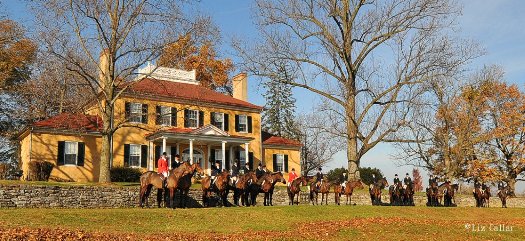 Cleveland Bays assemble before Farnley. / Liz Callar photo
Pennsylvania Cleveland Bay breeder Sharon Hanna was thrilled to notice several Cleveland Bays galloping on either side of her as she followed Master Anne McIntosh closely behind the hounds. Following the hunt, participants were invited inside for a hunt tea provided by the Mackay-Smith family. Reflected Peter Cook, “I think the day was a tribute to the esteem in which the father, Alexander Mackay-Smith, was held. The fact that so many came, and that they came in such great style, was truly appreciated by the family.”
Many of the horses in the hunt field on Saturday carried the bloodlines of Farnley Exchange, a stallion bred by Alexander Mackay-Smith and exported back to England in the 1940s as an outcross stallion to revitalize the threatened Cleveland Bay breed. Even to this day, the Cleveland Bay tops the Critical category in the watchlist maintained by the UK’s Rare Breeds Survival Trust, with fewer than three hundred purebred breeding females left in the world.
The Cleveland Bay Hunt is an annual event organized by the Mid-Atlantic Cleveland Bay Show Series. We will be hosting another Cleveland Bay Hunt in conjunction with our year-end awards reception on Sunday, January 19, 2014 with the New Market-Middletown Valley Hounds at Margaux Tip LLC by the kind invitation of Cleveland Bay breeders Hunter and Lauren Wilson. More information is available from [email protected].
The Cleveland Bay Horse
The Cleveland Bay is said to be England’s oldest breed of horse. As the name suggests, the breed originated in the Cleveland region of the northeastern part of that country. Descendant mares of the so-called Chapman horses—pack horses bred by the monks at the monasteries in the Middle Ages—were crossed in the mid-seventeenth century with imported barb stallions for both pack and harness use. The Chapmans were the foundation mares of the Cleveland Bays.
In the eighteenth century, these useful Chapman-barb crosses were crossed with Thoroughbreds to increase their speed under harness. The resulting crosses became known as the Yorkshire Coach Horse—tall, elegant, and a favorite of royalty and the well-to-do.
We know these horses today as the Cleveland Bay, and the breed is dangerously rare. According to the Cleveland Bay Horse Society of America, there exist in the world only five hundred purebreds, and in America less than two hundred.
Always bay in color, the Cleveland Bay is intelligent, versatile, sensible, bold, and honest. Because it has a strong character coupled with a sensitive temperament, it can be ruined by insensitive handling early in its schooling.
The Cleveland Bay breeds true to type (reproduces with consistency), and with its good substance and free movement, makes an excellent cross with the Thoroughbred. [-Ed.]
Posted December 6, 2013