
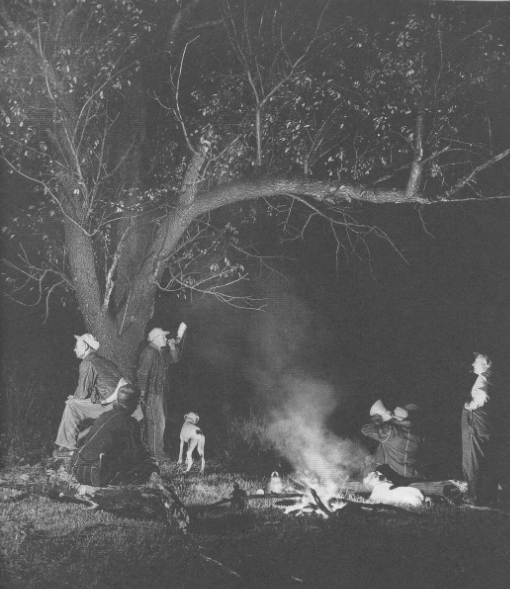
This is a true story as best as I can recollect. I was about six or seven years old that night, but as you can imagine this was a story told and retold around many a local foxhunter’s fire for many years thereafter.
Dad often took me foxhunting with him when I was little. I don’t have many memories of those hunts other than falling asleep in the back of whatever old car dad had at the time. The foxhunting that dad and his friends participated in did not involve horses or fancy scarlet coats. Their steeds were Ford and Chevy, GM and Oldsmobile; the uniforms worn were usually whatever work clothes they had been wearing that morning.
Hunting a fox in southeastern Kentucky consisted of meeting your buddies at a “good” hunting spot, gathering wood from the local forest, preparing a fire, and when it was close to dark everyone releasing their hounds to find a fox. I never understood the “hunt” part of this adventure as a fox was never caught by the dogs and certainly not by the foxhunters, whose sole hunting skill in this endeavor was to sit around the fire and listen to the dogs bay once they were on the trail of a fox. A good hunter knew the cry of his dog as if were the sound of his own child calling his name.
After the dogs were released to chase after the elusive fox a pot of coffee was made and kept at a boil by the fire, a prerequisite for the hunters to stay up all night and tell stories in the frequent lulls when the dogs would lose the fox’s scent.
On this particular night my dad’s friend—we’ll call him Peter Angel—had brought a dog that for whatever reason was not in the mood to announce his intentions to the fox during the chase. This was smart of the dog in that he was not revealing himself to the fox and, I think, a good hunting strategy. To the foxhunters, however, this was a fault, for in their thinking the louder the dog was baying the closer it was to the fox. This was how the hunt was judged, and many an argument arose over whose hound had bayed the loudest in the pack.
Peter’s friends being the mature twentieth-century men that they were waited a good half hour before relentlessly assaulting Peter with remarks about his dog. (A hound dog’s ability to track and bay to report his progress or lack thereof was considered a direct reflection upon the dog’s owner.) After what seemed a very long time to this little boy, Peter decided he could not handle the shame of such a poor excuse for a hunting dog to be associated with his good name as a hunter.
Peter and my dad entered into negotiations over the sale of the dog to my dad with sips of whiskey interspersed with what we would call today *trash talk.* In the end a sum of twenty dollars was reached as a fair price for this no account hound dog; money was exchanged; and a good pull on the whiskey bottle sealed the deal for both men.
After returning to the fire the jokes and jibes stopped as dad’s original hound was doing well in the chasing of the fox, and since Peter no longer had a dog in this hunt he was left in relative peace. A few minutes after they had returned to the fire the pack picked up a strong scent and began to bay, each hound making its own distinctive sound and as they did the hunters would acknowledge which dog was theirs in a litany that is now reminiscent of a church service. “That’s Bell,” or “That’s ol’ Blue,” the hunters would say, and the other men would nod to each in unspoken agreement.
At the height of this part of the chase a hound began to bay in a way that was agreed to by all as signaling its close proximity to a fox. The hunters became exited. The men looked around the fire and began to remark about the lead dog in the pack, and it was decided that the lead dog was my dad’s, and he was given the silent credit of having the best dog at the moment.
Peter had been watching and listening to the other hunters and at the hounds until he could stand it no longer, for what is a hunter without a hound. Once again the whiskey bottle came out and new negotiations were struck up between dad and Peter. This discussion occurred around the fire with other hunters adding their pearls of wisdom first to Peter and then to my dad as to what the best price was for this great foxhound. In the end because of the friendship that they had and the whiskey they had drunk in ample quantity it was decided that thirty-five dollars was a fair price. The deal was made, the other hunters were witnesses, and that was that. Peter had himself a new and proven valuable hunting dog.
 As the chase and the night wore on, Peter’s new hound grew silent as the other hunters’ dogs continued to give loud chase to the fox. Peter knew he was in trouble again, and for the rest of his very long night he was as silent as his dog. Maybe it was kindness, maybe the whiskey, but the other hunters decided Peter had been put upon enough and left him alone in his quiet misery.
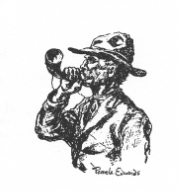
As night turned into dusky dawn and the baying of the hounds had ceased, the hunters pulled out their horns to signal their dogs to return to camp. A foxhunter’s horn is about as old school as you can get: take a common bull’s horn, which must be cleanly hollowed out; cut the sharp tip off a little ways from the end; use something rough like sandpaper or your ex- wife’s tongue to smooth out the rough-cut edge; and learn how to blow a series of notes that your hound will recognize as belonging to you.
Each hunter blew his trumpet, and one by one the hounds answered the call of their pied piper. Peter’s and dad’s hounds found their way back to us, and dad put his hound in the backseat of his old car. Peter did the same with his hound, calling it by name as it jumped into its accustomed spot in the bed of his truck. If you hadn’t already guessed, Peter had arrived that night and left the next day with the same ol’ hound dog!
Posted November 11, 2013
Alexander Cox was raised in rural Gray, Kentucky. He is a computer network administrator and still lives in the area.