
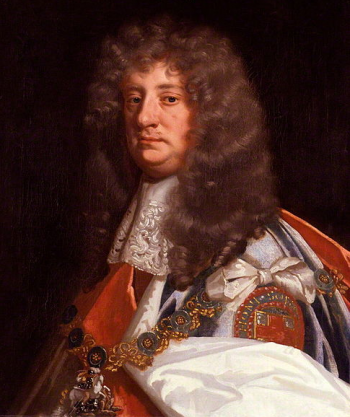
 George Villiers, second Duke of Buckingham died of a chill caught while foxhunting. His mother bred some of the earliest Thoroughbred racehorses at Helmsley Stud. Portrait by Peter Lely, courtesy of the National Portrait Gallery.A new book on the beginnings of mounted foxhunting in the English shires—From the Deer to the Fox: The Hunting Transition and the Landscape 1600-1850—has been published by the University of Hertfordshire Press and released on September 15, 2013. Written by Bandy de Belin, the book disputes one commonly-held theory of why English sportsmen shifted from hunting the deer to hunting the fox as the primary quarry.
Traditional theory, according to de Belin, suggests that the disappearing woodlands and increased enclosures of the open space led to the decline of the deer population, so hunts, by necessity, turned to the fox.
De Belin suggests rather that the development of the Thoroughbred horse and faster hounds during this period were the determining factors. With that came greater speed and the thrill of galloping mile after mile over open countryside, rather than woodland hunting of the stag. She posits that the hunting of deer was more about watching hounds work and theorizes that if seventeenth century hunting was about hounds, nineteenth century hunting was about horses.
De Belin’s theory is interesting and could well be on the mark. However, the fact that deer were the property of the king and could not be hunted except in his presence surely was another factor. The late Alexander Mackay-Smith noted that when the Second Duke of Buckingham, one-time close friend of King Charles II and Master of Horse, fell out of favor with the king and had to leave the court, he went back to his own estate and hunted the fox by necessity. Other noblemen out of the king’s favor or out of his company must have done the same. And it’s easy to see that with the development of the Thoroughbred paralleling this era, long gallops across open country after the fox could well have stimulated increased attention to Charles James as a challenging quarry on his very own.
Mandy de Belin completed her MA and PhD studies in the Centre for English Local History at the University of Leicester, where she focused on the connection of the East Midlands with the history of hunting. Her interest in the subject originated in a passion for the landscape and for horses. Dr. de Belin is an Honorary Visiting Fellow at the University of Leicester.
Her new book is currently en route to Foxhunting Life; report to follow.
Posted September 17, 2013