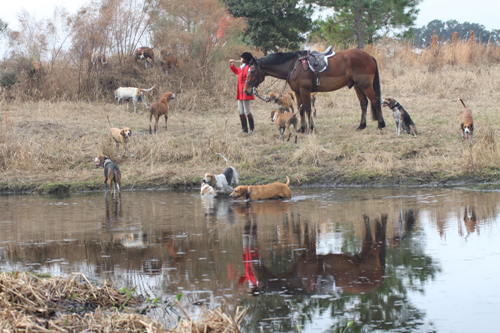
 Master and huntsman Alexis Macaulay calls hounds to water at day’s end / Carolyn Carnes photo
At the time that Mac and I started our pack, I had never before drag hunted. The territory I was able to secure, however, was public land, and the regulations stated, “taking of fox is strictly forbidden.” While that has since changed, we have such a steady pack on the drag at this point that I hesitate to send it live. Also, we hunt on several small, privately owned fixtures that are extremely popular with the members because of the interesting terrain and abundance of jumps, and in those fixtures it would be impossible to hunt live because of the size.
In the beginning, since I knew nothing about the sport, I read everything I could get my hands on about drag hunting. I experimented with various scents and scent combinations, but the pack was light on cry, so I sought help. The hounds, which had been drafted from the Middlebury Hunt (CT) when they disbanded, were live hunters, so we had a double challenge—the blind leading the blind.
Hounds would follow the drag line, but not very enthusiastically. Masters Ken and Arle Adams came up from the Palm Beach Hunt (FL), which was also a drag pack, and helped me out. I was routed to Kerry Glass at the Norfolk Hunt (MA), who was considered the drag hunt guru, and she was a tremendous source of information for the first six to eight years of the pack.
Things really started clicking after I went up to the Myopia Hunt Club (MA) for one of their drag hunt seminars (before the MFHA began sponsoring drag hunt seminars). I spent about five days up there with huntsman Eugene McKay and Don Little, MFH, and they very kindly let me follow their daily kennel routine. A few months later, we had Eugene come down to evaluate our pack first-hand and coach us daily. It was a fantastic mentoring session, and our pack has since taken-off and improved with each season and breeding.
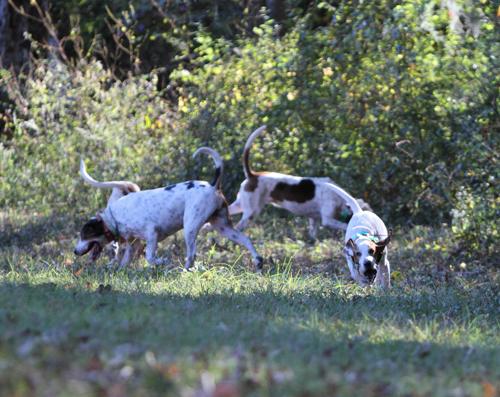 The find! / Allene Rachal photo
What we found at the Field Trials during the Centennial, was that drag hunts do the same things in very different ways. Many have a “worry” at the end of the drags, but most don’t. Other hunts would scatter treats or meat at the end of the line, or have someone throwing treats, or have tubs of water to signal the end. The kill bag was totally my idea. No one I talked to had done anything like that, but I wanted something very definite to successfully mark the end of the drag and at the same time simulate as best we could a kill at live hunting. We also noted which hounds consistently found it.
It’s just a brown lunch bag full of dog biscuits & meat scraps (usually Mac and my leftovers from the week before). We place it either up a tree, down a hole, or tied behind a bush, but it is not placed in an obvious spot. I expect hounds to overrun slightly and hook back once there is no scent, to search for it. It’s fun to watch; hounds will scrap over it or hoard it, but eventually it disintegrates, forcing them to share it with the others. Folks who are present and who have named a puppy that takes the kill bag are heroes for the day!
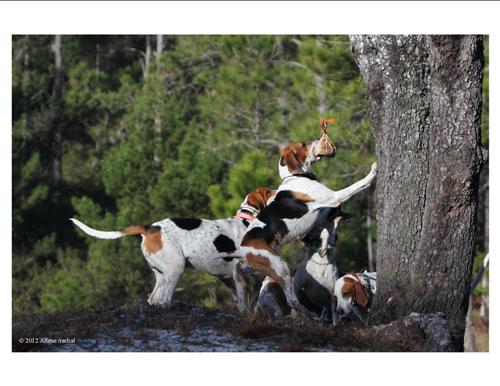 Hounds find “kill bag” / Allene Rachal photo
We want our hounds to hunt with accuracy. We do not simply lay a straight line; we twist and turn it, lift it up for five hundred yards or more, then make a turn—all to keep them searching for it. I love to watch the pack work when the drag has been lifted. They loop and circle to recover the scent, then it’s hold on to your hats; they’re off and screaming!
Some hunts lay the scent with drip bottles, others drag a rag. We have used a coon drag that works well. Some lay it off horseback, some run it through the woods on foot, some use ATVs. Some use anisette liquor, some use fox urine, some use fox “drag” which also has sediment out of the fox kennels, and some use the fox scent that is sold in hunting catalogs. All of us have to see what works best for our pack and our weather conditions.
I know that many live hunters scoff at drag hunting, but it is really a lot of fun and there is much to appreciate. There’s great hound work to watch, and you can really evaluate how true the hounds are. We can take them out onto 25,000 acres of really wild Florida terrain with all sorts of distractions, and yet, most of the time we end up with all hounds on at the kill. It is literally like finding a needle in a haystack, but they do it time and time again.
Drag hounds have to be especially biddable and eager to please, since they aren’t pursuing live game, which is so very natural to their predator instincts. After all, they are really chasing nothing and are passing up all sorts of live game and interesting scents along the way. When you get hounds that are locked into the drag game, they are spectacular to watch.
Drag hunting is very social, and I have to admit we play at our “kill” areas while the next drag line is being laid. Live hunters, I’m sure, would be horrified. With permission, field members often lark over jumps that are right there, for we often locate the “kills” at areas with a variety of jumps. Since we don’t particularly worry about spooking live game, we can afford to be a little more relaxed.
Posted June 1, 2013