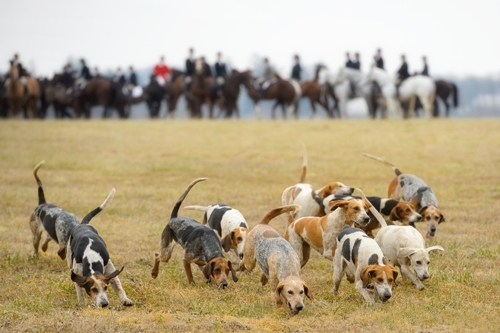
 The new Cheshire Crossbreds combine the best traits of two disparate foxhound types / Jim Graham photo
When an established hunt with a reputation for showing the best of sport to the best of horsemen in the best of countries comes up with a novel idea for breeding a better foxhound, and sees it through to fruition and success, one has to pay attention.
The venerable—one hundred years this season—Mr. Stewart’s Cheshire Foxhounds in Unionville, Pennsylvania traditionally hunted the Old English foxhound under the hunt’s founder W. Plunket Stewart and the active Mastership of his step-daughter, the late Mrs. John (Nancy Penn Smith) Hannum. Masters and members know the breed very well.
Ireland’s County Galway Foxhounds (The Blazers), another venerable hunt renowned for showing world-class sport, also hunts the Old English foxhound. Cheshire huntsman Ivan Dowling grew up following the Blazers, and he too knows the Old English foxhound very well.
History and familiarity notwithstanding, seven years ago the Cheshire Masters and their Galway-born huntsman Dowling decided to continue a breeding experiment begun two years earlier by former huntsman John Tullock. They committed to the notion of crossing the English foxhound with the Penn-Marydel foxhound—two disparate types—in the hope of making a better foxhound for their country. This was a chancy endeavor, understandably fraught with controversy within the hunt.
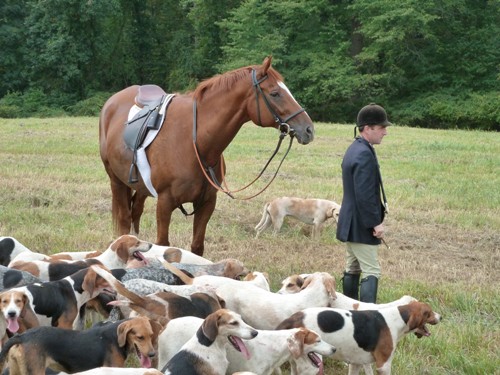 “Depending on the day and the conditions….they all get their turns to shine.” -Ivan Dowling, huntsman / Jim Graham photo
Each of the two hound types has their proponents and detractors. What’s interesting is that the strong points of each type tend to compensate for what some see as weaknesses in the other—weaknesses, that is, that are seen only by the detractors and not the proponents of each.
Has their experiment succeeded? Considering the demand for Cheshire drafts by those who have hunted behind the pack, one would have to say, yes. Certainly, Masters, staff, and subscribers deem the experiment to be an unqualified success.
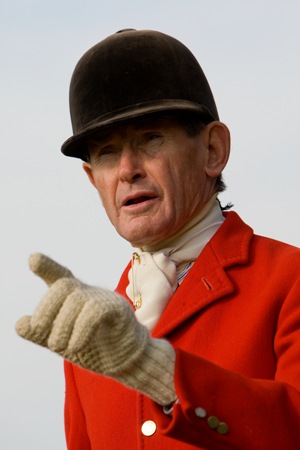 “What we want is the best hunting pack of hounds we can put in the field.” / Jim Graham photo“You Have to Persevere”
How did it all start, I wondered, and what were they trying to accomplish? I talked to Joint-Master Russell Jones and huntsman Ivan Dowling, the two individuals most directly involved in implementing the new program. Jones is a long-time horse breeder and bloodstock agent, so it was natural for him to take great interest and participate fully in the hound breeding.
Before discussing his hounds and the Cheshire program, Jones issued a strong warning to anyone thinking about changing the breeding program at their own hunt: “It was an experiment,” said Jones, “and it was only made possible by a continuity of management that stayed on the job for the last ten years and was able to follow through with the original plan.”
“With something like this you have to persevere,” agreed Dowling.
It was Dowling’s predecessor, Cheshire huntsman John Tullock, who started it all. Although English-born, Tullock learned to admire the Penn-Marydel while in New York State. Upon coming to the Cheshire as huntsman in 2003, he began drafting the English hounds to other packs and replacing them with Penn-Marydels. Dowling came to the Cheshire with Tullock as whipper-in and was witness to the transition from the start.
When the horn passed to Dowling in 2005 the time was ripe for a long-term decision. Both Jones and Dowling had faith in Tullock’s hound sense and decided to continue the program to produce a new hound type that would exhibit the best traits of both breeds. They sought to combine the sensitive nose and booming voice of the Penn-marydel with the toughness and stamina of the English foxhound.
“Times have changed,” explained Dowling. “We have more traffic on the roads than they used to have, and we have more landowners from the city. We can no longer just let hounds go and chase after them as best we can. I need to stay in touch with hounds, and the bigger voice lets me do that.”
Because the two types of hounds are so different, the pups, especially in the early litters, varied greatly. As they gained experience, however, they learned which bloodlines of both types proved to reproduce more uniformly.
Cheshire keeps and hunts only bitches. In addition to the majority of Crossbreds in the pack—mainly fifty/fifty crosses—they maintain several selected lines of pure Penn-Marydel and pure English bitches for breeding purposes. These purebreds run with the pack and provide a reservoir of bloodlines of each hound type though the female lines. They are put to dog hounds of the opposite type at other hunts, selected for the attributes they feel will nick with each bitch. All dog hound puppies, for which they have great demand, are drafted to other hunts.
Emphasis on the Team, Not Uniformity
The typical Crossbred is less hard-headed than the English hound and possesses more voice and a lower scenting capability. So how do the pure English hounds with their aggressive drive, the pure Penn-Marydel hounds with their devotion to the line of the fox, and the Crossbreds with a mix of these attributes work together? Jones and Dowling couldn’t be more pleased.
“It’s amazing how they respect and value each other,” said Jones.
“They are a team,” explained Dowling. “Each has a role to play, and depending on the day and the conditions, one type or the other will lead the way. They all get their turns to shine.”
Uniformity in the pack is not a priority at Cheshire, as it is in so many other hunts.
“We never were show-oriented,” said Jones, “and there are no classes for our hounds in today’s hound shows. What we want is the best hunting pack of hounds we can put in the field.”
Dowling thinks that in time they will be able to breed Crossbred to Crossbred and reproduce to type, but as of now he’s in no hurry to do that.
“I don’t want to fix what’s not broken,” he said. “I’ve got a team that works, and I’m in no rush to change the system.”
Today, ten years on, Jones says he couldn’t be more pleased with the results of the program, and he gives huge credit to Dowling.
“Ivan made it work,” said Jones, “and not every one could have done that. And we still see improvements every year.”
Dowling admits he’s never completely satisfied. “We keep fine-tuning it each year,” he said.
One recent visitor to the Cheshire field observed, “This pack bursts out of covert like a swarm of bees!”
“That’s the sort of pack I want!” exclaimed Dowling.
Posted April 22, 2013
A version of this article was first published in The Chronicle of the Horse, February 4 and 11, 2013
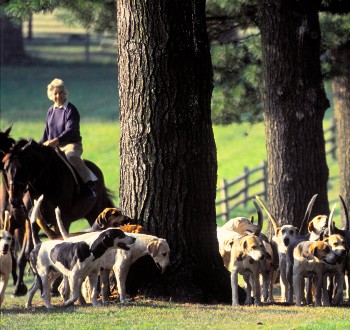 The late Nancy Hannum, MFH with her beloved Old English foxhounds
Posted April 22, 2013