
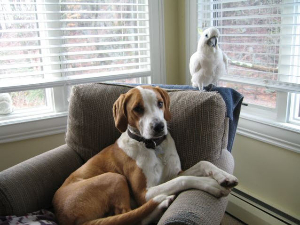
 At home with Cathy and friendCathy Eising has a twenty-month-old foxhound out of her mother’s rescue foxhound, and she works at his training diligently. She writes:
“I am seeking advice on how to raise the foxhound as a family dog, especially off-leash training. Will he ever stop chasing wild things and pay attention to me outdoors? I have done a lot of obedience with him, and all areas are coming well except off leash outdoors. He needs to run and I can’t walk fast enough or long enough for him to get properly exercised, so I need to trust that he will come when called under all circumstances (including around deer). I’m very dedicated and work with him every day.”
We asked Hugh Robards, Jerry Miller, and Gail Andersen for their advice.
Hugh Robards is a member of Foxhunting Life’s Panel of Experts. He is currently huntsman of the Saxonburg Hunt (PA). For twenty-seven seasons he was huntsman of the famed County Limerick Hounds in Ireland. Before joining Saxonburg, he was MFH and huntsman of the Rolling Rock Hunt (PA).
Jerry Miller, MFH and former huntsman of the Iroquois Hunt (KY) is another member of FHL’s Panel of Experts. He is the founder of the Hound Welfare Fund, a registered non-profit charity that cares for foxhounds when their hunting days are over.
Gail Andersen is ex-MFH and former huntsman of the venerable Norfolk Hunt (MA). FHL sought her advice on this question because she has retired many foxhounds from the kennels to her house over the years.
Hugh Robards
“A young foxhound is a handful. If it were an older retiree, that might work better. I drafted a third season hound to a household, and it settled in, but it was a soft old thing to begin with.
“Yes, a huntsman can stop a pack of hounds from going on, but he has the help of a whipper-in to reinforce his commands during the training period and beyond.
“As for the invisible fence, I had a hound that barged right across it no matter how high the voltage was turned up! Foxhounds are tough. But even that’s of no use if the owner wants to walk in the fields and woods. I suppose the judicious and proper use of an electronic training collar might be the answer. But the genes will always be there.”
Jerry Miller
“I would advise Cathy to use a training collar to help her to remind her hound to pay attention to her voice. We have trained many retired foxhounds and this method is a fail-safe way of correcting any problems, particularly with regard to voice control.
“However, it is very important to remember that this is not a way of punishing a hound; it is merely a way of reminding it to pay attention. So, it should always be used sparingly, after verbal commands have been given and ignored, and followed by a reward of some kind for the hound when it responds. Be certain that the hound clearly understands the command you are giving it before using the training collar.
“If in the course of training, if Cathy has further questions, she is welcome to contact me.”
Gail Andersen
“I would want to know more about the bloodlines before becoming enthusiastic about prospects for success with this hound. For example, do we know where the dam—“her mother’s rescue foxhound”—came from? Did she come from a foxhunting club, and was she drafted “for cause”? What was the cause? Or did she come from deer hunters? If so, she will certainly have generations of deer-running genes.
“If Cathy doesn’t know the bloodlines, she should neuter him. That will also help with the biddability issue.
“I have retired many foxhounds from the pack into my house, but these were generally older hounds that were, in some cases, happy to retire. If they had difficulty in adjusting to a more sedentary life, I let them get a bit pudgy. That slowed them down!
“A twenty-month-old foxhound, however, is going to be full of energy and a slave to its nose. I would give him plenty of play in a fenced area to take the edge off. Then do his obedience training on the leash in an enclosed area to hold his attention and form good habits. Graduate to off-leash training still in the same secure area. When you take him outside, put him back on the leash to reinforce the training before letting him run loose. If Cathy’s mother’s hound is obedient, it might be a good idea to walk out with both hounds. The youngsters learn from their elders.”
Readers are invited, as always, to use the Comments space below to add to this discussion.
Posted February 2, 2013