
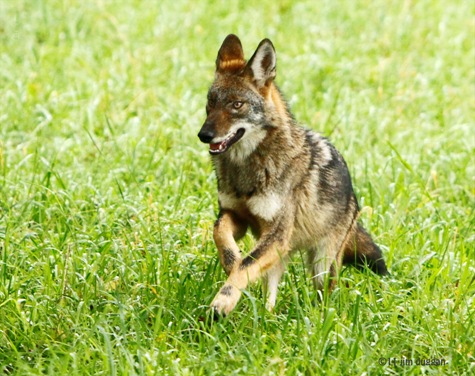
 Jim Duggan photoAs a followup to Mark Twain’s rollicking description of the coyote and Susan Walker’s report on the Longreen Foxhound’s recent coyote chase, here’s further information about that secretive animal that provides so many North American hunts with their sport. I’m unable to provide a source reference for this excellent bit of wood lore, but if any reader recognizes it and can identify the source, we will publish that information in a future issue.
The coyote, Canis latrans, with its many varieties, known also as brush wolf and prairie wolf, is widespread and well known.
I sometimes think that the most conspicuous coyote sign is his night song. Certainly a camp on the plains in the Southwest or in the western mountains is cozier when enhanced by the serenade of coyote in the moonlight. He who would follow the mammals in the wilds should know something of the significance of this. Unaccustomed ears, trained by traditional journalism, might interpret the coyote voice as something doleful, a sad requiem that makes one crowd closer to the campfire. Or a flippant tongue might speak of the “yapping” of the coyotes.
But if the coyote could reflect and speak he would say this is his song, simply that. However it may appear to human ears, to the coyote it satisfies the universal impulse for expression of emotion, simple as that may sometimes be among furred animals.
 The coyote song is much higher pitched than that of the wolf. It is the soprano of the tribe. It may begin with a long clear call, breaking into a violent tremolo, these alternating irregularly. It may begin with a few barks that merge into a long call.
In our family we have used the coyote call as a signal. One evening as I approached within a quarter mile of camp I gave the coyote call to let them know in camp that I was coming. On an open hillside nearby a coyote replied with a lusty outburst!
Coyotes, and dogs that still retain this unsophisticated urge in their being, will often respond to such a call. Also coyotes may sometimes approach to investigate a simulated mouse squeak if they are within hearing, or the louder cry or scream of an animal in distress, if it can be imitated, and if you are in the lee of the coyote. In this instance, of course, it is the hunting instinct that is aroused. When you happen to approach a coyote den, you may hear the parents bark, much like a dog.
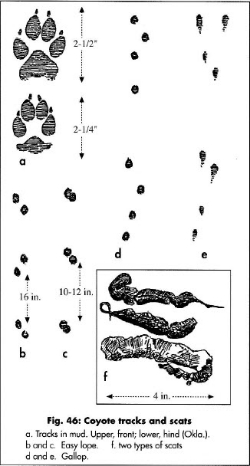
The tracks follow the general pattern of the large wolf, and dogs, as shown in the accompanying sketches. As in the other Canidae, the front foot is larger than the hind foot. Front tracks, in soft mud, are 2-1/4 to 2-3/4 inches long, 1-3/4 to 2-3/8 inches wide. The hind tracks in mud have measured 2 to 2-3/8 inches long, 1-1/2 to 1-7/8 inches wide. Note the differing patterns in the heel pads of the front and hind tracks, Figure 46a. This clear outline, however, rarely appears in the tracks you find. In loose snow and many other surfaces the heel-pad pattern is only suggested and usually appears roughly like that of the front foot. It is on firm snow, and mud, that this outline may appear.
One wintry day I followed a coyote trail in the snow for a short distance. Where the trail crossed an opening in the woods, the coyote had at several places turned aside to dig in the snow. Finally, at one place, he had been rewarded by finding the remains of a ruffed grouse. Some feathers were strewn about near the hole in the snow. At first, I thought the coyote has pounced on the grouse, resting in its burrow under the snow, as grouse do, but the coyote had dug much too deeply for that, and there was no blood on the snow. So it would have to be the remains of a bird lying far beneath the snow. Was it originally left by the coyote for future use, or did the coyote’s keen nose detect it under several feet of snow? I don’t know.
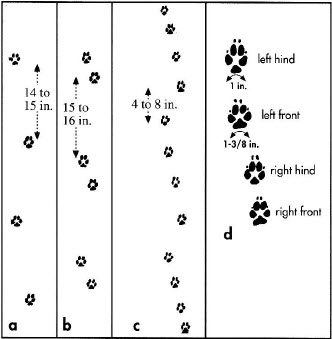 This same coyote gave me the track patterns shown in Figure 48: walking in b, trotting in c, and with a slow lope in d. The width of the trail, or straddle, was 4 inches in b and c, and 6 inches in d. In e we have an enlarged view of the lower track series of d. The hind pad of the hind foot generally registers in a somewhat circular form in snow, and smaller than the well-lobed front pad.
In the track patterns b, c, d, and e of Figure 46, the hind prints are forward of the front prints. When the coyote was galloping fast, the leaps here figured measured 32 to 61 inches, in snow. In other cases they leaped 51 to 120 inches.
Coyote scats are extremely variable in size. The residue from pure meat is likely to be semi-liquid. The scats consisting of much hair are likely to be large. Those resulting from a diet of pine nuts or chokecherries are likely to crumble. In size, coyote scats overlap those of the wolf and the red fox, and those of pups are of course much smaller.
Scats are likely to be deposited along trails. In the western mountains they will be found where a trail comes over a little knoll, or level place, or any other point of special interest to the coyote. There is likely to be an accumulation where two trails cross as when a ridge trail dips down a slope and crosses a trail coming over a saddle.
Such accumulations may be at the scent post used by dogs, wolves or foxes. This may be a rock, a prominent tuft of grass, a stump, or almost anything that stands out, where urine is deposited by members of the dog family who casually investigate it when passing by.
Posted January 20, 2013