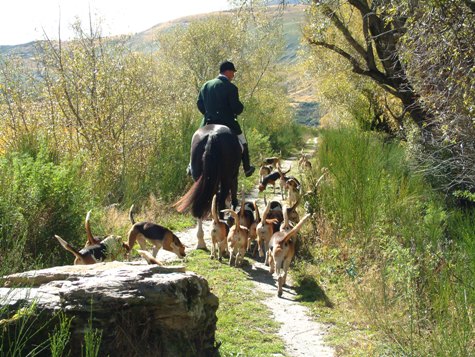
 Central Otago Hunt, South Island, New Zealand
Second and final installment by national award-winning journalist and author Karin Winegar
At midweek Glynne Smith, MFH of the Central Otago Hounds (COH) and I drove up to a meet above the Ida Valley. Mountains stretched away below us in silver, slate, lichen and plum. Glynne greeted farmers driving a pickup truck carrying a wrinkle-nosed ram uphill in spatters of cold rain, shepherds crooks rising from their truck bed.
Chill wind buffeted the phantasmagorical rocks at the top of the ridge where we unloaded the horses. Lord of the Rings Riders of Rohan scenes were filmed in this forlorn country. And Ted Ottry, a COH whipper-in who had been an extra in the film, rides a white Thoroughbred he purchased from the Lord of the Rings herd.
A few minutes after moving off, we faced an uphill six-strand bare wire fence. Etta easily sailed it, and Glynne zoomed past me grinning under his white mustache: “Ha! Now you are one of us.”
And I was. I was hooked through the heart, the eye, the nose, the ear—galloping open mouthed on surefooted Etta at full tilt over rock, zigging and zagging as hounds lifted hare after hare. Herds of Angus parted for us, and flocks of confused merinos split, temporarily foiling the scent in a haunted and lunar landscape where schist and quartz gleam, blue borage, silver tussock and gorse dot the gullies and ravines.
New Zealand’s nineteenth century gold rush drew Chinese and English mine workers to this area, and we clattered around the remains of their stone works and lonely cabins under clouds slanting like avalanche fields. The field followed hounds uphill around rock tables and slabs interspersed with prickly matagauri (a thorn Kiwis call wild Irishman) and down slopes where bracken fern and rushes frame cool rills of pure streams.
“Now Harley, old fellow, steady on, righty oh,” Glynne talked to Harley. I didn’t need to talk to tireless Etta, who knows her job better than any rider ever will.
We arced over six strands with a seventh of barbed wire and a frill of rabbit fence along the bottom. Standing in his stirrups, Glynne raced past: “Hut, hut, hut—that was Lawrence of Arabia to his camels was it?” he called jovially.
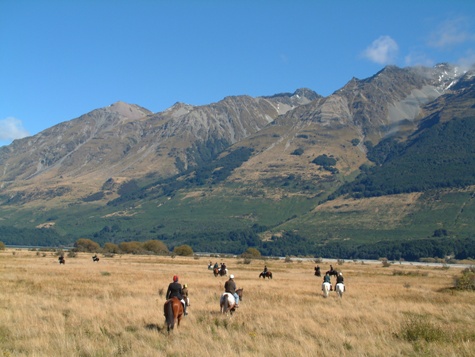
We did a good thirty kilometers by the time Dick blew for home, everyone elated with the day, even the Kiwis conceding nothing could have topped it. Squeezed into a horse van against the spitting rain, we shared sandwiches, port, cake, whiskey, beer, and chocolates. Ted suggested “cordite, horse sweat, and saddle leather all mingled with slight tones of gin” is the ideal male aftershave—a mix vividly present in our damp coats, boots and hair.
Pillars of the COH, Glynne and Lynley knew each other in childhood in Dunedin, South Island where his family ran the Otago Central Times newspaper and Lynley’s family founded Speight’s Brewery in the same coastal city. Once married, they moved west to Queenstown, then to a station at Mount Rosa, thirty minutes east, to raise their three sons. Some of their high pastures were so steep that Glynne, the boys, and hands would occasionally muster by flying up in a helicopter with dogs (called New Zealand huntaways) and moving the animals down the slopes to the wool sheds.
Lynley showed me their farm, now a successful vineyard in a valley burgeoning with vineyards, and beyond it a ravine with a chill, foaming river where musterers crossed in a cage with their dogs, pulling a cable to reach the far side.
Glynne served as both MFH and huntsman for the first few years of COH. Then in 1982, he was instrumental in helping create a national harrier hound register for the New Zealand Hunts Association. Philip Langdale, Bruce Jessep, and Ray Coles decided there should be a national recording of hunt hounds, Glynne explained.
“Some hunts were recording and others weren’t. They got it started, and it was only through their foresight that we are where we are today.”
“The job proved more onerous than expected and more costly what with computerization, endless correspondence, and toll calls, for many hunts had not kept accurate records, ever, but the consequent straightening out and updating more than proved the necessity of the register,” wrote Theo Herbert in the New Zealand hunt histories Harking Back I: 1870-1969 and Harking Back II: 1970-1989, now collected and expanded in a luxurious 332-page hardbound volume Kicking On Through the History of Hunting In New Zealand (2012, edited by Susan Barry).
Beyond sales of the handsome book, New Zealand hunts have some imaginative ways of fund raising. Race meets were the original method of choice, but as costs made them trickier, Kiwis resorted to other means. Members of The Poverty Bay once crutched twenty thousand sheep and plucked and sold two thousand chickens over two years to raise funds.
On a day between hunts, Glynne drove me to visit the COH kennels in Roxburgh.
“The Dannevirke drafted three-and-a-half couple of hounds to COH every year for three years at the outset,” explained Glynne on the drive. “So that gave us the nucleus plus a very good bloodline from the Maniawatu at Christchurch. Being older they hunted slowly but surely so they made me, as an amateur huntsman, look much better than I really was, because all I did was sit on the horse and follow them. The hunt has grown stronger over the years. I don’t say financially, but we have enough for our needs and recently had enough to do up a nice hound conveyance, and we pay our huntsman. We’d love to have our own property and huntsman’s house and kennels on it.”
Huntsman Dick Michelle and his wife Charmaine and the youngest of their six sons live in a sunlit modern house high on a steep slope overlooking a jumping ring and a wide, heavenly mountain valley of fruit orchards. Power comes from a rushing stream coursing over a water turbine, and the kennel fence is solar powered.
Charmaine did mustering and Pony Club as a child and is now a show jumper. Dick came to hunting via rodeo riding. They care for the COH pack and run a shearing gang business—units of four shearers, four helpers and a presser processing twenty-eight thousand ewes here and twelve thousand there.
COH has eleven couple registered not including new entrants that are being tried out. The compact, cheerful hounds have dug warrens under their kennels, because central Otago can be quite hot in summer said Dick, who sprays down the concrete to cool them. The COH pack gets pork, mutton, beef, venison, and Dick leaves bones in pens “for a half hour; it’s good for their teeth.”
“My situation is a wee bit different than other huntsmen,” he said. “We don’t do road work because we don’t have roads. I just take them out hunting and let them do their natural thing, and try to get them to pack up. We have a vast country so our hounds don’t need the discipline like other huntsmen near town. When we ask them to turn and follow a line, they do it—good as gold ”
“With our hounds I sit right back when they wheel. Instead of lifting hounds, I’d rather hounds figure it out. They are very pack-oriented, have a good attitude, and their threshold of pain is incredible. They are not aggressive, and I don’t work on them.”
The country is so vast and the hunts so fast, he said, that “we usually put a GPS on the whip—we can do fifty kilometers in an afternoon, and hounds do that plus a third more.”
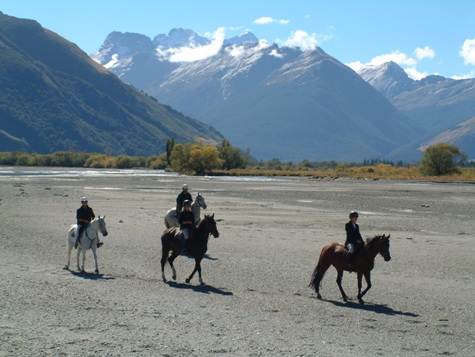
At the end of the week, with more hunts to go, the COH met at Wedderburn Pub outside Ranfurly for blue fish and lamb, rugby on the pub TV, and New Zealand’s justifiably celebrated sauvignon blanc, its deeply fragrant pinot noir, and of course, Speight’s.
“Mountain hunting behind hounds was unknown in Central Otago when we started,” Glynne recalled. “We started out when most of the other hunts were building up to their centennial.”
With the large influx of horse-loving Irish miners who quickly got their own jockey clubs going in Central Otago, why did hunting not start earlier? Glynne says the problem was rabbits.
“The country was crawling with rabbits, literally moving,” he explained. “The weather was more severe, and the winters would have put jumping and running out. So with getting the rabbit pest under control, a more benign climate, and the spread of irrigation (which happens now earlier in the season), we hunt this country because it’s easier on the horses. And generally the hare are not too far away, although a hare will travel up to fourteen kilometers of an evening for a feed and then go back to lie up in its favorite place.”
After two more days of hunting—one with the whole field following hares in blistering figure eights over fences and hilly meadows—I was scheduled for home, frankly weeping as I gazed at snow-covered Remarkables—the southern Alps—from the Queenstown airport with Lynley. There will be no matching this, I thought. New Zealand hunting, hospitality, and horses, indeed good as gold.
Posted December 12, 2012
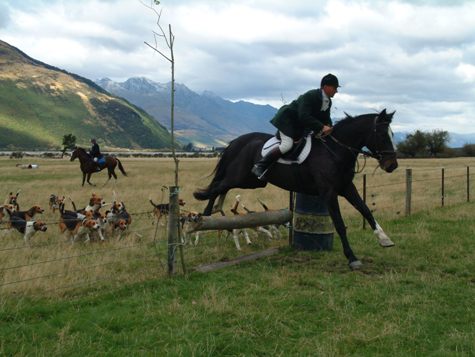 Some fence sections are “sparred” on hunting days to ease the way.