
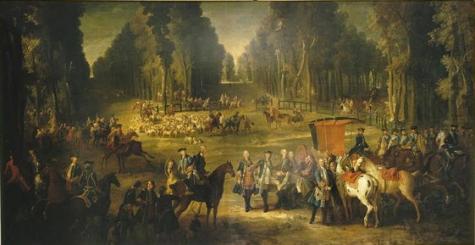
 Rendez-Vous…in the Forest of Compiegne: preliminary painting for the tapestry by Jean-Baptiste Oudry at Fountainebleu
As a John H. Daniels Fellow at the National Sporting Library in Middleburg, Virginia, last fall, I did research concerning a series of nine large tapestries woven for Louis XV between 1736 and 1753 at the Gobelin manufacture. Called The Royal Hunts or The History of Louis XV, these tapestries decorated Louis XV’s favorite hunting chateau at Compiègne, just north of Paris. The artist who designed the tapestries, Jean-Baptiste Oudry* (1686-1755), was the official painter of the royal hunts who followed the hunt as part of the king’s entourage. He also painted numerous portraits of the royal hunting dogs.
Louis XV was known for his love of the hunt, and the series was meant to document the ritual of the hunt, the well-managed royal hunting grounds, and, of course, to glorify Louis XV. In the tapestries, as well as in the preliminary paintings for the tapestries now at the chateau of Fontainebleau, there are recognizable portraits of Louis XV, his hunt officers, his favorite horses and dogs, and specific sites in the royal forests of Fontainebleau and Compiègne. I was endeavoring to learn exactly what was transpiring in the images by consulting the eighteenth-century hunt treatises and manuals in the collection of the National Sporting Library.
First, it must be understood that the royal hunt was synonymous with stag hunting. The Grand Ordonnance of Waters and Forests of 1699 decreed that hunting the stag was a privilege reserved only for the king and members of the royal family by blood. The stag was considered the most noble animal, to be hunted by the most noble of the nobles. A hierarchy of animals was hunted by a corresponding social hierarchy: The nobility had the legal right to hunt certain kinds of deer and other “lesser” prey, and commoners had the legal right to hunt “nuisance animals,” such as rabbits and vermin. Fox hunting was not ranked high. According to Le Verriere de la Conterie’s School of the Hunt (1763) the fox was an ignoble animal, and fox hunting was an unworthy genre of hunting. In the eyes of the French authors, the fox hunt was considered an English hunt, and hence inferior.
The royal hunt, or grand chasse à courre, required manpower and royal means. It was estimated that in 1750 there were 2,100 horses in the two stables at Versailles; specialized packs of dogs, one of up to 200 dogs for hunting stag; with separate packs for deer, wolf, and wild boar. All these hunting animals had to be cared for and trained. There were equipment and property to keep up. Within the budget for the king’s household were individual divisions charged with overseeing the stables and the hunts. The officers of Eaux et Forêts (Water and Forests) oversaw the use and management of these resources, and those of the Bâtiments du Roi (King’s Properties) were charged with the upkeep of forest byways and the royal hunting lodges and pavilions.
The royal stag hunts were highly organized and ritualized. Nevertheless, as all the hunting manuals remind us, hunting is something that one learns only through years of experience. All hunts began the day before the actual course when the dog valets took the bloodhounds to discover the scent of the stag. The next morning there was the meeting and the report, which is represented in the painting and tapestry Rendez-Vous at the Crossroads of the King’s Well in the Forest of Compiègne. In it, all the members of the hunt gather at one of the important intersections of bridle paths in the forest of Compiègne.
You will notice that all the hunters in attendance wear the royal hunt uniform, which was a blue jacket lined with red and trimmed with gold and silver braid. In the center Louis XV participates in the booting ceremony, in which the first gentleman of the chamber puts on Louis XV’s hunting boots (note that he is not wearing the blue uniform, which means he will not be participating in the hunt but is there only for his role in the ceremony). This ceremony literally “kicks off” the hunt. A man passes a piece of paper to Louis; this is the report, or a detailed description of the stag that is to be coursed during the next phase of the hunt, the chase. The spotted horse in the foreground was one of Louis XV’s favorites; note that all the horses involved in the hunt have clipped manes and bobbed tails, as was the custom. In the mid ground we see the hunting dogs—a cross between English and French dogs and were thought to have the best qualities of each. Near the middle of the foreground one of the hunt officers carries a large hunting horn on his shoulder. This was a type of horn or trompe named the trompe à la Dampierre, after the marquis de Dampierre, who first used it to a dramatic effect. It had a diameter of about twenty-eight inches and was later replaced by horns that were a bit more compact.
While I was a Daniels Fellow I had the opportunity to follow a cubbing hunt of the Blue Ridge Hunt, thanks to Martha Wolfe and David Norman. I noticed both similarities and differences between the grand chasse à courre and the more convivial Blue Ridge hunt. I am sure the Virginia hunters in their ratcatcher attire would have found Louis XV’s uniforms a bit cumbersome; and at the Virginia hunt rendez-vous, at no time did I see anyone being “booted!” Although the hunting horns still play an important role, they are no longer the rather awkward trompe à la Daumpierre. Perhaps the greatest similarity, however, is to be found in the idea expressed in the eighteenth-century treatises that to be truly appreciated, the hunt must be experienced.
*******
*The book on Oudry that includes a discussion and illustrations of the Royal Hunts—J.-B. Oudry by Hal Opperman, 1983—can be found in the National Sporting Library, Middleburg, Virginia.
Dr. Julie-Anne Plax is Associate Director of the School of Art and Professor of Art History at the University of Arizona, Tucson.
Posted December 6, 2012
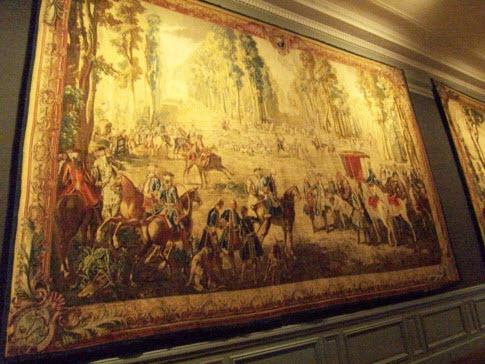 The Oudry-designed tapestry at Compiegne / Julie-Anne Plax photo