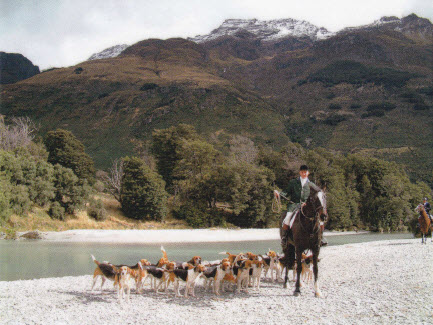
 Central Otago Hunt, South Island, New Zealand
First of two installments by national award-winning journalist and author Karin Winegar.
Yes, they jump wire.
Wire and mostly wire fences, three to four feet high, five or six taut strands with a top strand, often barbed, is what contains New Zealand’s thirty million sheep, defines its vast stations, and renders rides thrilling for outsiders.
No one—at least not the Kiwis—thinks anything of it.
Kiwi horses, harrier hounds, and riders just barrel cheerfully along in a landscape that resembles (depending on the hunt country and the season) Provence, Africa, Montana, Ireland, California, or Norway. And given the size of New Zealand’s population—only 4.4 million—there are lots of horses, hounds, and riders.
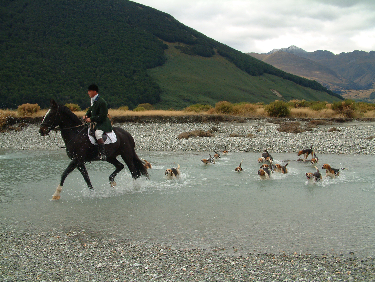 “We have six hundred hounds in twenty-eight packs, and on any given weekend in the New Zealand season (mid-March to late June in South Island, longer in North Island) there are six thousand people out,” said Glynne Smith, MFH and co-founder of the Central Otago Hounds (COH). Founded in 1989, Glynne’s hunt is the smallest and the youngest (the oldest is the Pakuranga formed in 1873) of New Zealand’s hunts. COH, however, has the largest hunting country with venues ranging from five thousand to twenty thousand acres.
Glynne and his wife Lynley are retired sheep farmers who live in the village of Ranfurly (population one thousand) on the Maniototo plains of Central Otago on the South Island. Early last season, Lynley loaned me her beautiful and powerful Etta James, a dark bay mix of Clydesdale pack horse and Thoroughbred. Etta is named for her origin on the St. James Station, some 190,000 high country acres on South Island devoted to cattle, sheep and good horses.
“The Kiwis put blood over bone (Thoroughbred stallions to draft mares) and let the results run wild for two or three years before training,” explained Glynne, who shaped the mare with dressage and hunting.
His own bay gelding Harley “was the champion bucking horse of his herd,” he added. Harley owes his natural jumping ability and impressive cannon bones to his Irish Draught blood through Kingsway Diamond, a stallion imported by the Smiths’ friend Thady Ryan, MFH of Ireland’s legendary Scarteen Hounds. Thady retired with his wife Anne to her native country in 1987. Glynne’s philosophy is “if a horse doesn’t buck, he’ll never jump, because he isn’t athletic enough to get off the ground.”
On my second day in Ranfurly, with Etta and Harley tacked up, rugged up, and loaded in his 1984 Isuzu van, Glynne and I headed to the meet. The horses wore extra thick felt saddle pads, and Glynne applied a mix of mutton fat, Stockholm tar, and canola oil as a hoof dressing.
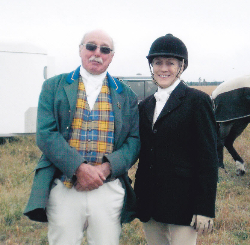 Glynne Smith, Co-Founder and MFH of the Central Otago Hunt with Karin WinegarThe Otago rainfall, usually sixteen inches, had been twenty-seven inches, rendering the countryside more lush than usual. The mountainside and plains were drizzled with moving clouds of sheep—white Romneys and grey merinos—their wool saturated with lanolin. Seas of red deer dozed or nibbled in vast pastured herds and greenswards were dotted with Holstein-Friesian and belted Galloway cows. Hawks, magpies, and paradise ducks dipped above ponds, and a few wild boar hides swung in the breeze on wire fences. The air was sweet with the scent of crushed wild thyme.
We passed rugby pitches, outdoor curling rinks, Boer goat flocks, and the railbed of the Otago Central Railway, now converted to a biking and hiking trail through grassland as green and golden as the Serengeti, where stone cottages with woodpiles—no central heating needed here—display signs offering free-range eggs and honey. The only traffic was the occasional red three-decker stock truck packed with sheep going to what Glynne calls the meat works.
“Fairly bred, useful horses” are Glynne and Lynley’s preference, and their formula has included a stallion named Red River, a Thoroughbred-Hackney cross who produced solid family hunters. That’s what greeted us at the meet: Jeeps pulling fiberglass horse floats (trailers) disgorged sturdy-footed mixes of Irish Draught, Standardbred, Clydesdale, Hackney, Thoroughbred, Appaloosa, Connemara and Welsh. Riders poured the bubbly into sterling cups, and I was introduced to Mike Paterson, a dairy farmer and president of the COH, and COH huntsman Dick Michelle, who had brought twelve couple in the club’s new trailer towed behind his massive RV.
Members of COH include dairy farmers such as Melissa Foley, who milks one thousand cows every sixteen hours and squeezes in a hunt several times a week; Marion Hamilton, a nursing home manager; Pauline Huddleston, a cafe owner; and a sprinkling of former rodeo riders—Shane Cooper and Richie Morrow.
New Zealand’s Maori name is Aotearoa or Land of the Long White Cloud, and although this was noon, the cloud hung heavy on the Hawkdun Range. Shafts of light revealed a sweep of untrammeled land in all directions, ranks of pines, long barrows of vacuum-sealed sweetgrass, and above them ridges, peaks and gorges speckled with a dusting of snow.
“…have fun, be safe, and look out for the person next to you,” Glynne concluded his advice to the field, and we moved off. Etta James swung her head to follow when hounds struck a line, and for a second I regretted having only a snaffle.
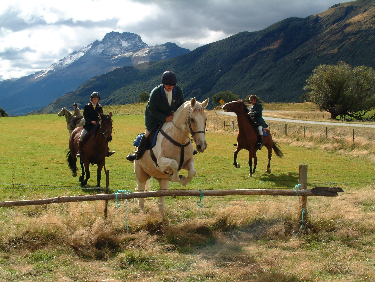 A few sections of wire in the hunting country are “sparred.”On hunting days a few fence sections of this country are sparred—hung with a length of wood—to make them slightly lower and more visible. There are occasionally plastic milk bottles atop of some fence posts.
“The hunt convenor sets up the spars or droppers, more for humans than horses,” Glynne had explained. “Usually he or she is a black-pudding-and-bacon person who looks at the lie of the land and decides where it’s good to jump or the best of a bad area.”
We swarmed forward, first field blithely popping over the sparred wire, Etta bounding easily over and galloping smartly afterward. A slim, pigtailed pre-teen named Brook passed me on a cavorting grey pony named Smarty, a Welsh-Standardbred cross who bucked through the entire hunt and jumped every fence like a demon. A smaller child in sneakers jostled along on a shaggy one-eyed pony named Willie. There was a telltale clink of beer bottles in saddlebags as some riders took the fences.
“Now Harley, easy old boy,” Glynne said as he reined Harley to a trot before each fence, then opened up to keep ahead of the field.
To hound music we galloped, trotted, checked, and jumped sparred fences, then came a pair of fences with two strides between. Everyone cleared it until there was a screech of wire against post and a rider tumbled, not at all seriously, onto what Kiwis call lucerne (alfalfa).
”Here That’s a lady’s who’s off. Don’t cheer and watch, go over and give her mouth to mouth,” yelled somebody.
“Our hares are lean, mean running machines,”Glynne explained to me. “Hares lie up in warm, dry places, tussocky areas. They live in pairs and one will run, come across its mate, squat and the other one will get up and run with new scent. And pregnant hares have no scent at all. Talking to other Masters and huntsmen overseas, I am led to believe hare scent is a very elusive scent, and this year scenting has been hard work. The harder you press a hare, the less scent the hare gives; this is Mother Nature’s way of creating survival of the species.”
New Zealand’s hares and rabbits are a textbook case in non-native species wreaking ecological havoc. One South Island station was so decimated that its topsoil was blowing into a village ten kilometers away. In reclaiming the station, 17,500 rabbits were killed in the first thirty days alone. And Lynley has seen landscapes where “if you clapped your hands, the whole hillside moved.”
Hares have a sixty to ninety percent chance of surviving a hunt, Glynne explained, partly because “a hare will jink, and its scent roll downhill, so they are hard to follow. A good huntsman walks his hounds downhill.”
The fastest run of the day happened as we were nearly back at the trailers, when a hare popped up and sprinted along a windbreak for a couple of miles. Once back at the trucks, the horses got a warm wash prior to the tailgate that ended the afternoon. Then we drove home to Lynley’s dinner of tender mutton, kumera (similar to a sweet potato )and apricots, an evening of wine, and watching rugby on the TV by the woodstove with our feet tucked into sheepskin rugs.
Posted November 28, 2012