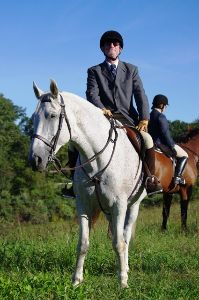
 Steve Price and Frosty test their mettle at Old Dominion / Tom Sullivan photoI wouldn’t consider myself a real foxhunter.
True, I’ve ridden to hounds several times, but always more like a spectator than a participant. This September, however, I had an awakening!
Thanks to the good graces of my friends Betsy Parker, proprietor of Hunter’s Rest in Flint Hill, and Norman Fine, of Millwood (and Foxhunting Life), I’ve been wending my way for the past four years from my New York City home to steep myself in semiannual Virginia equestrian sprees. Trail riding on Betsy’s school horses and on one of Norm’s hunters, Guitar, is the primary lure. In addition, Norm has taken me hunting with the Blue Ridge Hunt in the hilltopping field.
Now, while there’s absolutely nothing wrong with hilltopping, it’s often like watching a Broadway play from the second balcony. In my past experiences, hounds and horses moved out from the meet, the first field went their way, and we hilltoppers went ours. True, I had opportunities to watch hounds work, but as if through the wrong end of a telescope. At hunt breakfasts later in the day, I would hear people recounting finds and runs, but all I could do was smile and nod without having a true feeling or appreciation for what they saw and did.
All that changed this September.
 Betsy Parker holds an “Introduction to Foxhunting Weekend” at her Hunter’s Rest in Flint Hill, Virginia for riders interested in foxhunting. (www.huntersrest.net)
My visit with Betsy coincided with the Hunter’s Rest “Introduction to Foxhunting” weekend. A dozen other guests from around the country spent a day or two receiving instruction in such essential skills as bridging reins and controlling upper bodies over steep terrain, all put to practical use during Saturday morning’s cubhunting with the Old Dominion Hounds.
The meet was at Betsy’s farm, which gave us a start-to-finish close-up view of hounds emerging from their truck and the hunt staff forming them into a pack. Betsy, who serves as Field Master of Old Dominion’s third field, simultaneously organized her charges into a line that took our place in the great order of things.
Uphill through a wood we trotted, along a road we trotted, down a hill we trotted. Betsy had described what we would be doing as a “purposeful trail ride,” and we certainly trotted with a purpose. One or two of the horses that guests had brought felt their oats, but Frosty, on whom I posted away comfortably and confidently, strode along resolutely with a veteran’s “welcome to the big leagues” attitude.
Scenting wasn’t at its best that day, so waiting and watching from a high vantage point didn’t bring any panoramic vistas of finds, views, or runs. One sight was captivating, however: one of the whippers-in galloping—and I mean galloping—up the hill then down the hill and across a field. How he maintained his upper body in perfect balance was an object lesson in hunting horsemanship that no lecture or photograph could replicate.
Another memorable sight came as we clattered up a narrow trail through the woods when came the shout, “Staff, please!” from behind. No sooner had we moved off the trail, when two whippers-in galloped by followed close behind by both the first and second fields. We couldn’t have had a better view of the cavalcade, and as one of our group said to me, she felt as though she was part of the action. And I did too.
After two hours we turned onto the road that led to Hunter’s Rest. Several others started back to the meet, and The Unfittest Man In New York City decided that joining them was the better part of valor.
In lieu of a hunt breakfast, Betsy hosted a picnic that evening that featured pulled pork and all the trimmings to the accompaniment of live bluegrass music. Joan and Norman Fine were among the picnickers, and as is my custom, I drove up to Millwood with them for the balance of my Virginia spree.
From Banjos to Guitar
A thick fog greeted our arrival at the Blue Ridge Hunt kennels for a Monday morning cubhunting meet. As we waited for the fog to lift—a full hour later than the scheduled 7:00 A.M. departure—I drank in the spectacle of horses and riders milling through the mist and an occasional glimpse of the hunt staff’s scarlet coats. Think of Sir Alfred Munnings as an Impressionist, and you have the picture.
The first covert was not far from the kennels, a long expanse of low covert. With only twenty hunters out that morning, the first field was asked to stay on one side and our hilltopping group on the other to make certain that any fox found went away in a safe direction. No second balcony that day—Norm on his horse Chance and I on the redoubtable Guitar were front-row center. With Norm providing a whispered running commentary, my first close-up opportunity to watch hounds work was both enlightening and exciting. Several long minutes after hounds were sent in, we were rewarded with a view: a fox cub broke covert with hounds on his trail. I had forgotten how accurate the phrase “spine-tingling” can be until I heard the sound of twenty-four-and-a-half couple opening up. The music is indeed as hair-raisingly emotional as any Wagnerian chorus.
The cub dashed under a nearby wire fence and immediately went to ground. The huntsman and first whipper-in handed off their horses, climbed over the fence, collected hounds, and we moved off again.
Thanks to our field master Joint-MFH Doris Stimpson’s expertise, our group’s hillside vantage points were exactly where we needed to be to view two other foxes over the next ninety minutes. A young deer preceded one of them out of covert. Some forty yards from where we stood, the deer zigged, the fox zagged, and hounds chased the latter with nary a second glance, all except for one youngster that chose to do his own thing. But, as I was told, that’s why it’s called the cubhunting season. It’s all about training the young entry.
As Doris led our group back to the kennels and our waiting horse vans, I reflected on both that day’s and Saturday’s outings: front-row views of staff and working hounds, proximity to first and second fields, spectacular cross-country scenery, camaraderie with riders, the image of horses and hounds through morning mist—and three viewed foxes.
Why, a few more days like these, and I might start to think of myself as a foxhunter.
Posted September 22, 2012
Steven D. Price is a writer/editor, a member of Foxhunting Life’s Panel of Experts with expertise in equestrian and foxhunting literature, and a mandolin player who picked with the bluegrass jammers at Betsy Parker’s hunt picnic.
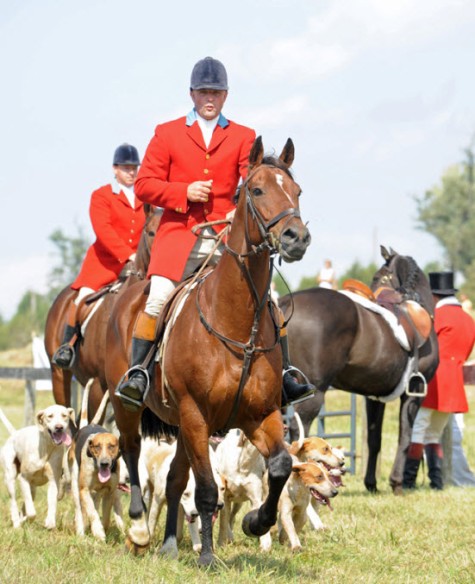 Blue Ridge Huntsman Guy Allman (foreground), first whipper-in Neil Ammat , and hounds pushed three foxes under Steve Price’s nose to make his day in the field. / Betsy Parker photo